Enterprise ArchitEcture

Found this helpful? Share it with peers.
Introduction
Strategic roadmapping is essential for organizations that need to translate transformation goals into concrete and executable plans. In dynamic business environments, defining objectives is not enough. Organizations must also identify, prioritize, and communicate the steps required to achieve them.
This is where many transformation initiatives struggle. Strategic roadmapping provides the missing link between vision and execution by structuring goals over time and aligning stakeholders around a shared plan. In the context of enterprise architecture (EA) , strategic roadmaps enable organizations to coordinate change, manage complexity, and guide EA initiatives toward measurable business outcomes.

Antoine de Saint-Exupéry
What is a roadmap?
A roadmap is a structured visualization of the steps required to achieve strategic goals over time. It shows what needs to be done, in which sequence, and within which timeframe, making strategy tangible and actionable.
In the context of strategic planning, a roadmap represents the visual outcome of the planning process. It connects objectives with concrete initiatives, milestones, and dependencies, helping organizations communicate direction, priorities, and progress in a clear and consistent way.
Why Roadmappings Matters
Roadmapping plays a critical role in helping organizations manage change in a structured and coordinated way. By visualizing strategic initiatives over time, it ensures that efforts across business and IT are aligned with shared objectives rather than driven by isolated decisions.
Strategic roadmapping provides clarity around priorities, dependencies, and timing. It creates a common understanding of where the organization is heading and how transformation steps relate to one another. As a result, roadmapping becomes a key enabler for alignment, flexibility, and effective communication throughout enterprise architecture initiatives.
Goal Alignment:
Strategic roadmapping ensures that transformation initiatives remain aligned with overarching business goals. By linking initiatives, milestones, and outcomes to strategic objectives, roadmaps prevent isolated decisions and support a shared direction across the organization.
Flexibility and Adaptability:
By covering an extended time horizon, strategic roadmaps allow organizations to adapt plans as priorities, market conditions, or technologies change. This flexibility helps teams respond to uncertainty without losing strategic focus.
Communication Tool:
Strategic roadmaps also act as powerful communication tools. They translate complex architectural and strategic decisions into a clear, visual format that stakeholders at all levels can understand and discuss.
Technical aspects of strategic roadmapping
The technical aspects of strategic roadmapping provide the structure needed to turn high-level goals into executable plans. They ensure that strategic intent is grounded in architectural reality and that transformation initiatives can be delivered in a controlled and sustainable way.
By incorporating architectural elements, lifecycle considerations, and risk awareness, strategic roadmapping helps organizations manage complexity while maintaining transparency across initiatives and dependencies.
Architecture Components:
Strategic roadmaps incorporate key architecture components, delineating how systems, applications, and data interact and evolve over time.
Technology Lifecycle Management:
Technology lifecycle management ensures that technologies remain relevant, secure, supported, and aligned with strategic goals. By embedding lifecycle considerations into the roadmap, organizations can proactively plan modernization, replacement, or retirement activities.
This helps avoid technical debt, reduce risk, and ensure that the technology landscape continuously supports evolving business and transformation needs.
Risk Mitigation:
Risk mitigation is a critical technical aspect of strategic roadmapping. By identifying risks early and linking them to roadmap initiatives, organizations can anticipate challenges, reduce uncertainty, and avoid costly disruptions during transformation.
What is the purpose of roadmaps?
The primary purpose of roadmaps is to communicate strategy and execution plans in a clear and structured way. Roadmaps translate strategic intent into concrete implementation steps that can be understood and discussed across the organization.
Roadmaps create a shared understanding of transformation stages by visualizing vision, direction, priorities, and progress over time. They act as a central source of information that connects objectives with requirements, milestones, and timelines, enabling teams and stakeholders to align their actions and expectations.
Strategic roadmapping vs tactical planning
Strategic roadmapping and tactical planning operate at different levels of decision-making. Strategic roadmapping focuses on defining direction, priorities, and transformation milestones over a longer time horizon, ensuring alignment with business strategy and enterprise architecture goals.
Tactical planning, in contrast, concentrates on short-term execution, detailed task planning, and resource allocation. While tactical plans describe how work is carried out, strategic roadmaps define what should be achieved and when. Together, they form a coherent planning framework in which strategic intent is translated into executable actions.
Who should be involved in strategic roadmapping
Strategic roadmapping is most effective when it involves a diverse set of stakeholders across the organization. Including the right roles ensures that roadmaps are realistic, aligned, and broadly supported.
Key stakeholders involved in strategic roadmapping typically include:
-
Enterprise architects, who ensure alignment with architecture principles and long-term strategy.
-
Business leaders, who define strategic objectives and priorities.
-
IT and technology leaders, who assess feasibility and technological implications.
-
Transformation and portfolio managers, who coordinate initiatives and dependencies.
-
Delivery teams, who provide practical input on execution and constraints.
By involving these roles early, organizations increase transparency, reduce resistance to change, and improve the overall quality of their strategic roadmaps.
To enable this collaboration in practice, many organizations use shared workspaces where stakeholders can contribute, review, and align on roadmaps in a structured way. This ensures that input from different perspectives is continuously integrated rather than collected in isolated planning phases.
What are the different types of roadmaps?
Strategic roadmapping can take different forms depending on the scope, audience, and transformation goals. While all roadmaps visualize change over time, they emphasize different perspectives and levels of detail.
Common types of roadmaps in enterprise architecture include:
Transformation roadmaps
Transformation roadmaps present strategic initiatives on a high-level timeline, often structured by quarters or years. They typically focus on departments, domains, or the organization as a whole, showing how major transformation topics contribute to overarching business goals.
Tipp: See an example of how you can build a sustainability transformation roadmap.
Application Roadmaps
Application roadmaps describe the planned evolution of software systems that support core business functions. They help organizations evaluate existing applications, make investment decisions, and plan modernization or replacement initiatives in a structured way.
Capability Roadmap
Capability roadmaps focus on the strategic capabilities of an organization. Built on a business capability map, they show which capabilities need to be strengthened to support strategy execution.
To build them, organizations assess each capability (e.g. business importance and maturity), define a target state, and map concrete initiatives and timelines to close the gaps.
This makes capability development actionable and helps prioritize investments based on strategic impact.
What does a roadmap actually look like?
A strategic roadmap can be represented in different ways, depending on the audience and the level of detail required. In enterprise architecture, roadmaps are used to visualize change over time and make complex transformation plans understandable and actionable.
Two commonly used representation styles are architecture-based roadmaps and Kanban-style roadmaps.
ArchiMate-based representation
In enterprise architecture, intermediate roadmap states are often modeled as plateaus. Each plateau represents a milestone in the transformation journey and reflects a stable architecture state achieved by closing specific gaps.
Behind every plateau is an architectural design that includes business processes, data, applications, and technologies. As the organization moves from one plateau to the next, these elements evolve through initiatives such as introducing new software, optimizing processes, or creating integrations. The final plateau represents the target architecture, providing a clear end state for transformation planning.
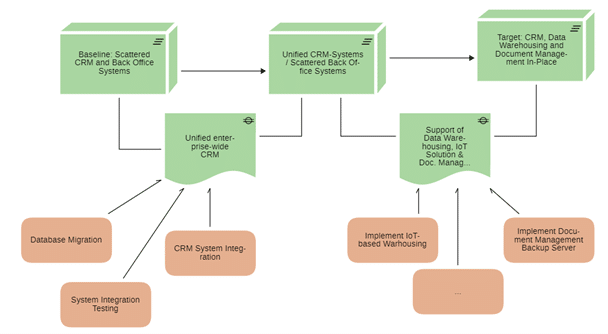
Example of an ArchiMate-based strategic roadmap visualized in the EA-Tool ADOIT
Kanban roadmap style
Kanban-style roadmaps organize requirements as cards on boards, arranged in columns that typically represent time periods or execution stages. This format provides a clear overview of initiatives, priorities, and implementation status.
Kanban roadmaps are widely used because they are easy to understand and encourage collaboration. By visualizing progress through simple status indicators, they help stakeholders quickly grasp where initiatives stand and foster engagement across business and IT teams.
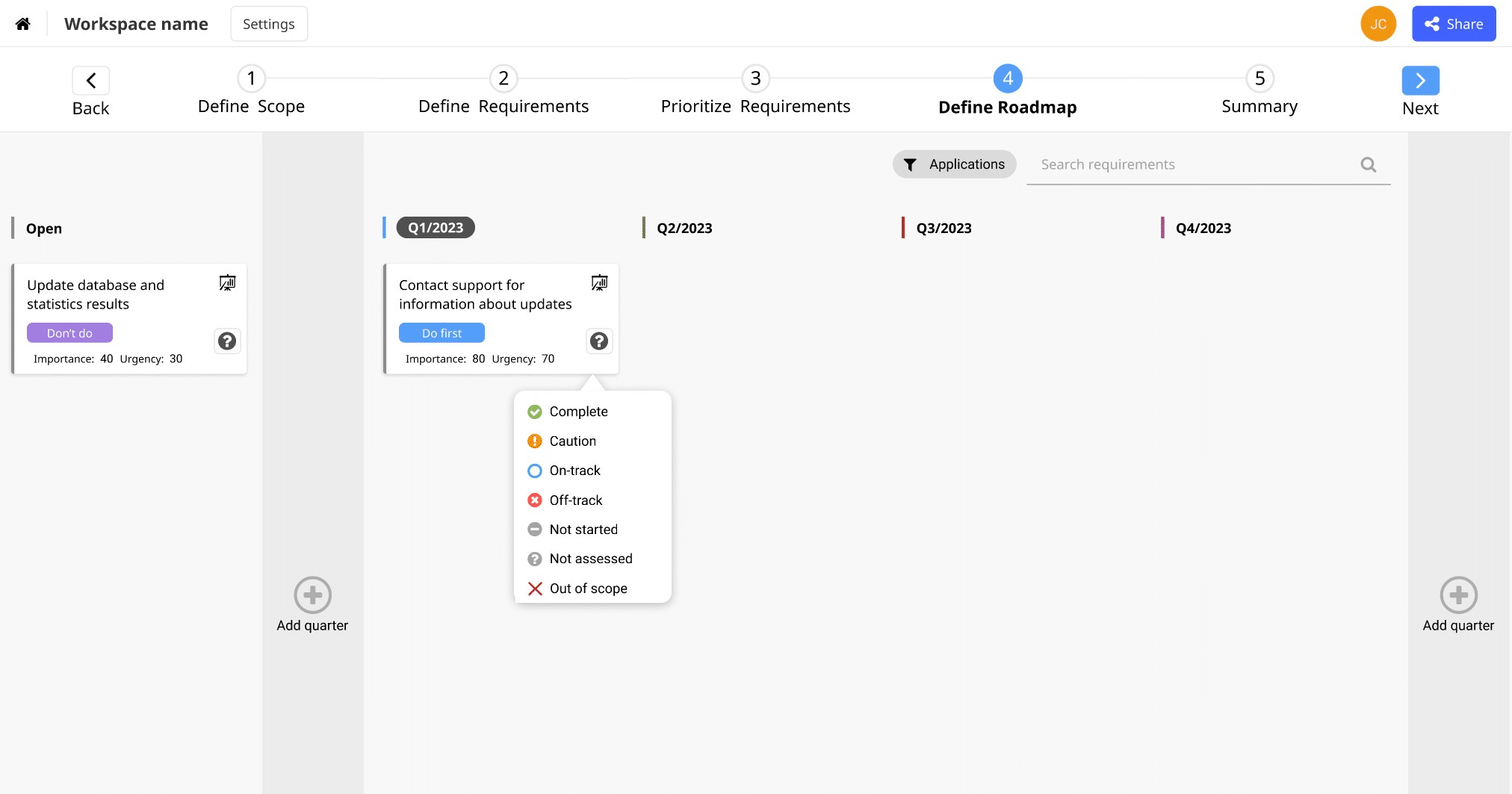
Example of a strategic kanban roadmap visualized in the EA-Tool ADOIT
Benefits of having a roadmap
A strategic roadmap delivers clear benefits by turning complex transformation initiatives into structured and manageable plans — explore how to create effective EA roadmaps to get started. It provides a shared reference that helps organizations coordinate efforts, make informed decisions, and stay focused on long-term objectives.
Key benefits of having a roadmap include:
Strategic Alignment
Roadmaps visualize how initiatives and architectural decisions contribute to overarching business goals. This alignment ensures that every step taken supports the organization’s strategy rather than isolated or short-term objectives.
Communication and Transparency
By presenting plans, priorities, and progress in a visual format, roadmaps make complex information accessible to stakeholders at all levels. This transparency fosters trust and shared understanding across business and IT.
Change Management
Roadmaps support structured change by breaking down transformation initiatives into manageable phases. This reduces disruption, helps teams prepare for upcoming changes, and increases acceptance across the organization.
Prioritization and Phasing
Strategic roadmaps help organizations prioritize initiatives based on business value and urgency. Phased planning allows teams to focus on high-impact activities while maintaining a clear view of what comes next.
Risk Mitigation
By visualizing dependencies and timelines, roadmaps enable early identification of risks and potential conflicts. This allows organizations to proactively address issues before they impact transformation outcomes.
Adaptability to Change
Roadmaps are not static artifacts. They evolve as strategies, markets, and technologies change, ensuring that transformation plans remain relevant and responsive over time.
Quick-wins for successful roadmapping
Successful strategic roadmapping does not require overly complex methods from the start. A few practical principles can significantly increase adoption, credibility, and long-term value.
Accessible Roadmapping
Make your roadmaps easily accessible to everyone who is affected by or involved in transformation initiatives. Publishing them on a shared platform or intranet ensures visibility and encourages engagement across the organization.
Using a dedicated Enterprise Architecture tool such as ADOIT EA Suite allows organizations to centralize roadmaps, link them with applications, capabilities, and initiatives, and make them accessible through shared workspaces. This enables application-based roadmapping and ensures that stakeholders always work with consistent and up-to-date information.
Keep the roadmap up to date
Outdated roadmaps quickly lose credibility. Regularly review and adjust the roadmap to reflect changes in strategy, priorities, or external conditions. When the vision changes, the roadmap must evolve accordingly.
Long term Roadmapping
While roadmaps should be updated, they should not change constantly. Maintaining a stable long-term direction helps preserve trust and transparency, even when individual initiatives are adjusted.
Transparent Roadmapping
Be transparent about how the roadmap is created, who is involved, and how decisions are made. This openness builds trust and increases acceptance among stakeholders.
Collaborative Roadmapping
Encourage feedback and participation in the roadmapping process. Involving teams early reduces resistance to change and fosters a shared sense of ownership.
Elaborated Roadmapping
Support high-level roadmaps with detailed architecture designs where needed. These details should be accessible through drill-downs, ensuring clarity without overwhelming stakeholders.
Summary
Strategic roadmapping helps organizations translate business strategy into clear, actionable transformation plans. By visualizing goals, priorities, and milestones over time, it creates alignment across business and IT and provides a shared direction for enterprise architecture initiatives.
Used as a strategic planning instrument, roadmaps bridge the gap between long-term vision and day-to-day execution. When supported by the right stakeholders, clear governance, and regular updates, strategic roadmapping becomes a central enabler for successful enterprise transformation and sustainable EA outcomes — all of which the ADOIT EA tool is built to support.





Already got our weekly updates?