Enterprise ArchitEcture

Found this helpful? Share it with peers.
The Challenge: When the Future Refuses to Stay Still
Enterprise Architecture is built on a simple premise. You figure out where the organization needs to go, map what that requires across technology and business, and build a roadmap to get there. For a long time, that was enough.
The catch is that the whole approach depends on the future being reasonably predictable. A target state defined today needs to still make sense by the time you reach it. That used to be a safe assumption. It isn’t anymore. Planning cycles that once felt reliable are struggling to keep up, and the gap between what was planned and what the business actually needs keeps getting wider.
By the time many organizations reach their planned future state, it no longer fits the reality they’re operating in.
The Consequence: Architecture Becomes a Bottleneck
Most organizations don’t realize their architecture has stopped working until they’re already deep into executing it. There’s no single moment when the plan goes wrong. Budgets get committed and work moves forward as planned, based on assumptions that were reasonable when they were made. By the time those assumptions start to look shaky, too much is already in motion to easily change direction.
So the plan keeps going. Decisions that no longer make sense stay in place because revisiting them is disruptive. Investments keep flowing down a path that fewer and fewer people believe in. The architecture was meant to guide the organization forward, but at some point, it quietly switched roles. Now it’s the reason changing course is so hard.
A Shift in Thinking: From Defining the Future to Exploring It
Some organizations have started approaching this differently. Rather than locking in a single future state and building a roadmap around it, they treat the future as something to explore before committing to it. Multiple directions are modelled and evaluated. Decisions get made later, when there is more to go on.
For enterprise architecture, that is a meaningful shift. The work is no longer just about defining a target, but more about helping the organization make better decisions when the answer isn’t yet clear.
Hint: Learn more about the evolution of strategic planning in the era of AI in our blog post.
Scenario Planning: Turning Architecture Into a Decision Engine
Scenario planning is how that works in practice. Instead of one fixed path, different futures get modelled side by side. Each one can be evaluated, compared, and tested against what the organization actually cares about before anyone commits to it.
Each scenario represents a possible direction, for example:
- Modernizing an existing application versus replacing it
- Building a solution internally versus buying it
- Moving to the cloud versus keeping systems on-premise
The main objective here is to explore your options in a structured and transparent way.
Scenario Planning in Practice
Rather than modifying the baseline architecture, changes are modelled as part of a scenario. Elements can be marked as planned, existing components can be decommissioned, and relationships can be adjusted. These changes exist only within that scenario and don’t touch the current state.
Different scenarios can run in parallel, each representing a different possible direction. Teams can compare them directly, stress-test assumptions, and then decide when they have enough information to move forward.
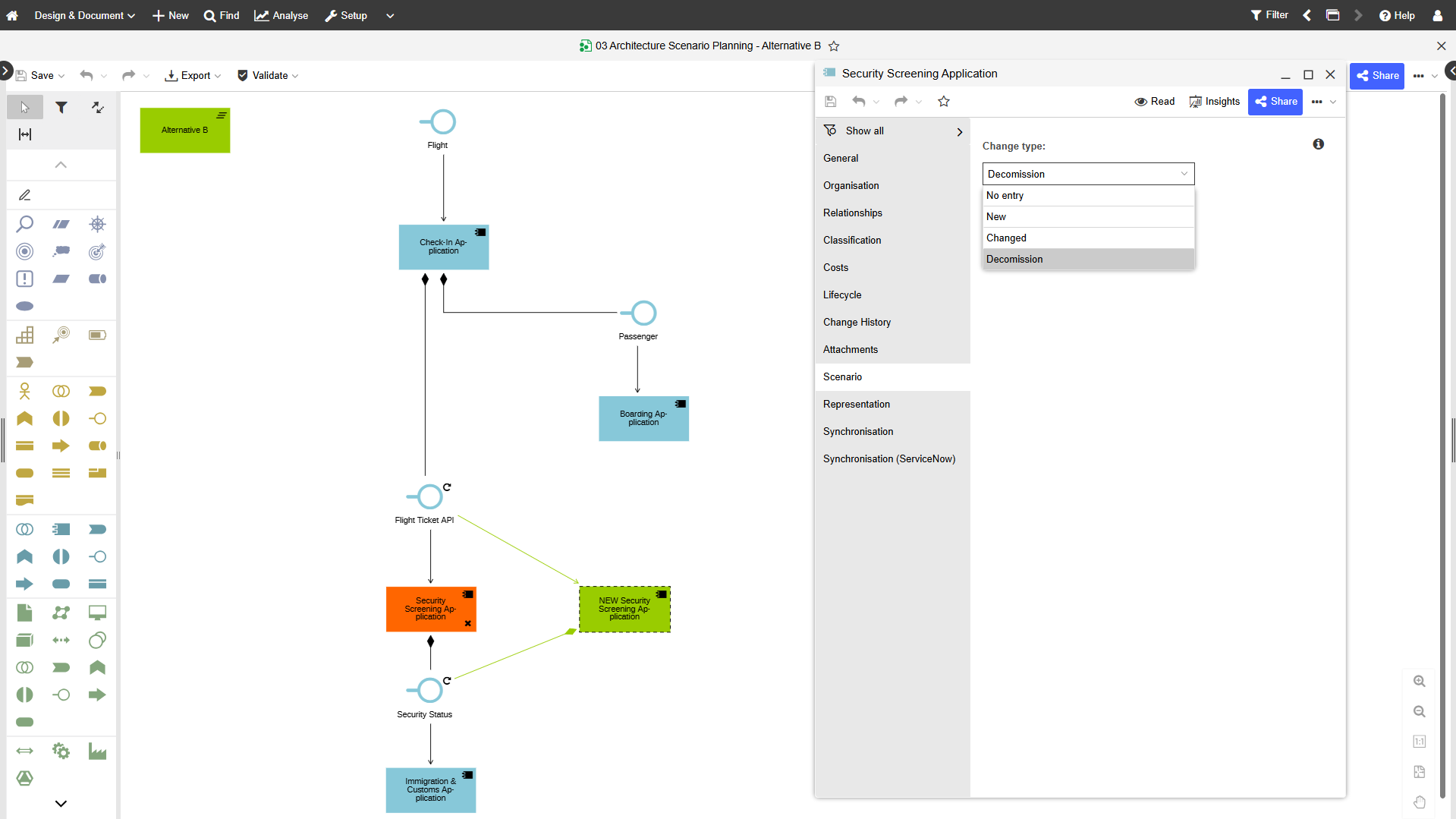
Applying scenario planning directly within an architecture model in ADOIT
From Assumptions to Evidence-Based Decisions
Scenario planning only creates value if the scenarios can actually be compared. That requires shared criteria, otherwise, every stakeholder evaluates options through a different lens and the conversation goes nowhere.
Frameworks such as ISO 25010 offer a structured starting point, covering functional suitability, performance efficiency, reliability, security, and maintainability. In practice, many organizations work with a more concise set of decision attributes:
- Cost
- Implementation Time
- Architecture Fit
- Risk
These attributes help focus discussions and make trade-offs visible without adding unnecessary complexity. If needed, this set can be extended to reflect more detailed quality perspectives. This creates a shared understanding across stakeholders, from business to IT.
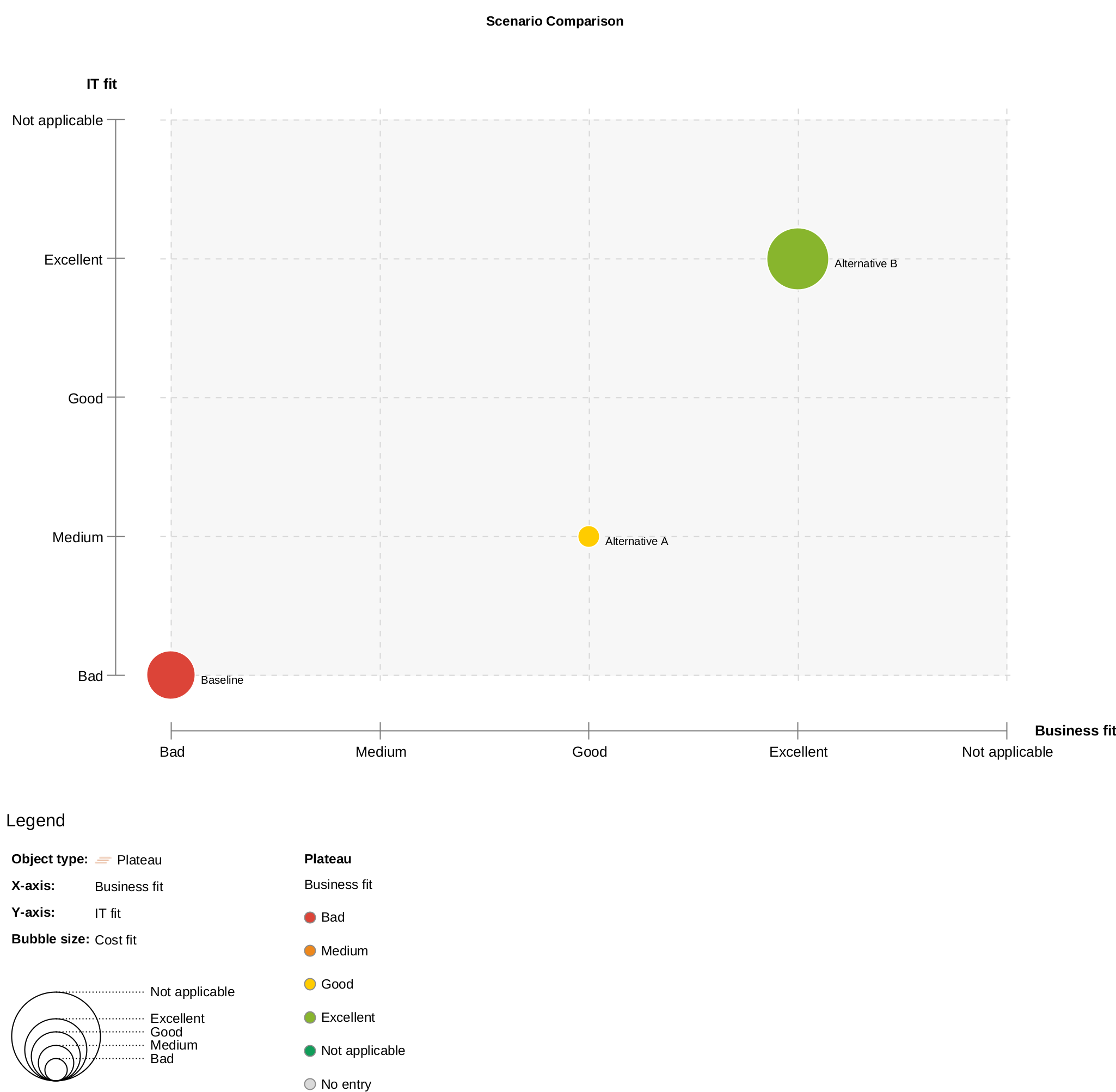
Comparing different scenarios against each other in ADOIT
Keeping the Baseline Stable While Exploring Change
Because scenarios are separate from the baseline, the current architecture stays intact throughout the process. Teams can model significant changes, compare directions, and work through the implications without touching anything that is actually in production. Instead of committing early, organizations can learn first and decide later.
Making Architecture Truly Dynamic
Scenario planning is a foundation for a more dynamic form of enterprise architecture. As conditions change, decisions can be revisited. New information gets incorporated into planning without waiting for the next cycle. Assumptions that no longer hold get updated rather than worked around. Planning stops being a periodic event and starts being how the organization operates on day-to-day.
Beyond IT: A Broader Impact on Business Planning
This approach isn’t limited to application landscapes. The same logic applies wherever strategic decisions need to be made under uncertainty:
- Capability development
- Investment planning
- Transformation initiatives
- Workforce and skill planning in the context of AI
Organizations can pressure-test assumptions and understand what each direction actually demands before budget gets allocated. The earlier that kind of structured thinking enters a decision, the less it costs to course-correct later.
What This Means for Enterprise Architecture Teams
For enterprise architects, this way of working asks something different. Less time spent arriving at the right answer, more time spent making sure decision-makers have what they need to find it themselves. That means surfacing alternatives, making trade-offs visible, and staying useful as conditions change rather than defending a plan that was written months ago. The role shifts from setting direction to supporting decisions.
Conclusion: From Static Plans to Continuous Decision-Making
Static target architectures made sense when the future was stable enough to aim at. That's a harder condition to meet now, and organizations that keep planning as if it were true are finding the gap between their architecture and reality increasingly difficult to close.
Scenario planning is a practical response to that problem. It keeps architecture connected to decisions that actually need to be made, and gives organizations a way to adapt as the picture changes rather than waiting for the next planning cycle.
The question driving the work changes too.
It is no longer: What is our future state?
But: Which future should we choose, and when?




Already got our weekly updates?