Governance, Risk & Compliance

Found this helpful? Share it with peers.
Introduction: Cutting Through the Noise
Discussions about GRC trends tend to create the same problem every year. New priorities are presented as equally urgent, even though only some of them change how Governance, Risk, and Compliance work is actually carried out. The result is pressure to react broadly rather than decide deliberately.
Looking toward 2026, the core challenge is no longer speed. It is control. GRC teams are operating in an environment where regulatory expectations are enforced more consistently, external risks are harder to isolate, and reliance on data-driven systems continues to grow. In that setting, responding quickly matters less than knowing where oversight needs to be sustained.
From an enforcement perspective, 2025 marked a turning point. Across Europe, regulatory frameworks, such as the EU AI Act, DORA, CSRD and NIS2 are moving rapidly from consultation to enforcement. Requirements related to operational resilience, cybersecurity, sustainability reporting, and the use of AI increasingly overlap. For many organizations, these developments did not arrive sequentially but at the same time, placing continuous strain on governance structures.

At the same time, expectations from boards and regulators have shifted. Declared intent is no longer sufficient. Organizations are expected to show how governance works across processes, systems, and responsibilities, and to demonstrate that evidence can be traced consistently rather than assembled when scrutiny begins. A the same time, this level of transparency supports organizations internally, as decisions depend on a clear and shared understanding of how controls, responsibilities, and risks are defined and applied.
This blog post focuses on the changes that will shape GRC work in practice in 2026. It looks at what these shifts mean for teams that want to move away from reactive handling of requirements and toward a more stable, operationally grounded approach to governance.
Trend #1: From Periodic Compliance to Continuous Oversight
Annual audits and one-time assessments are no longer sufficient. This is not because audits are disappearing, but because expectations around how control effectiveness is demonstrated have changed. Regulators expect organizations to show that controls work consistently over time, not only at the moment an audit is conducted.
Frameworks such as DORA are accelerating this shift. Stricter requirements for ICT risk management, incident handling, and oversight cannot be fulfilled retrospectively. Evidence assembled shortly before an audit no longer meets expectations when resilience and operational readiness are under scrutiny throughout the year.
As a result, many organizations are moving away from compliance snapshots toward continuous monitoring. Controls, responsibilities, and supporting evidence must remain traceable at all times. The emphasis is no longer on preparing for audits, but on being able to demonstrate control effectiveness on demand.
This change is also reflected in market behavior. According to PwC Global Digital Trust Insights 2026, 60% of executives rank investments in cybersecurity among their top strategic priorities. This signals a broader shift toward continuous risk and control monitoring rather than occasional reviews.
In this context, the selection of a GRC platform becomes critical, as continuous monitoring needs to be seamlessly embedded in daily work. In ADOGRC, evidence is generated as part of regulated processes and implemented through workflow-based responsibilities, versioning approvals, reliable information and audit trail.
Trend #2: Compliance Moves Closer to Operations
Policies alone do not ensure compliance. What matters is how requirements are implemented and maintained in daily operations. By 2026, the gap between documented compliance and implemented compliance is becoming more visible, as regulators and stakeholders look for evidence that controls are effective in practice.
This shift is pushing controls closer to business processes and the roles responsible for them. Compliance requirements are no longer expected to exist in isolation. They are being embedded into workflows such as incident management, third party oversight, and continuity planning. As a result, reliance on manual tracking and fragmented documentation is gradually declining.
This development is also reflected in how GRC platforms are positioned in the market. They are no longer designed primarily as repositories for policies and controls, but as operational infrastructure that supports continuous readiness by assigning responsibilities and collecting evidence as work is performed. For example, ADOGRC supports the operationalization of compliance and enables end-to-end traceability across governance activities by linking scoped requirements out of our compliance library directly to processes, roles, and related assets.
Trend #3: Fewer Controls, Better Connected
Adding more controls does not automatically improve corporate governance. In many organizations, complex and overloaded control landscapes create the opposite effect. Effort is duplicated, testing becomes inconsistent, and responsibilities are harder to assign and maintain.
This runs counter to the logic of continuous monitoring. When controls proliferate without coordination, transparency decreases rather than improves.
By 2026, the focus is shifting toward rationalization. Instead of expanding control catalogs, organizations are streamlining them. The aim is to work with fewer controls that are clearly defined, traceable, and reusable across multiple regulatory frameworks and reporting requirements.
This approach supports a platform oriented way of working. Controls are assigned once, linked to relevant processes and roles, and then reused across audits and compliance obligations. Governance becomes easier to maintain because consistency is built into the structure rather than enforced manually.
In practice, this represents the operational counterpart to integrated GRC strategies that many organizations have already adopted. It also aligns closely with how modern internal control systems are evolving, with an emphasis on coherence, reuse, and sustained oversight.
Trend #4: Risk Thinking Shifts Toward Resilience
Risk management is moving beyond registers and visual summaries. What is changing is not the use of these tools, but their role. On their own, they do not help organizations anticipate disruption or coordinate a response when conditions change.
Recent years have made this gap clearer. Disruptions related to cyber incidents, external dependencies, and geopolitical developments are occurring more frequently. When risks recur rather than remain hypothetical, the focus shifts from categorizing them to understanding how they unfold and how the organization reacts. This makes risk assessment relevant as an operational tool, not just a scoring exercise, by clarifying likelihood and impact to guide prioritization and preparedness.
This is also reflected in current regulatory expectations. Cybersecurity and third party risk management are now treated as core elements of organizational resilience under frameworks such as NIS2 and DORA. In parallel, sustainability and supply chain accountability requirements under CSRD and CSDDD extend risk considerations beyond internal operations. Together, these obligations increase the need for coordination across functions rather than isolated risk ownership.
As a result, stronger risk management is less about the size of the risk inventory and more about preparedness. Organizations need to test how they would respond, clarify who is responsible under specific conditions, and ensure that information flows across teams when pressure increases. What regulators and stakeholders look for is not the volume of identified risks, but the ability to demonstrate operational control when risks materialize.
Trend #5: Trustworthy Data Becomes a GRC Differentiator
In many organizations, evidence remains distributed across multiple tools and formats. This creates practical problems. Teams spend time reconciling versions, confirming ownership, reconstructing audit trails, and correcting errors that emerge from fragmentation. Findings from PwC’s Global Digital Trust Insights 2026 highlight this gap, showing that only a small share of organizations have fully implemented the data risk management measures assessed. The issue is not intent, but execution.
As a result, compliance functions increasingly recognize the need for centralized information structures. The objective is not consolidation for its own sake, but improved transparency and reliability. When governance data is consistent and traceable, reporting becomes more stable and decisions can be based on a shared understanding of the current state.
In this context, GRC platforms function as information backbones rather than reporting layers. In ADOGRC, the integrated compliance library with over 1,000 control objectives, 30 standards and over 40 domains, combined with the reliable information from your controls, risks, processes, measures, etc., functions as a digital twin of your organization. This provides visibility into dependencies and the impact of change over time, supporting informed decisions based on reliable, continuously maintained information.
Trend #6: AI Raises the Bar for Governance (Quietly)
AI does not replace GRC; it rather reinforces its importance. As AI-supported decisions become more common, organizations are expected to control not only processes but also the assumptions, responsibilities, and boundaries that shape how decisions are made.
This expectation is formalized in the EU AI Act. Since 2024, its requirements have been introduced in stages, with increasing emphasis on transparency, classification of AI systems, and ongoing oversight. Organizations are expected to demonstrate how AI systems are monitored and controlled in practice, not only how they are designed.
Hint: Self-assess your EU AI Act readiness with our free interactive survey.
For 2026, the implication is practical. Organizations do not need a comprehensive AI strategy before they can act. What they need is clarity on acceptable use, defined transparency obligations, and clearly assigned human oversight. Without this foundation, the use of AI remains difficult to justify under regulatory scrutiny.
Within this context, GRC platforms support structure rather than strategy. In ADOGRC, companies can determine which requirements of the AI Act are relevant to their AI systems and can be linked to affected processes, use cases and further applications. Risks and responsibilities remain traceable across the landscape, allowing organizations end-to-end transparency and to demonstrate how AI governance is embedded into existing control structures.
What This Means for GRC Leaders in 2026
In 2026, GRC leaders should focus on the following priorities:
- Shifting from reactive audits to continuous readiness to ensure evidence, basis for action and accountability are available at all time.
- Strengthen operational resilience by focusing more on integrating cyber, third-party, and continuity risks more into your GRC landscape.
- Invest in data credibility, as reliable information is a key requirement for automation and AI-driven decisions.
- Embed governance into day-to-day operations to reduce manual handovers and compliance friction.
- Protect data and deployment sovereignty, especially with increasing geopolitical volatility.
Hint: ADOGRC is fully containerized and can be deployed in SaaS, private cloud, or on-premises environments, ensuring complete data and deployment sovereignty.
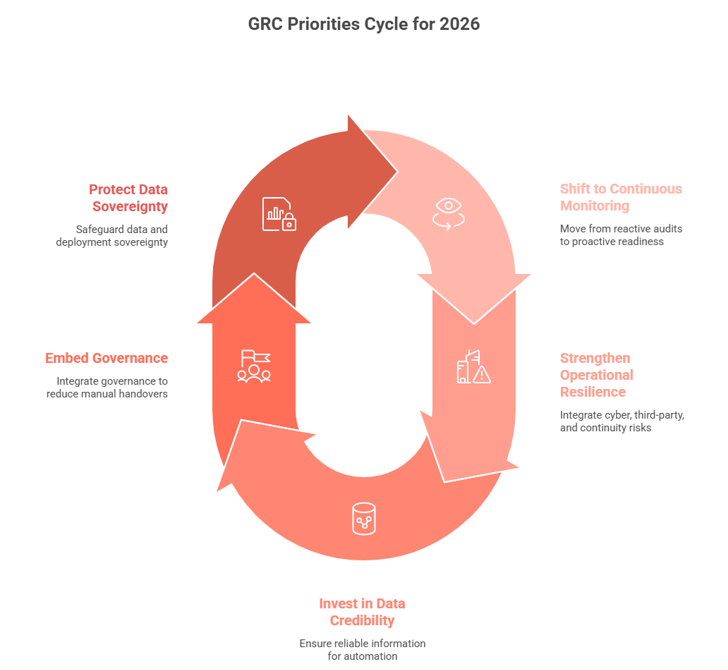
GRC priorities every leader should focus on in 2026
Summary: Focusing on What Matters
Taken together, the developments outlined above point to a clear direction for GRC in 2026. Expectations are shifting away from periodic demonstrations of compliance toward structures that work continuously and can be explained at any point in time. Governance becomes more operational, more connected to daily work, and more dependent on reliable information than on static documentation.
Organizations that adapt successfully are those that focus on clarity of responsibility, consistency of controls, and transparency of evidence across their landscape. This does not require more frameworks or greater complexity, but a more deliberate approach to how governance is embedded, maintained, and demonstrated in practice.

Sources:
European Union – Digital Operational Resilience Act (DORA)
European Commission. Digital Operational Resilience Act (Regulation (EU) 2022/2554).
European Union – Corporate Sustainability Reporting Directive (CSRD)
European Commission. Corporate Sustainability Reporting Directive (CSRD).
https://finance.ec.europa.eu/capital-markets-union-and-financial-markets/company-reporting-and-auditing/company-reporting/corporate-sustainability-reporting_en
European Union – Network and Information Security Directive (NIS2)
European Commission. Directive (EU) 2022/2555 (NIS2).
https://digital-strategy.ec.europa.eu/en/policies/nis2-directive
European Union – Artificial Intelligence Act (AI Act)
European Commission. Artificial Intelligence Act.
https://digital-strategy.ec.europa.eu/en/policies/european-approach-artificial-intelligence
PwC – 2026 Global Digital Trust Insights
PwC. 2026 Global Digital Trust Insights: C-suite playbook and findings.
October 2025.
https://www.pwc.com/us/en/services/consulting/cybersecurity-risk-regulatory/library/global-digital-trust-insights.html
Gartner – Agentic Automation & GRC Context
Gartner. Predicts 2026: The New Era of Agentic Automation Begins.
December 2025.
BOC Group. EU AI Act Explained – What Organizations Need to Know.
https://www.boc-group.com/en/blog/grc/eu-ai-act-explained/




Already got our weekly updates?