BUSINESS PROCESS MANAGEMENT

Found this helpful? Share it with peers.
The Hidden Bottleneck in Process Modelling
Most organizations already possess extensive process knowledge. It exists in standard operating procedures, policy documents, work instructions, manuals, spreadsheets, and departmental guides. Yet when process management initiatives begin, teams often encounter a familiar obstacle: the knowledge exists, but it rarely lives in a form that can be easily governed, analysed, improved, or reused across the BPM lifecycle.
Instead of starting with process design or optimization, modelling often begins with manual translation. Analysts read through documentation, identify activities, interpret handoffs, reconstruct decision points, and clarify responsibilities before a BPMN model can even take shape.
What sounds straightforward quickly becomes time-consuming. Modelling work starts with transcription rather than improvement, slowing repository growth and delaying the broader value BPM is meant to deliver.
What organizations ultimately need is not more documentation, but a faster way to transform the knowledge they already have into structured process assets.

Why SOPs Don’t Easily Become BPMN Models
At first glance, converting an SOP or other process documentation into a visual model may seem like a simple formatting task. In reality, it is an act of interpretation. That is because procedural documentation and BPMN models represent processes in different ways.
Documents such as SOPs, work instructions, policy descriptions, or operational guides are written to support execution. They explain how work should be performed, typically using narrative descriptions or step-by-step instructions that guide employees through a procedure.
Process models aim to provide similar clarity, but they do so differently. Instead of describing procedures in text, they represent the structure of work visually, showing activities, sequence flow, responsibilities, handoffs, and decision logic in a standardized and reusable format.
Documentation typically explains what people are supposed to do, often in a linear description of steps. Process models reveal how work is structured across roles, decisions, and process flow. That difference matters. Take a sentence like: Finance reviews the request and sends it back if information is missing.
For a modeller, this immediately raises several questions:
-
Is the review one task or multiple checks?
-
What exactly triggers the return?
-
How should the rework path be represented?
-
Who decides that the information is insufficient?
Multiply this across dozens or hundreds of documents, and the effort compounds quickly. The real difficulty is not drawing the diagram. It is interpreting prose and turning it into consistent process structure.
That is why translating process documentation into BPMN models still takes time, even in organizations that already document their work thoroughly.
Why AI Makes Sense in This Use Case
This is exactly the kind of problem where AI can create practical value.
Large language models are good at working with natural language. They can identify structure in unstructured text, detect actions, recognize roles, and infer sequence and conditions from procedural descriptions. In the context of BPM, that makes them especially useful for turning existing documentation into a structured first process draft.
Instead of rebuilding a process manually from scratch, teams can begin with an AI-generated interpretation of the source document and focus their effort where it matters most: validating, refining, and improving the model.
That shift is important. The value of AI in BPM does not lie in replacing process expertise. It lies in removing friction from repetitive work so that experts can spend less time translating documentation and more time analyzing flows and improving the process itself.
Hint: Want the broader context? Explore our blog on The Future of AI in Business Process Management.
From SOP to Structured Draft in ADONIS
With the ADONIS AI Process Extractor, existing SOPs and work instructions can be used as direct input for process modelling.
The workflow is designed to be simple and controlled:
-
Upload the source document
Add an SOP or similar process document in a supported format such as PDF, DOCX, or XLSX. -
AI Assistant extracts the process description
ADONIS analyses the content and generates a structured draft of the process based on the information in the document. -
Review and refine the result
Users can adjust wording, clarify task logic, refine responsibilities, and improve the extracted description through a conversational interaction with the ADONIS AI Assistant. -
Generate the process model
Once refined, the structured draft is transformed into a graphical BPMN model that remains editable in ADONIS.
This means the modelling workflow changes from:
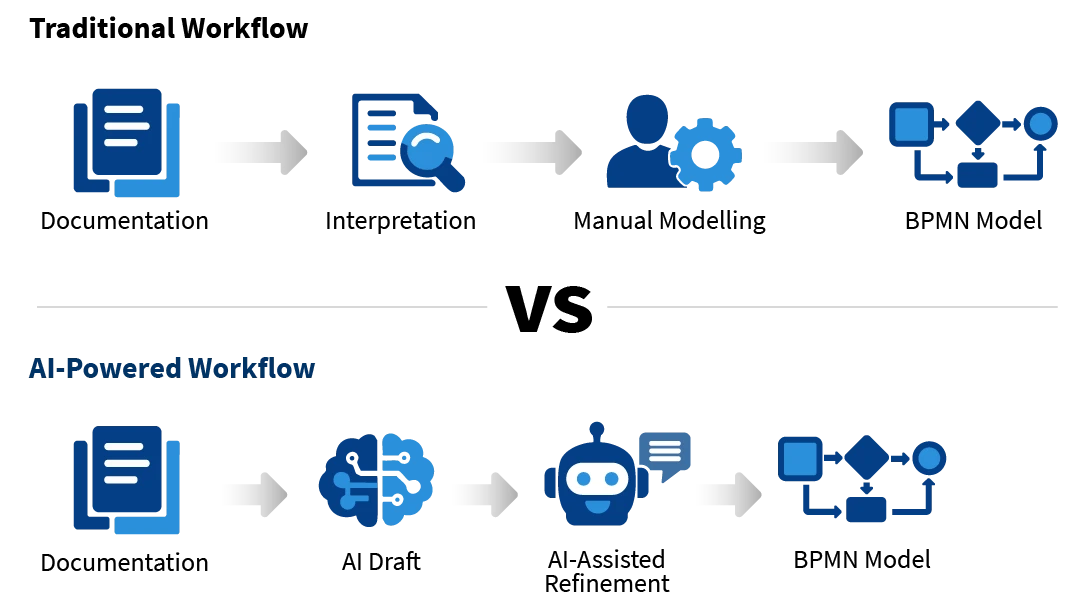
The difference is not only speed. It is also where expert attention goes. Instead of investing most of the effort in manual conversion, teams can focus on model quality and process logic from the start.
Hint: See how ADONIS supports AI-powered process design, understanding, and analysis in How ADONIS Elevates AI-Powered BPM.
What Changes in Practice
When documentation extraction becomes part of the modelling workflow, the benefits extend beyond faster diagram creation.
Less manual conversion work
Teams no longer need to recreate process logic line by line from textual documentation. A large share of the translation effort is removed upfront. It also helps create more consistent modelling results. When different analysts translate documentation manually, variations in interpretation and modelling style can easily arise. Starting from a structured AI-generated draft reduces these inconsistencies and simplifies further refinement.
Faster repository growth
Existing documentation becomes a direct starting point for structured modelling. This enables organizations to expand their process repositories more efficiently without building up a modelling backlog.
Better use of expert time
Process owners, analysts, and BPM teams spend less time transcribing documentation and more time validating flows, improving clarity, and identifying optimization opportunities.
Stronger foundation for downstream BPM work
Once a process exists as a structured model, it becomes easier to review, govern, standardize, publish, analyse, and connect it with related enterprise objects.
This is what makes the use case strategically relevant. AI-supported documentation extraction is not just about saving modelling time. It turns static documentation into structured process knowledge that can be governed, analysed, and improved across the BPM lifecycle.
Where Expert Review Still Matters
AI can significantly accelerate the path from documentation to process model. However, publishable process knowledge still requires expert validation within a human-in-the-loop approach.
Procedural documents often contain ambiguities that only domain experts can resolve properly. Steps may be described too broadly, responsibilities may be implied rather than explicit, and exceptions are often mentioned without being clearly modelled. Decision criteria may also need to be clarified before they can be represented consistently in a process model.
That is why the most effective use of AI extraction is as a structured first draft, not as a finished model.
Before publishing an extracted process, teams should review key aspects such as:
-
Is the level of detail appropriate for the intended purpose of the model?
-
Are similar activities and structures represented consistently across models?
-
Are responsibilities clearly assigned?
-
Is decision logic explicit enough to model consistently?
-
Are rework paths and exceptions represented clearly?
-
Do task names follow internal modelling standards?
Used this way, AI accelerates modelling without compromising process quality, consistency, or governance.
Who Benefits Most
This use case is especially valuable for teams that already have documentation but struggle to turn it into structured process models at scale.
Process Owners
Gain faster visibility into whether documented procedures are complete, clear, and ready for structured modelling.
Business Analysts
Spend less time interpreting prose and more time improving handoffs, responsibilities, and process design.
Compliance and Quality Teams
Move more efficiently from approved procedures to reviewable, governed process assets.
Transformation and BPM Leaders
Reduce modelling backlog, accelerate repository growth, and create a stronger process foundation for improvement initiatives.
From Documentation to a More Connected BPM Foundation
Once documentation becomes a structured BPMN model, it becomes far more valuable than a static file.
In ADONIS, process models can be embedded in a broader process landscape and linked to related enterprise assets such as roles, organizational units, systems, risks, and controls. That turns isolated documentation into connected process knowledge that can support governance, transparency, and operational improvement.
This also matters for organizations pursuing a broader Digital Twin of the Organization approach. A connected, trustworthy process foundation cannot be built from scattered documents alone. It requires structured models that can be maintained, related, and reused.
AI-powered extraction helps accelerate that foundation by making it easier to convert existing operational knowledge into structured BPMN models in the first place.
Final Thoughts
Most organizations are not starting from zero. They already have process knowledge. The problem is that this knowledge often remains trapped in documents that are useful for local execution, but not for structured process management.
That is the gap AI-powered process extraction helps close.
By turning SOPs and other process documents into structured business process drafts, ADONIS reduces the effort required to move from documentation to model. Teams can spend less time decoding documents and more time refining, governing, and improving how work is performed.
In that sense, AI does not replace modelling. It makes modelling start from a much better place.
Hint: For a broader look at how AI improves documentation workflows, check our blog How Process Documentation AI Transforms the Way You Work.




Already got our weekly updates?