BUSINESS PROCESS MANAGEMENT

Found this helpful? Share it with peers.
Artificial intelligence is becoming an increasingly important topic in Business Process Management. As organizations manage growing operational complexity, many are exploring how AI can help them understand processes faster, reduce manual effort, and uncover improvement opportunities across their operations.
But beyond the broader discussion about AI in BPM, a practical question emerges: what does AI actually look like inside a BPM platform?
In ADONIS, artificial intelligence is embedded directly into the BPM environment through the ADONIS AI Assistant. These capabilities support users in modelling processes faster, analyzing workflows, exploring process knowledge, and converting existing documentation into structured BPMN diagrams – making process management more accessible and efficient across the organization.
Smarter Content Discovery
Large BPM repositories often contain hundreds or even thousands of process models and related documents. Finding the right information quickly can become difficult, particularly for employees who are not deeply familiar with the process landscape.
The ADONIS AI Assistant helps users explore process repositories more efficiently by recommending relevant models and documentation based on repository context and user interaction patterns. Instead of manually browsing large libraries of models, users can more easily discover related process content and explore how processes connect across the organization.
Each recommendation includes a visual preview that allows users to quickly understand the context before opening the model. This improves navigation across the repository and helps make process knowledge more accessible to both process experts and business users.
AI-Assisted Process Modelling
Process modelling often begins with written descriptions, workshop outcomes, or existing documentation. Translating this information into structured BPMN diagrams can require significant effort, particularly when starting from a blank modelling canvas.
With the ADONIS AI Assistant, users can generate BPMN process models automatically from natural-language prompts. By describing a workflow in simple terms, users receive an initial process draft that can then be reviewed, refined, and enriched.
ADONIS also supports the AI Process Extractor, which converts SOPs and process documentation into structured BPMN diagrams. By analyzing written procedures, the AI identifies activities, responsibilities, and decision points to generate an initial model that teams can refine further.
Together, these capabilities allow organizations to turn process knowledge into structured models faster, significantly reducing the effort required to translate written procedures into BPMN diagrams.
AI turns text prompts or documents into BPMN models.
AI-Supported Process Analysis
Analyzing processes manually can be time-consuming, especially in large and multi-level process landscapes. AI capabilities in ADONIS help teams analyze process models faster and identify potential improvement opportunities across their workflows.
Through natural-language interaction, users can ask questions about process models and receive explanations of steps, roles, and dependencies. The ADONIS AI Assistant can highlight structural patterns that may indicate bottlenecks, inefficiencies, automation opportunities, or compliance risks helping analysts focus their attention where improvements may be needed.
By supporting structured analysis with AI-driven insights, organizations can review processes more efficiently while maintaining expert oversight and governance.
Spot inefficiencies instantly, no manual digging required.
AI-Powered Process Understanding
Process models can sometimes be difficult to interpret for employees who are not familiar with BPM notation. AI capabilities in ADONIS help address this challenge by translating complex process models into clear explanations.
Users can ask questions about workflows, responsibilities, or specific process steps and receive concise answers generated from the underlying process model. This allows employees to explore process knowledge using natural language rather than navigating complex diagrams.
By making process knowledge easier to understand, AI helps connect structured process documentation with everyday operational work.
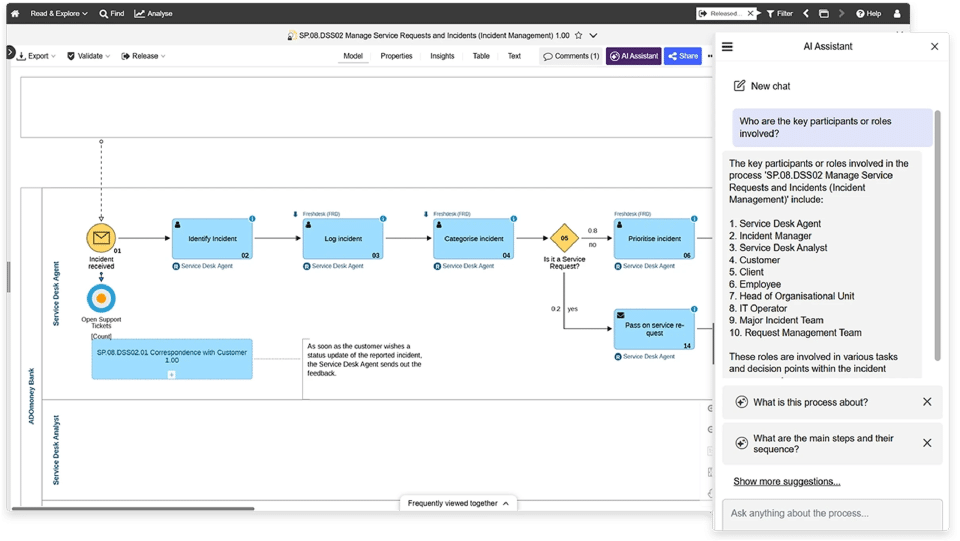
Navigate processes with natural-language answers.
Multilingual Process Content with AI
Organizations operating across regions often maintain process documentation in multiple languages. Ensuring consistency across languages can require significant manual effort.
ADONIS includes AI-supported translation capabilities that allow process content to be translated across multiple languages with minimal manual work. This enables global teams to maintain consistent and accessible process documentation across international operations.
Practical Benefits of AI-Powered BPM
When artificial intelligence is embedded into structured BPM environments, organizations can realize several practical advantages:
-
faster creation of process models
-
easier discovery of process knowledge
-
improved understanding of complex process landscapes
-
more efficient analysis of workflows and dependencies
-
stronger alignment between documentation and operational work
By amplifying established BPM practices with AI assistance, organizations can manage and improve processes faster and at greater scale while maintaining transparency and governance.
The Road Ahead
AI capabilities in ADONIS continue to evolve as organizations explore new ways to interact with process knowledge. Ongoing developments focus on expanding modelling assistance, improving process understanding, and enabling more efficient analysis of complex process landscapes.
By embedding artificial intelligence directly into the BPM environment, ADONIS enables organizations to document, analyze, and improve their processes more efficiently while maintaining the structured governance required for effective process management.
Follow Up Questions




Already got our weekly updates?