BUSINESS PROCESS MANAGEMENT

Found this helpful? Share it with peers.
AI Adoption Starts With Understanding Impact
Almost every management team is having some version of the same conversation right now, caught between a board pushing for an AI strategy and competitors already showing off their own pilots. Meanwhile, employees have quietly started using tools nobody signed off on, moving faster than any official rollout ever could. Underneath all of it sits a pressure most people won’t say out loud: the fear of being the organization that moved too slowly.
That fear is rational, but it points people at the wrong target. 88% of employees already use AI at work, yet only 5% use it in ways that genuinely transform how they work. And the money tells a sharper story: 85% of companies increased their AI investment last year, while only 6% saw it pay back within a year. Adoption is not the problem. Almost everyone is adopting. Turning that adoption into measurable value is where organizations struggle.
What decides whether AI adoption succeeds is what the technology changes once it enters the business. It changes how work gets performed and which data gets touched. It draws in new applications and introduces new risk. It changes who ends up accountable for the result. Management wants to know where AI creates real value and where it can genuinely transform the work, and answering that depends on seeing the change clearly first.
So before AI can be governed or scaled, an organization needs a concrete answer to a very concrete question: which processes, tasks, roles, data, applications, risks, and controls does AI actually touch? Get that visibility, and adoption becomes something you can steer. Skip it, and you’re scaling something you can no longer see.
AI adoption becomes manageable once organizations can see what it changes across the business.
When An AI Inventory Is Not Enough
Ask most organizations where AI actually stands today, and most will point to a list. Someone pulls together every tool employees have picked up and every pilot project currently running, then puts it in front of leadership as proof of where things stand, a set of familiar activities, now running in a new, AI-shaped way.
It feels like progress, because there’s more of it every month, and on the surface it all looks good. Whether any of it is actually efficient, safe, or solving anything real is a separate question nobody quite gets around to asking. The list fills up, a pilot succeeds, a demonstration runs fast, and the unspoken logic takes over. Introducing AI becomes the achievement itself, rather than the starting point for a harder question. Did the work actually get more efficient, or just faster at the front while someone quietly fixes the output behind it? Is the data still where it should be? A demonstration was never built to answer those questions, and a list of tools can’t answer them either.
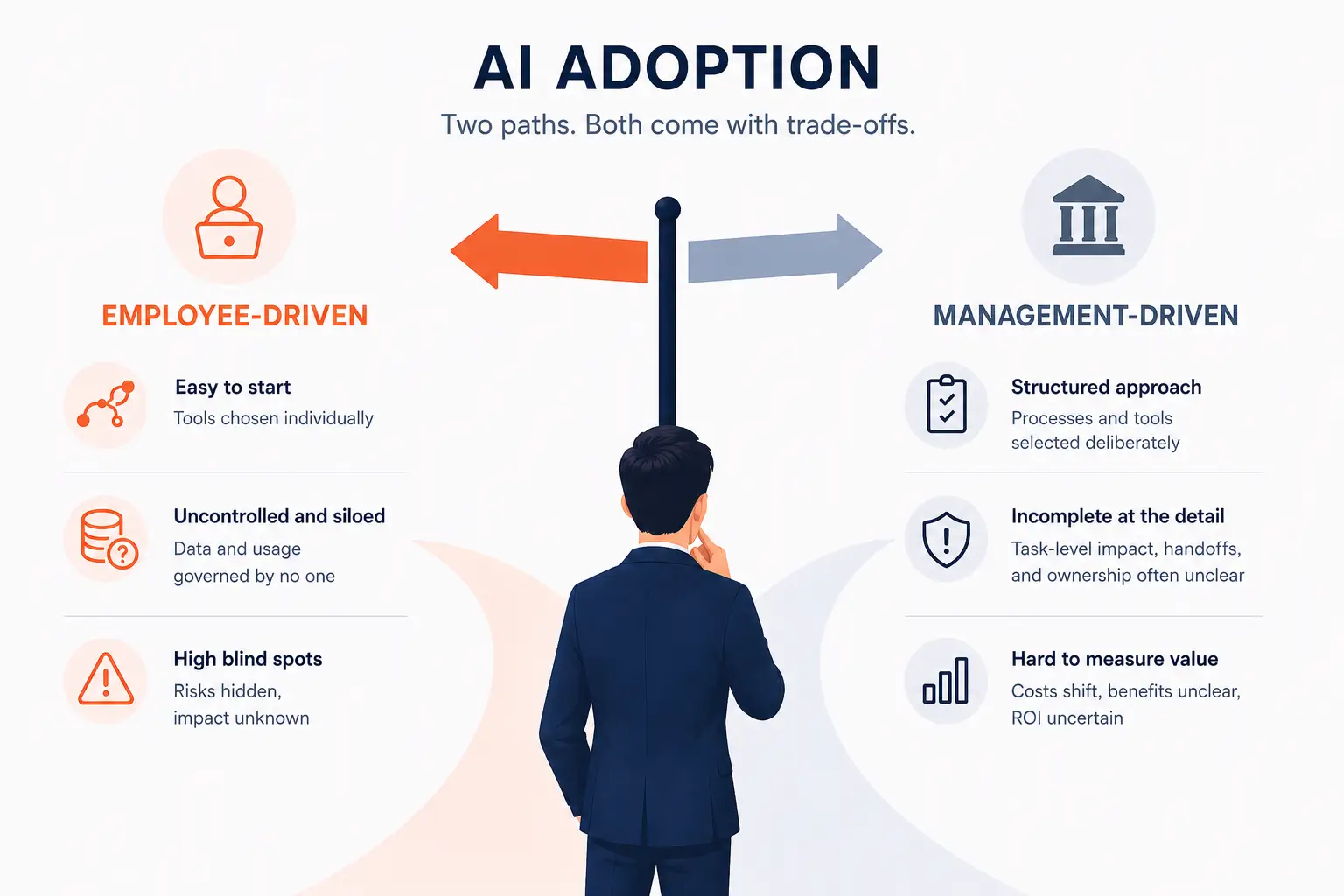
To see why, look at how AI gets into the organization in the first place. Mainly it comes through two drivers:
Driver 1: Employees automating their own work
What it gets right. The introduction of AI happens simply, through people doing their regular job. They have work to deliver and are eager to find ways to simplify and speed it up, especially now that the tools are one browser tab away and cost almost no time to try. Having found the right one, they go ahead and use it.
Take the customer desk as an example. Complaints arrive all day, and each one needs a judgment call. Some just need clarifying, others call for a refund. The more serious ones get escalated to legal. Someone signs up for the newest AI system everybody’s talking about and downloads a couple of ready-made skills from the community. Then they point it at the complaint inbox. It reads the message and pulls up the account history for context, then suggests what to do. It’s faster than doing it by hand and right most of the time, so the desk keeps it.
From there it becomes the standard way the work gets done. The team gets comfortable with it and starts expanding it into other tasks, which then appear to move faster too. It leaves a great impression of employees using AI efficiently, and that’s something any company would naturally want to encourage.
What it costs. Because it works, it spreads and nothing constrains it, since there are no guidelines on which applications are allowed and no rules on which data can safely be exposed to them. Each employee settles on their own approach to AI adoption, entirely off the books. The company loses the ability to observe which AI tools now support its business processes, and along with that, any real way to keep those processes stable and compliant.
Back at the customer desk, the setup looks efficient enough that employees connect it straight to the customer service system and stop reviewing its output case by case. Customer data now flows to an AI provider the company never assessed, under terms nobody read. Nobody even established how long that data would be retained, and none of it was checked against the obligations the company actually operates under. So AI gains autonomous access to a customer process, with no control in place.
The employee-driven approach deserves credit for how naturally it starts, but the people introducing it are solving their own workload first, not adopting a company-wide tool where accountability and compliance have already been considered. Under the hood of a faster, AI-supported process sits siloed, employee-driven adoption. It leaves the company with process blindness, and exposure that runs anywhere from data breaches to compliance violations.
Driver 2: Management pushing adoption from the top
What it gets right. The second driver comes top-down, from management. The pressure to increase efficiency and cut costs never really lets up, so when a technology promises both, it gets attention fast. Management does its own research into where AI could help, and watches what competitors are deploying, which only sharpens the pressure when a competitor’s move looks like it’s paying off. From the overview of the organization’s whole process landscape, management can identify heavily loaded business processes that could use some AI to loosen them up, and spot where there’s efficiency to gain or cost to save on manual work.
Let’s again assume the customer desk was selected among the candidates. It was a strong one, being high-volume and time-intensive while still following a set of familiar workflows. Management approves the move, and AI applications get reviewed and chosen carefully, following all the compliance requirements. AI is then introduced into the business process, and employees learn to use it with dedicated time set aside for exactly that. In that supportive environment, the tool genuinely seems to help process customer desk requests faster.
Compared to the first driver, this is a serious improvement. The process was chosen for reasons anyone can defend, and the tool was checked before it was ever used. Someone also decided the question was worth real structure and money. Even though it sounds like the ideal approach, this is exactly where the pitfalls begin.
What it costs. A global outlook on the processes helps management highlight the right candidate, but implementing it properly needs a closer look at each task’s specifics, starting with which applications connect to it and what data it uses. Each task also carries its own risks, and those need weighing on their own. Without assessing them, signing off on AI adoption for a process still leaves a lot of uncertainty about how each individual task should actually look. When should AI run it completely on its own, and when does a human review need to be involved? How should the handover from one AI task to the next actually work? Those small details are what decide whether the process gets assessed well enough to introduce AI the right way.
Back at the customer desk, the tool worked, because the pilot was chosen to succeed. It landed in a department with time and resources dedicated to introducing AI properly, on a narrow slice of the cases, with a willing team actively fixing whatever broke. In that supportive, if somewhat artificial, environment, the tool got its chance and the rollout looked quite successful. Employees would generally tell you the process runs better now. But how much better is hard to measure, and none of the conditions that made it work survive when the tool goes everywhere.
Typically, when AI gets introduced this way, the cost of the process before and after is never documented, so there is nothing to compare against. The organization ends up relying on people saying it saves time. What that misses is that AI cost is rarely just the visible bill. It spans the model, the infrastructure around it, the orchestration, the maintenance when a provider changes something underneath you, and the human review time the tool was meant to remove. This is why 42% of organizations say they cannot even assess the return on their AI investments. The saving at the front of the process can quietly be paid for at the back, and without the numbers, nobody sees the transfer. Nor did anyone weigh whether the added compliance risk is worth the accident it might eventually cause. And there’s a question nobody asked at all: who answers for the AI task once it runs on its own, and who owns it when the person who set it up has moved on?
Those same details are the foundation for evaluating the return. Without them, it’s hard to say what AI actually delivered, whether tasks got cheaper and faster or instead grew in time or cost. It’s just as hard to tell which work quietly shifted to another department entirely. So what looks on the surface like a controlled speed-up still leaves gaps nobody assessed. Tasks run without oversight and costs go untracked. The company eliminates one kind of work while creating another, with no way of telling which of the two is larger.
Two different starting points, bottom-up and top-down, and the same ending: AI is already in the business, and nobody can say exactly what it’s doing there. The question is where to look.
Real Impact Shows Up in the Process
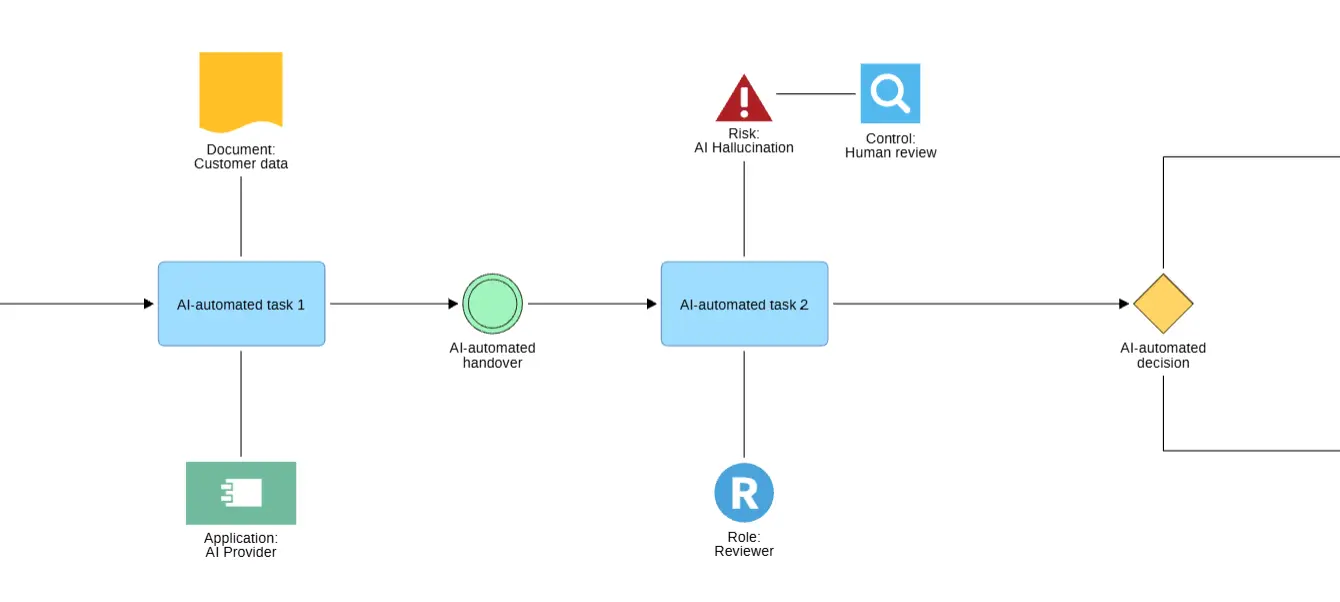
Every business process is really just a chain of tasks, each one carried out by someone, feeding on some data, running through some system, and carrying its own share of risk. That’s the level where AI actually leaves its mark, task by task, some of them merely supported, others accelerated, automated, or handed over almost entirely.
“We use AI in customer desk processes” is a slogan. “In the complaint handling process, the severity assessment task is now AI-supported, drawing on the complaint text and the account history and running through an external AI service, with the case handler reviewing the suggestion before it goes out” is something you can actually govern.
But the task itself is only the starting point. In a process model, every task connects to the business context around it, and introducing AI changes that context along with the task itself. That’s where the real impact becomes visible. Viewed this way, AI’s effects reach further than the value it creates. They surface in shifting responsibilities and changing risk profiles. They also show up in controls that quietly stop catching what they were built to catch. A few examples make this concrete.
Full-scale view of AI-supported processes
Data
The data itself has not changed, but its exposure has. A person reading a customer record is fundamentally different from an AI model consuming it, and so are the risks that come with each.
Applications
AI adoption introduces a new kind of dependency. The model behind a task becomes part of the enterprise architecture, with its own costs, security exposure, and vendor risk. But it runs deeper than an outage, because access can be withdrawn by decision, not just interrupted by failure. Providers have already restricted API access for entire regions, and governments increasingly treat access to advanced AI as something they can control by policy.
This is why sovereign AI, control over the models, data, and infrastructure you depend on, has become a board-level concern. And the dependency is not easily undone, since many organizations find switching AI providers very difficult. A process that quietly comes to depend on one external model inherits all of that, usually without anyone deciding it should.
Risks
AI introduces new risks of its own: hallucinations, model drift, biased outputs, provider outages. More importantly, it changes the existing risk profile of tasks that already carried operational risk before AI arrived. That shifts the conversation from the unhelpful idea that “AI is risky” to the actionable question of which risks have changed, on which tasks, and by how much.
Controls
A control built to catch human failure will not necessarily catch machine failure. A four-eyes review is good at spotting human mistakes, but it may miss an AI confidently producing something plausible yet wrong. The more fluent and convincing the output appears, the less likely a reviewer may be to challenge it critically. The control still gets ticked off in the audit, even though it no longer protects against the risk it was designed for, which is worse than having no control at all because it manufactures false assurance.
Roles
Roles shift rather than vanish, moving from performer to reviewer and from doer to overseer. That’s a real change in the competence required, well beyond a change in title. It’s also the direction regulators are converging on worldwide. The EU AI Act is one example, requiring oversight of high-risk systems to sit with a named person who can genuinely override them, and the same principle runs through governance frameworks well beyond Europe. Mere human involvement on paper is not the same as a reviewer with the authority and independence to challenge the decision.
Process flow
AI adoption changes more than the objects connected to a process. It changes how work actually flows through them. When AI automates adjacent tasks, the handover between them often disappears, and while that can shorten cycle time, it can also remove an informal checkpoint that used to catch issues before they spread further. Decision authority shifts gradually from people to systems too, which makes recording who remains accountable for those decisions essential, especially as organizations move toward agentic AI.
None of this has to stay implicit. Tasks can be labelled by their AI maturity and linked to the provider behind them, tying each one back to the wider business context it sits inside.
From Process Insight to Scalable AI Adoption
The real power of BPM lies not only in making AI visible, but in making it measurable. Once AI-related attributes become part of the process model, organizations can move beyond documenting AI use to understanding how AI adoption is progressing and where governance attention is needed.
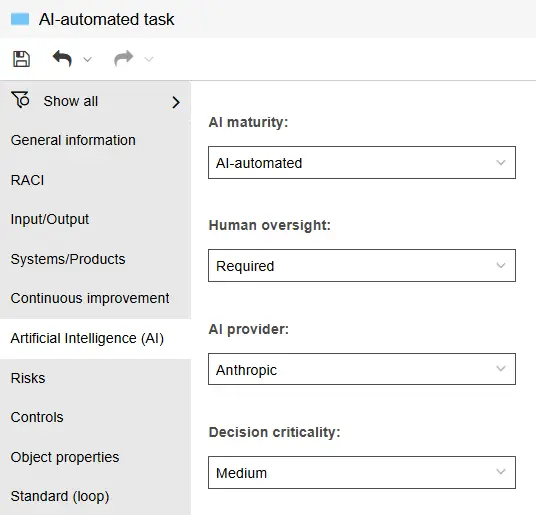
The relationships introduced in the previous section no longer remain static documentation. Organizations can label process objects according to their AI maturity, required human oversight, AI provider, decision criticality, or execution costs. This makes it possible to identify, analyze, and govern AI adoption across the process landscape.
Exemplary AI attributes of a task
It enables questions that an AI inventory alone cannot answer:
- AI maturity: Which tasks are still fully manual? Which processes already use AI? Where are autonomous AI agents operating?
- Human oversight: Which AI-supported decisions still require human approval? Where does AI operate without supervision?
- AI providers: Which external AI providers are used across the organization? Which business processes depend on a specific provider?
- Decision criticality: Which AI-supported decisions have the highest business impact? Which require the strongest governance and oversight?
- AI execution cost: What is the average AI cost of executing a task? Where can token consumption be optimized to improve cost efficiency?
Making AI Impact Actionable with ADONIS
ADONIS helps organizations transform AI adoption from isolated experiments into a strategic, governed business capability. Because all of this information lives inside the process model, organizations can analyze AI adoption from multiple perspectives – from high-level management dashboards down to individual process activities.
No matter which perspective you take, every AI initiative comes with costs, and rarely only the obvious ones. The real question is whether the value it creates justifies the investment behind it. Without a clear view of both, that answer remains a guess.
ADONIS creates that visibility by connecting costs to the tasks and AI agents that generate them. Because those same tasks can also carry information on human oversight, providers, decision criticality, and execution frequency, costs are not assessed in isolation. They can be evaluated in the context of what the AI is doing, how often the process runs, and how much control the task requires.
From there, ADONIS can reproduce how the process behaves under real conditions by factoring in how often it runs, the costs attached to individual tasks and AI agents, and the oversight each activity requires. Organizations can then compare an existing AS-IS process with proposed AI-supported TO-BE variants before changes are implemented. By combining process frequency, task-level costs, AI execution costs, and expected efficiency gains, organizations gain a structured basis for estimating the potential return. ROI becomes less of a story told after the fact and more of an informed decision made before investment and implementation.
At the process-landscape level, ADONIS also provides a consolidated view of AI maturity across entire business areas. Instead of reviewing processes one by one, decision-makers can immediately see which capabilities remain largely manual, where AI adoption is already progressing, and where the strongest opportunities for further improvement may lie.
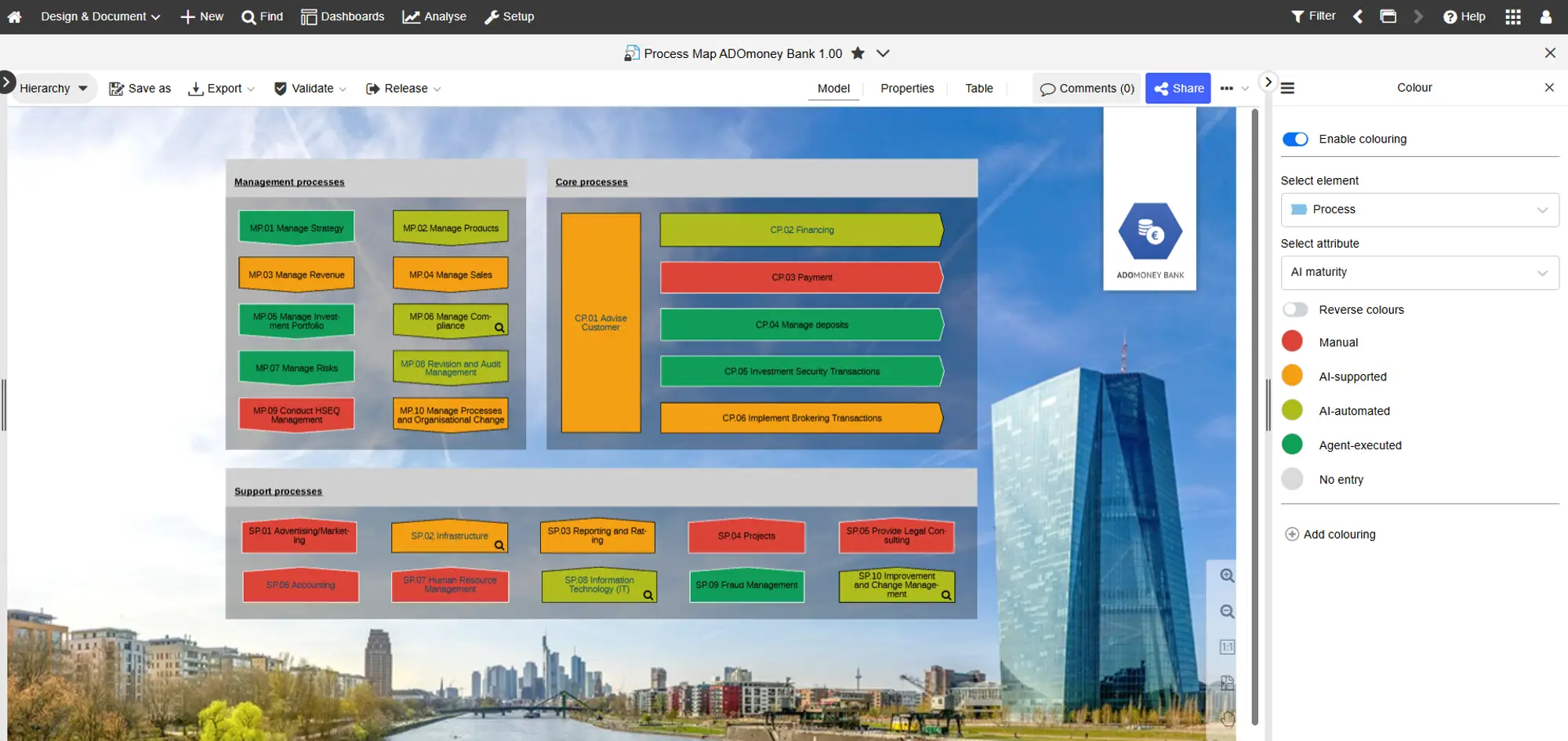
Overview of processes based on their AI maturity
The risks that matter rarely show up in a single dimension. A task running on its own is fine until it is also handling sensitive data, or making a business-critical call, or leaning on a single external provider. This is why ADONIS combines several AI attributes in one view, plotting maturity against decision criticality, colouring by process, so the dangerous combinations surface instead of hiding across separate reports. A highly autonomous task sitting on sensitive data, or a business-critical decision running with no human override, shows up as a position on the chart rather than something you have to search for manually.
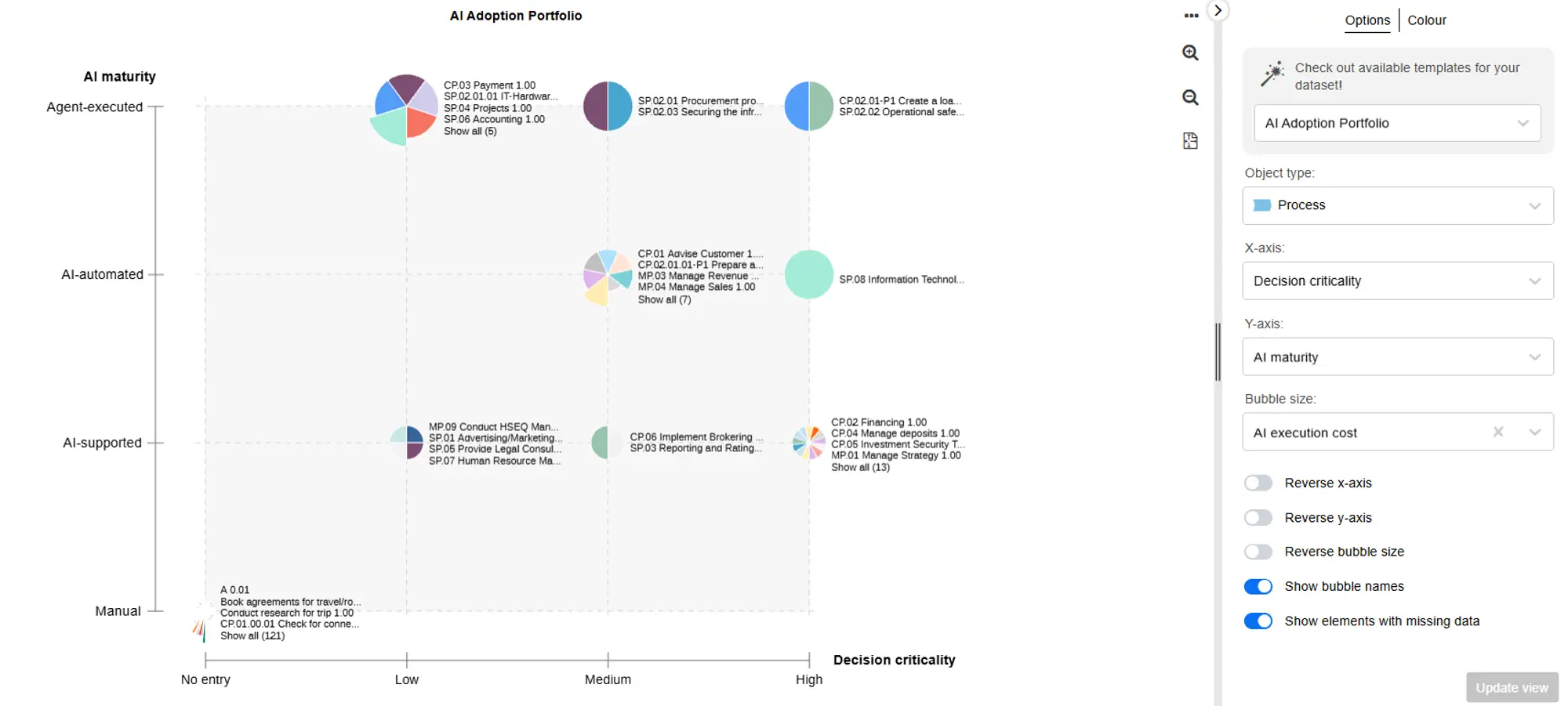
AI Adoption Assessment Portfolio
The same connections turn a provider problem into a solvable one. Every AI task carries the application behind it, and every application carries its risks and controls. So when a provider fails a compliance or data-protection requirement, you don’t launch a manual hunt for what’s affected. You follow the link: every process depending on that provider surfaces at once, risks and controls attached, and you can price the switch and model a new process variant before you commit. The provider dependency stops being a trap and becomes something you can see, price, and swap out smoothly.
Turning AI Transparency into Better Decisions
Seeing what AI touches only matters if it changes what happens next. In ADONIS, that visibility feeds directly into decisions, because the same model is already connected to everything a decision depends on: the applications behind a process, the data it uses, the risks it carries, and the controls meant to catch them, down to the task. Any AI attribute you need can be introduced wherever it belongs, on the process, the task, the application, the risk, or the role depending on your business needs.
That gives you a view from the whole landscape down to a single step, and a real basis for deciding which processes are genuinely the best fit for AI rather than simply the most visible.
From there, the decisions get real inputs instead of guesses. The same visibility that shows where AI creates value also shows where it’s likely to strain, which is what turns a question like where to invest or where to scale from instinct into evidence. It surfaces the harder calls too: where a task needs redesigning before AI ever touches it, where a control built for human error needs rebuilding for machine error, and where the right answer is to stop, an option nobody currently has the evidence to choose. Scenarios can be tested before you implement rather than discovered after you’ve already scaled: a manual baseline against an AI-assisted version, an agent-supported one. The same view that exposes risk exposes opportunity just as clearly.
Everything defined at task level, which step needs human review and which can run alone, stops being documentation nobody reads. Through MCP, an agent retrieves that knowledge at runtime and acts on the rules that apply where it is working. This closes the exact gap the second driver left behind, where management could pick the right process but never hand its requirements down to each task. With MCP, those requirements finally travel with the work itself.
Knowing where AI runs, seeing what it does, and exploring how it sits across the organization is a need in itself, and that is what the cockpit is for. Because the dashboards are configurable, they answer to whoever opens them. Management sees the whole picture on one screen: where AI operates across the organization, the applications and providers behind it, the risks those processes carry, and who is accountable for each use. An employee sees their own responsibility zone: the tasks they own, the AI and data involved, and where they are the one expected to review it and step in. Either way, every AI-supported task carries a named person standing behind it, so AI that once ran unseen becomes a visible and owned part of the process.
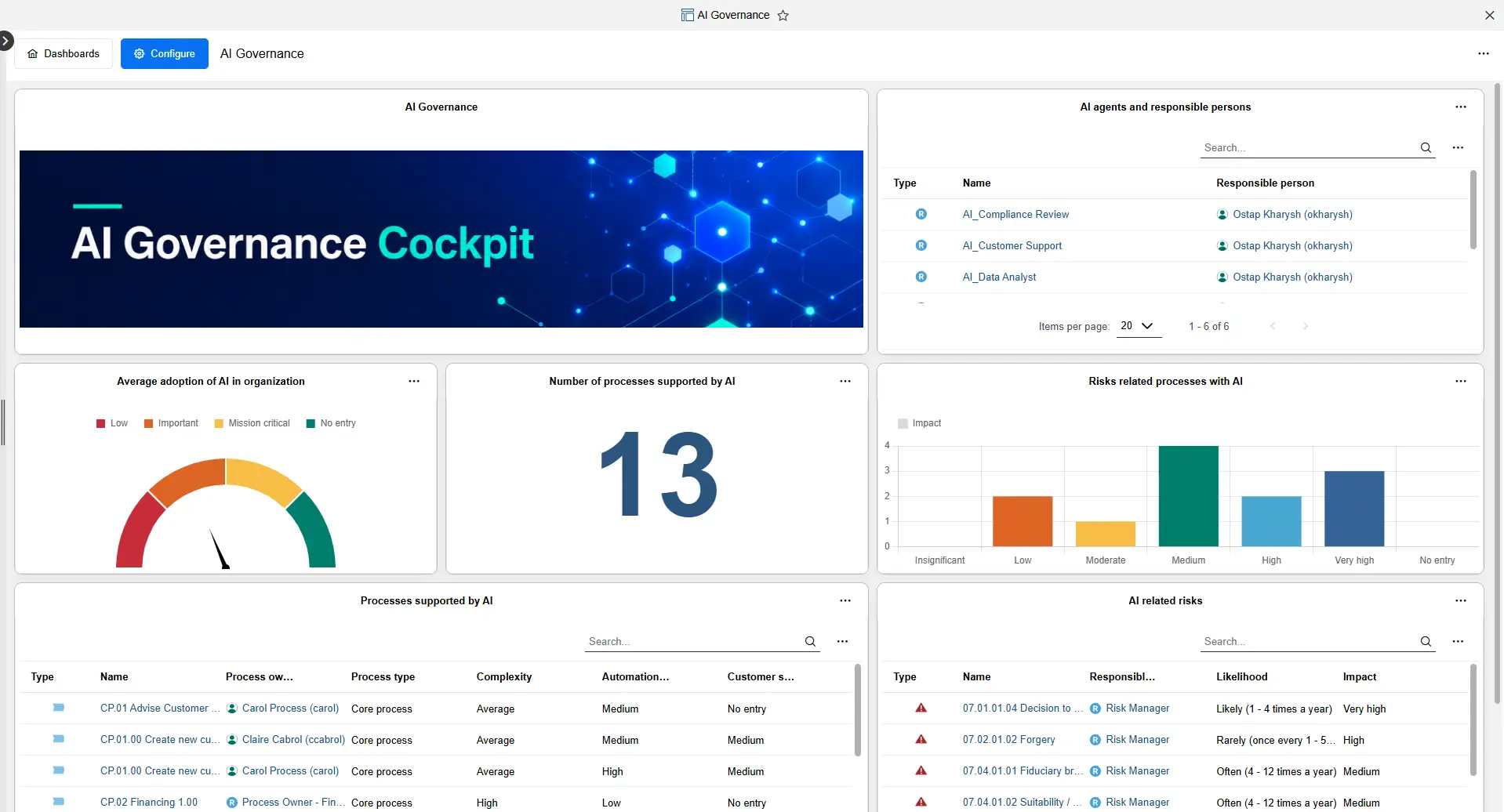
AI governance cockpit
And so the decision shifts. “Can we use AI here?” is a question about capability, and the answer is almost always yes. “Should we use AI here, and how do we do it responsibly?” is a question about value, risk, and ownership, one where the impact is measurable before anyone signs off.
With ADONIS, organizations can leverage reliable analysis capabilities to assess the impact of AI on any process, and decide where to invest, scale, redesign, or evolve.
Summary
AI adoption inside most organizations has already moved past the question of whether to allow it. Employees keep finding tools that speed up their own work, and management keeps hunting for the process where AI pays off fastest. Neither is going to stop, and neither should.
What separates the organizations getting real value from the ones still stuck running pilots comes down to one thing: whether they can see AI’s impact on a single task, the data it touches, the risk it changes, what it costs to run, the provider it leans on, and the person still accountable for the result. An inventory of tools can’t show you that. A process model can, because the task, the data, and the risk are already part of it.
That’s what ADONIS gives organizations to work with. The same process model they already maintain becomes the place where AI gets designed, costed, measured, and corrected, not a separate system tracking AI on the side.
AI will keep finding its way into the work either way. What’s still an open question is whether anyone in the organization can say, with evidence, what and how it changed and who’s responsible for it.




Already got our weekly updates?