BUSINESS PROCESS MANAGEMENT

Found this helpful? Share it with peers.
Why Process Documentation Still Drags
A few months ago, a compliance team at a global manufacturer faced a familiar challenge: an audit deadline was approaching, yet several key processes were missing documentation or were outdated. Days were spent chasing subject matter experts and reworking incomplete diagrams. The audit succeeded, but the stress and inefficiency were a wake-up call.
Stories like this are common across industries. In finance, documentation errors delay regulatory filings. In healthcare, gaps in process clarity slow compliance with patient safety standards. In manufacturing, incomplete process maps disrupt automation initiatives. Everywhere, process documentation is undervalued until it suddenly becomes urgent.
Accurate, up-to-date process documentation is the backbone of compliance, the foundation for onboarding, and the enabler of automation. Yet keeping it current is a common struggle. Insights from our BPM study confirm this picture: while 73% of organizations see transparency through documentation as its greatest benefit, 67% report lacking the resources and 48% the buy-in needed to sustain BPM practices effectively. These hurdles often spill over into documentation, making it difficult to keep process knowledge aligned with reality – leading to wasted time, higher risks, and missed opportunities.
AI is finally changing that dynamic.
Why AI Makes Sense for Documentation
AI does not replace BPM professionals; it amplifies their expertise. Its real power lies in making process knowledge easier to create, validate, and share – turning documentation into something the whole organization can benefit from.
By lowering the effort to document well, AI not only saves time but also opens the door for wider participation. Process owners can move from plain descriptions to structured drafts in seconds. Reviewers gain earlier visibility into gaps or inconsistencies. Compliance officers can trust that documentation stays closer to reality, without combing through outdated versions.
The result is documentation that is faster to produce, more reliable to maintain, and easier for everyone to consume – shifting from a specialized chore into a shared business asset that drives compliance, collaboration, and improvement.
What Smarter Documentation Looks Like
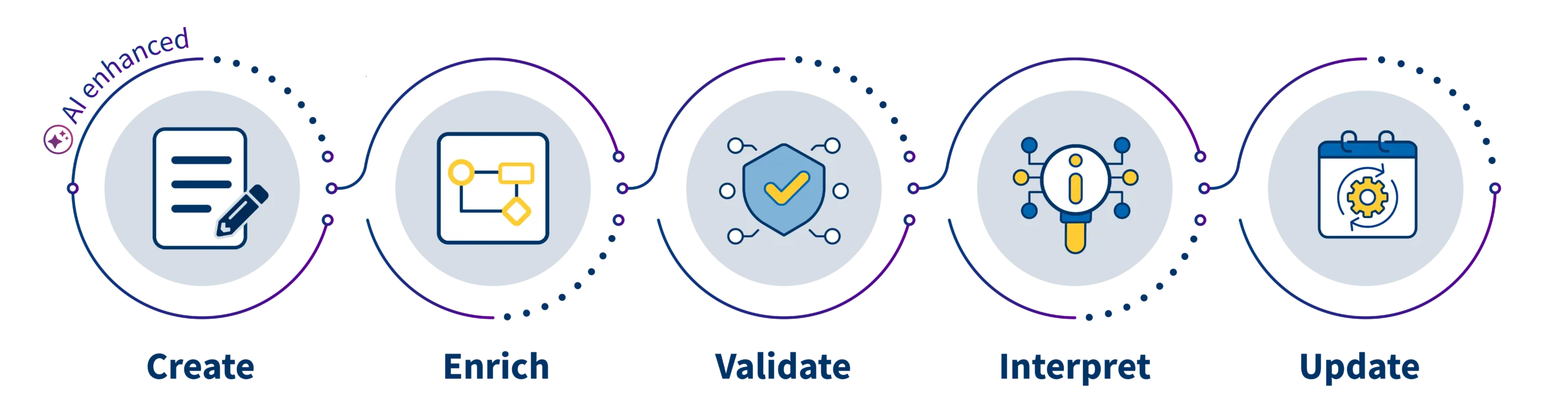
Smarter documentation redefines the entire lifecycle of process knowledge. It’s no longer about finishing a diagram once — it’s about keeping information clear, current, and actionable every day.
Kick-Starting with AI
With Process Documentation AI, workflows described in plain language become structured BPMN models in seconds. Backlogs shrink, and teams start strong with consistent, high-quality drafts that reduce manual rework.
Making Knowledge Accessible
AI bridges the gap between complex models and everyday users.
Employees can ask natural-language questions — “What happens next?”, “Who owns this step?” and get precise, role-specific answers. Process guidance becomes immediate, intuitive, and available to everyone.
Driving Real Business Value
As one ADONIS customer put it:
“Our documentation backlog shrank from months to weeks. For the first time, business users could contribute directly — and our analysts had more time for real improvement work.”
Smarter documentation turns process knowledge into a shared asset, empowers teams, strengthens compliance, and accelerates continuous improvement.
What ADONIS 17 Brings to the Table
The latest release of ADONIS 17 makes Process Documentation AI a practical reality — embedding intelligent features directly into everyday BPM work. These capabilities are not experiments; they’re ready to use today and already transforming how teams document and understand their processes.
AI Assistant for Process Creation
Turn plain language into structured BPMN models in seconds. The AI Assistant captures your input, creates the initial model, and lets you refine it, saving hours of manual modeling and accelerating every project start.
Conversational Process Understanding
With built-in natural-language processing, ADONIS lets employees ask questions like:
“What does this process do?” or “Who is responsible for this task?” and instantly get clear, contextual answers.
Seamless Integrations
ADONIS connects effortlessly with platforms like SharePoint and Confluence, bringing process knowledge straight into employees’ daily tools. Documentation doesn’t live in isolation and becomes a seamless part of everyday work.
Quickly generate and refine process models with the AI Assistant
Why This Matters
Process Documentation AI doesn’t just make documentation faster. It redefines its role inside the organization. What was once a compliance checkbox now becomes a continuous source of value.
From Catch-Up to Continuous Improvement
Backlogs shrink dramatically. Instead of spending hours updating outdated documents, experts focus on improving processes and driving automation. AI keeps documentation synchronized with reality, ensuring accuracy without constant manual effort.
Stronger Alignment Across Teams
When process knowledge lives in one intelligent, connected system, business and IT finally speak the same language. Everyone works from a single source of truth, reducing confusion, duplication, and risk.
Tangible Results Across Industries
-
In compliance, it means fewer risks and smoother audits.
-
In healthcare, faster onboarding and safer patient care.
-
In manufacturing, more reliable automation and higher output quality.
No matter the sector, AI-driven documentation transforms process knowledge from static paperwork into a strategic advantage that drives clarity, trust, and operational excellence.
Looking Ahead – The Future of AI in Documentation
We are only at the beginning of what Process Documentation AI can do. Today it accelerates creation and maintenance and tomorrow it will anticipate needs, detect gaps, and guide teams before issues arise.
Predictive Updates
Imagine your documentation alerting you that a process is drifting from compliance before the audit even starts. AI could soon flag potential deviations, suggest corrective actions, and keep models aligned automatically.
Real-Time Compliance Monitoring
Instead of checking documentation once a year, AI will continuously monitor processes against regulatory requirements. When standards change, updates will cascade across models instantly, reducing risk and keeping organizations audit-ready at all times.
Integrity Safeguards
As models become more connected, AI can help identify missing links, outdated dependencies, or contradictory steps. This ensures your documentation remains trustworthy, consistent, and usable, even as complexity grows.
For BPM professionals, this shift means moving beyond catch-up mode. Process Documentation AI turns documentation into a proactive driver of operational excellence , providing foresight, not just hindsight. The future isn’t about replacing expertise, but about enhancing it, helping teams work smarter, faster, and with full confidence in every process they own.
Final Thoughts
For years, process documentation was tolerated rather than valued. AI is changing that. With ADONIS, documentation becomes faster, smarter, and more impactful, turning it into a foundation for compliance, collaboration, and continuous improvement.
AI is not taking over documentation, it’s finally making it work for you.



Already got our weekly updates?