Governance, Risk & Compliance

Found this helpful? Share it with peers.
Introduction
Compliance risk management is the process of identifying, assessing, and mitigating risks that arise when organizations fail to comply with laws, regulations, internal policies, or industry standards. A structured approach helps companies reduce exposure, improve accountability, and strengthen governance across the business — and works best when embedded within a comprehensive compliance management system.
In practice, compliance risk management is not limited to reacting to regulatory issues. It also requires organizations to understand where risks exist, evaluate their potential impact, and establish effective controls to monitor and reduce them over time.
In this article, we explain what compliance risk management means, why it matters, and how organizations can manage compliance risks in three essential steps.
What Is Compliance Risk Management ?
Compliance risk management is the structured process organizations use to identify, assess, and mitigate risks related to non-compliance with laws, regulations, internal policies, or industry standards. These risks can arise from regulatory changes, weak internal controls, inconsistent policy enforcement, or a lack of visibility across business processes.
The goal of compliance risk management is not only to avoid legal penalties but also to strengthen governance and accountability across the organization. By identifying compliance risks early and assessing their potential impact, organizations can prioritize mitigation measures and allocate resources more effectively.
A mature compliance risk management approach typically combines risk identification, structured assessment, defined control measures, and ongoing monitoring. This allows organizations to move from reactive compliance efforts toward a more proactive and structured governance model — aligned with broader risk management practices across the organization.
Key terms related to compliance risk management include:
| Term | Definition |
|---|---|
| Compliance risk | The risk of legal, financial, or reputational consequences caused by non-compliance |
| Compliance risk management | The process of identifying, assessing, mitigating, and monitoring compliance-related risks |
| Compliance risk assessment | The evaluation of the likelihood and impact of compliance risks |
| Compliance controls | Measures designed to prevent, detect, or respond to compliance issues |
| Compliance monitoring | Ongoing oversight to ensure controls are effective and requirements are being met |
How to Manage Compliance Risk in 3 Essential Steps
A practical compliance risk management process can be broken down into three essential steps: identifying risks, assessing their potential impact, and implementing mitigation and monitoring measures. Together, these steps help organizations move from reactive compliance toward a more structured governance approach.
Step 1- Identify compliance risks
The first step in compliance risk management is to identify where compliance risks exist across the organization. These risks can originate from regulatory requirements, internal policies, contractual obligations, or operational processes.
Organizations typically identify compliance risks by reviewing policies, analyzing regulatory obligations, examining audit findings, and evaluating how business processes are executed in practice. When risks are not documented consistently, organizations often struggle to gain a clear overview of their compliance exposure.
Creating a structured inventory of compliance risks provides the foundation for effective risk management and enables organizations to move toward more systematic risk assessments.
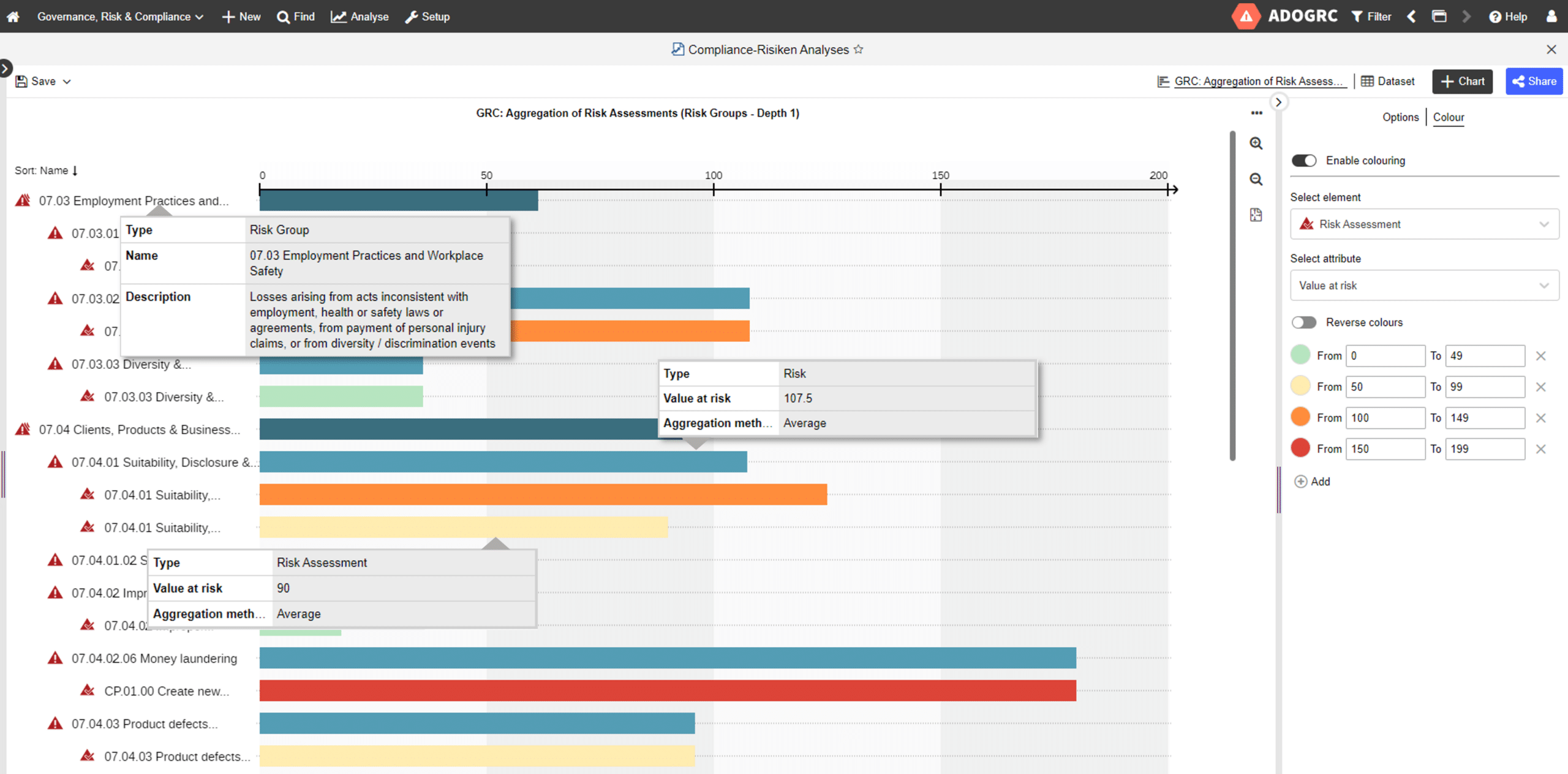
Example of a Compliance-Risk Analysis in the GRC suite ADOGRC
Once the list of compliance risks is considered complete for the time being, the next step is to assess them. But more on this in the next section.
Step 2- Assess and prioritize compliance risks
Once risks have been identified, organizations need to evaluate their likelihood and potential impact. This allows compliance teams to distinguish between minor issues and risks that could lead to significant legal, financial, or reputational consequences.
A compliance risk assessment typically considers several factors, including regulatory relevance, potential penalties, operational impact, and the maturity of existing controls. The goal is not simply to document risks but to prioritize them based on their potential impact on the organization.
By prioritizing risks effectively, organizations can allocate resources where they are most needed and focus mitigation efforts on the areas with the highest exposure.
Step 3- Mitigate and monitor compliance risks
AfterAfter assessing risk exposure, organizations must define appropriate mitigation measures and ensure that controls are implemented effectively. These measures may include updating policies, improving internal controls, clarifying responsibilities, or introducing additional oversight mechanisms.
However, mitigation alone is not sufficient. Compliance risks evolve as regulations change, processes are updated, or new operational challenges emerge. For this reason, continuous compliance monitoring plays a critical role in ensuring that mitigation measures remain effective over time.
Monitoring activities provide visibility into whether controls are working as intended and help organizations detect compliance issues early before they escalate into larger problems.
Key Components of a Compliance risk management plan
A compliance risk management plan provides the structure organizations need to manage compliance risks consistently across departments and processes. Without a defined framework, risk identification and mitigation efforts often remain fragmented, making it difficult to maintain visibility and accountability.
An effective compliance risk management plan typically includes several core components that ensure risks are identified, evaluated, and monitored in a systematic way.
Risk inventory
A compliance risk management plan should begin with a documented overview of the organization’s compliance risks. This inventory includes the source of each risk, the regulatory or policy context, and the business processes or departments affected.
Maintaining a structured risk inventory helps organizations avoid fragmented documentation and provides a single source of truth for compliance-related risks.
Risk assessment criteria
Organizations need clearly defined criteria to evaluate the likelihood and potential impact of compliance risks. These criteria ensure that risks are assessed consistently across teams and that prioritization decisions are based on objective factors rather than subjective judgment.
Common assessment criteria include regulatory severity, financial exposure, operational impact, and the effectiveness of existing controls.
Control measures
Control measures represent the actions organizations take to prevent, detect, or mitigate compliance issues. These controls may include policies, approval mechanisms, documentation requirements, or automated monitoring activities.
Clearly documenting controls is essential for ensuring accountability and demonstrating compliance during audits or regulatory reviews.
Roles and responsibilities
A compliance risk management plan should define ownership for risk identification, assessment, mitigation, and monitoring activities. When responsibilities are unclear, compliance risks are often overlooked or addressed inconsistently.
Defining clear roles helps organizations ensure that risk management activities are integrated into daily operations rather than handled only during audits or reviews.
Monitoring activities
Effective compliance risk management requires ongoing monitoring to verify whether controls remain effective over time. Compliance monitoring activities allow organizations to detect deviations, identify control weaknesses, and respond quickly to emerging compliance risks.
This is where compliance risk management connects closely with compliance monitoring, as monitoring programs provide the continuous oversight needed to maintain control effectiveness.
Reporting and review
Finally, compliance risk management plans should include regular reporting and periodic reviews. Reporting ensures that leadership maintains visibility over compliance risks, while periodic reassessments help organizations adapt to regulatory changes or evolving business processes.
Regular reviews also support continuous improvement by identifying areas where risk mitigation strategies can be strengthened.
Compliance Risk Management Best Practices
Organizations tend to manage compliance risks more effectively when risk management is treated as an ongoing governance activity rather than a one-time assessment. Establishing consistent practices helps ensure that compliance risks remain visible and that mitigation efforts remain effective as regulations and business processes evolve.
Several best practices can help organizations strengthen their compliance risk management approach.
Document risks and controls centrally
Fragmented documentation is one of the most common weaknesses in compliance risk management. When risks, controls, and mitigation measures are documented in different systems or spreadsheets, organizations often struggle to maintain visibility.
Maintaining a centralized overview of compliance risks and related controls improves transparency and helps compliance teams track how risks are being managed across the organization.
Connect risk management with compliance monitoring
Compliance risk management should not end once mitigation measures are defined. Organizations need mechanisms to verify whether controls are working in practice and whether risk exposure changes over time.
Connecting risk management with compliance monitoring activities ensures that mitigation measures remain effective and that emerging risks can be detected early.
Review compliance risks regularly
Regulatory environments evolve constantly, and business processes change as organizations grow or adopt new technologies. As a result, compliance risks must be reviewed regularly to ensure that risk assessments remain accurate.
Periodic reviews help organizations identify new risks, update mitigation strategies, and maintain an up-to-date understanding of their compliance exposure.
Use technology to improve visibility
As compliance environments become more complex, manual approaches to risk management become increasingly difficult to maintain. Technology can help organizations structure risk assessments, maintain risk inventories, and monitor the effectiveness of controls more efficiently.
Digital tools also improve traceability and help compliance teams demonstrate accountability during audits or regulatory reviews.
How Technology Supports Compliance Risk Management
As regulatory requirements and internal governance obligations become more complex, managing compliance risks manually becomes increasingly difficult. Many organizations still rely on spreadsheets, disconnected documentation, or fragmented reporting processes, which makes it challenging to maintain a clear overview of compliance risks and mitigation activities.
Technology can help organizations structure their compliance risk management processes more effectively. By centralizing risk information, documenting controls, and linking compliance requirements to operational processes, digital tools provide better visibility into the organization’s risk landscape.
Specialized governance platforms also support structured risk assessments, making it easier to evaluate the likelihood and impact of compliance risks. This helps compliance teams prioritize mitigation activities and ensure that risk management decisions are based on consistent criteria.
Technology also plays an important role in monitoring the effectiveness of compliance controls over time. By connecting risk management with monitoring activities, organizations can detect control weaknesses earlier and respond more quickly when compliance risks increase.
Solutions such as ADOGRC support compliance risk management by helping organizations document risks, perform structured assessments, assign responsibilities, and maintain transparency across governance activities. This creates a more consistent approach to managing compliance risks while improving traceability for audits and regulatory oversight.
Summary
Compliance risk management helps organizations identify, assess, and mitigate risks that arise from non-compliance with laws, regulations, and internal policies. A structured approach improves visibility, supports better prioritization of risks, and strengthens governance across the organization.
In practice, effective compliance risk management relies on three key elements: identifying compliance risks, assessing their likelihood and impact, and implementing mitigation and monitoring measures. When these activities are structured and supported by clear governance processes, organizations can respond more effectively to regulatory changes and operational risks.
By combining risk management practices with ongoing compliance monitoring and appropriate technology support, organizations can build a more resilient compliance framework and maintain greater transparency across their governance activities.





Already got our weekly updates?