Enterprise ArchitEcture

Found this helpful? Share it with peers.
Introduction: What Is Enterprise Architecture and Which Challenges Does It Face?
If you had to guess, how long has Enterprise Architecture been around? Most people might say a few years or a decade at most. The correct answer is the 1960s. Surprising, right? Yet it makes sense. As technology started reshaping organizations, people quickly realized they needed a way to align IT with business goals.
Since its early days, EA has grown alongside technology. It has proven value in improving alignment, transparency, and control. Yet many EA initiatives still struggle to gain traction. In this blog, we’ll explore why that happens by looking at key challenges in implementation, governance, and evolution, as well as how modern tools like ADOIT can help address them effectively.
Implementation Challenges – Getting Enterprise Architecture Off the Ground
Modern organizations generate vast amounts of data and technology continues to expand rapidly. Applications rely on various software and infrastructure to function, and these systems exist to support capabilities that help achieve strategic goals. Everything is connected. But in practice, that connection is often hard to see.
Challenge 1: Fragmented Data and No Central Repository
Without a central repository, all the artifacts described above appear as separate, disconnected items, scattered across spreadsheets and diagrams. Teams struggle to see the full technology landscape or understand how applications and processes relate to each other. Dependencies and risks remain hard to spot, and much of the information that could support better decisions stays buried simply because no one sees the full picture.
Solution: Centralize all EA information in a single repository. This provides a clear and reliable source of truth, highlights hidden dependencies, and supports better decision-making for future EA activities.
Challenge 2: Lack of Vision and Ownership
In a busy environment, it’s easy to focus on day-to-day tasks and overlook the bigger picture. Teams often work on their own initiatives without understanding how everything connects. This is exactly where EA in business transformation shows its value. Yet without clear vision and ownership, EA is often perceived as theoretical rather than practical.
Solution: Establish clear ownership and communicate the strategic purpose of EA initiatives. This ensures teams understand the relevance of their work and how it fits into the broader organizational goals.
Challenge 3: Limited Executive Buy-in
EA initiatives need support from executives to succeed. Leaders must understand the value of the work in business terms, including outcomes, KPIs, and improvements to capabilities. When EA is communicated this way, its benefits become tangible, and its contribution to strategic goals is easier to recognize and support.
Solution: Demonstrate EA’s impact using metrics and business-focused outcomes. Align its activities with executive priorities to secure buy-in and maintain ongoing support.
Challenge 4: Modelling Too Much, Too Soon
A common mistake is trying to model everything at once. Once EA benefits become visible, the instinct is to capture every detail immediately. But EA works best as an iterative process. Start with a simple capability map, then connect it to the application landscape. Only after that you can build your way toward the deeper architectural layers.
Solution: Begin with high-level models and expand gradually. Focus first on areas that deliver the most immediate clarity. This approach allows teams to adapt and refine the architecture as understanding grows.
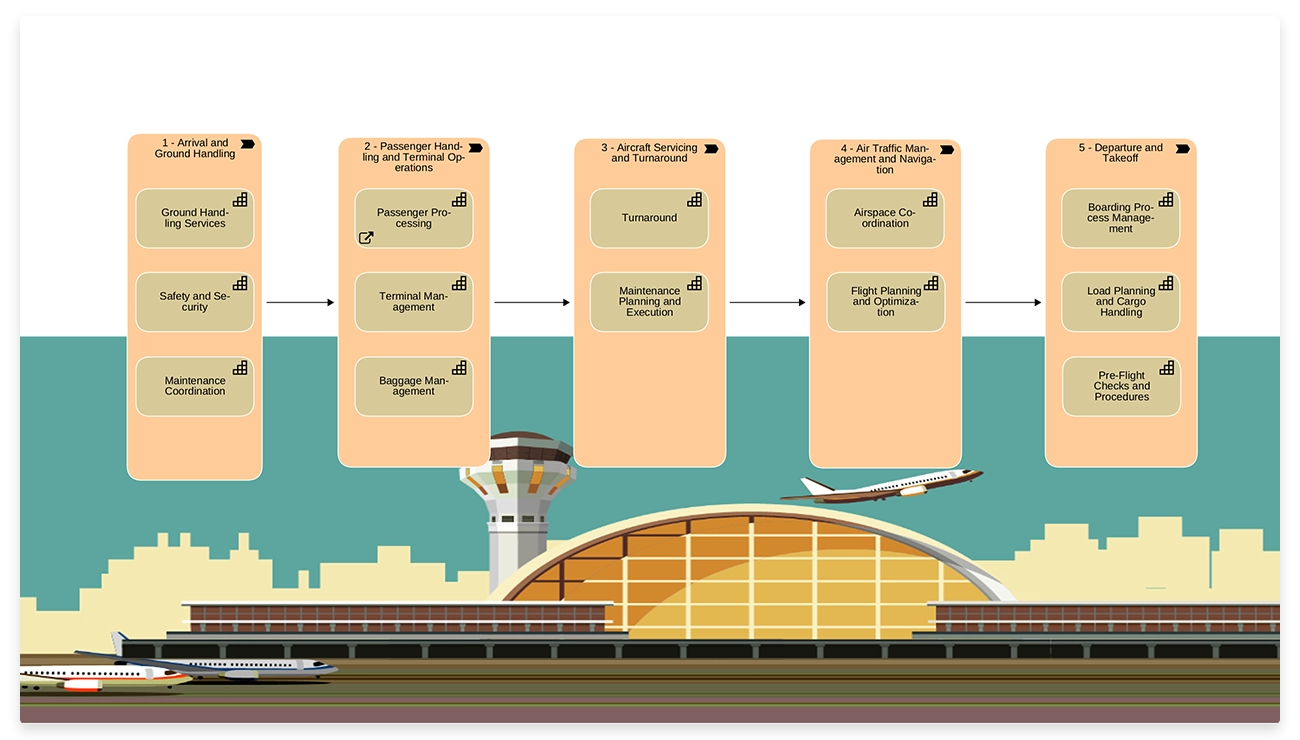
Example of a Capability Map for an airport
Challenge 5: The “Ivory Tower” Architecture
EA is not a one-person job. Involving all relevant departments is essential to ensure the architecture reflects operational realities. When architects work in isolation, EA becomes overly theoretical and disconnected from daily work. This “Ivory Tower” approach prevents the practice from delivering meaningful impact.
Solution: Bring people from across the organization into the EA work early. A capability map works well as a starting point because it gives everyone the same reference. Business and IT can see what the organization actually does, where their area fits, and why certain decisions matter, which makes collaboration easier and more natural from the start.
Hint: See how ADOIT Forms helps teams manage architecture input with more structure and less effort.
Challenge 6: Unclear Decision Rights
Although we’ve emphasized that EA is a collaborative effort, it still requires a solid governance model to fulfill its purpose. In many organizations, it is unclear who is responsible for decisions and who owns specific parts of the architecture. This lack of clarity can cause confusion and slow down EA activities.
Solution: Assign responsibilities and define decision rights so everyone knows their role, enabling smoother execution of EA initiatives.

Evolution Challenges – Sustaining Momentum and Proving Value
Challenge 7: Difficulty Showing EA Impact
EA does not deliver value instantly. Its benefits are often not visible in the early stages, which can make it hard for teams and leadership to see its importance. This can lead to doubts about the effort and slow adoption of EA practices.
Solution: Track EA outcomes using clear metrics such as cost savings, risk reduction, or improvements in agility. Demonstrating results over time helps build trust and shows the EA benefits that matter most to the organization. Along the way, it can also bring to light hidden risks, such as those tied to unmanaged application portfolios.
Challenge 8: Adapting to Emerging Technologies
Even after mapping the technology landscape, new trends and tools continue to appear. EA practices can quickly become outdated if they don't account for these changes, which makes it harder to maintain an accurate and relevant architecture.
Solution: Integrating approaches like Technology Scouting and Technology Lifecycle Management helps keep portfolios updated and ensures the architecture reflects the evolving needs of the organization.
Challenge 9: Resistance to Change
Organizations often hesitate to adopt EA because it can seem complex or overly technical. Teams may avoid using new processes, which makes it harder for EA to take effect across the organization.
Solution: Use intuitive tools and role-specific views to provide early, tangible results. Demonstrating quick wins helps teams understand the benefits and trust EA from the start.
Overcoming the Challenges – A Tool-Enabled Approach
Understanding EA challenges is essential, but the right tool can make managing them much easier. ADOIT provides a structured approach that mirrors how work actually happens, showing how strategy, processes, and technology connect. This clarity helps teams move from planning to action without losing sight of the bigger picture.
At the same time, ADOIT democratizes EA. Workspaces let everyone contribute, not just experts, so initiatives grow organically across the organization. By giving teams a way to see and act on architecture in a practical, everyday context, ADOIT helps EA initiatives gain traction and deliver value from the start.
Conclusion: Turning EA Challenges into Maturity Milestones
As everything, EA comes with challenges. But every EA challenge is just a signal of your organization's architectural maturity. Each obstacle you overcome, from fragmented data to unclear ownership or "Ivory Tower" tendencies, marks a step forward in building a stronger, more resilient EA practice.
By addressing these challenges with the right tools, clear governance, and collaborative processes, you don't just solve immediate problems – you set your organization up for long-term success. Every challenge turned into a solution is a milestone toward a connected, agile, and future-ready enterprise architecture.





Already got our weekly updates?