BUSINESS PROCESS MANAGEMENT

Found this helpful? Share it with peers.
Introduction
Ask any organization how it picks its next AI or automation project, and the answer usually points to a business case, projected savings and a clear line back to strategy. Ask how confident that business case actually is, and the answer gets shakier fast.
That gap is where AI investments tend to go wrong. The processes that make it onto a roadmap are rarely the ones best suited for automation. More often they’re the ones a senior stakeholder pushed for, or the ones a vendor happened to demonstrate well. Whether the underlying process can actually support automation rarely enters the conversation, and by the time that mismatch becomes visible, the budget is already spent.
Process mapping closes that gap. It replaces assumptions about how work happens with a model of how it actually runs, and that model is what decides whether a candidate is ready or not.
Why Most Organizations Pick the Wrong Processes for AI and Automation
The selection of AI and automation candidates is often driven by executive visibility, by the vendor who told the most convincing story, or by the pressure to match something a competitor just announced. None of it is irrational, just disconnected from the question that should actually decide the matter.
There is one question that must guide any automation decision: is this process genuinely suitable for it? That question cannot be answered from the room where the decision is made. Suitability lives in the detail of how the work runs, step by step, and a strategy conversation never goes there. A senior sponsor’s interest or a confident demo fills that space instead, and suitability never actually gets assessed.
This is also what makes AI prioritization different from ordinary project prioritization. A normal portfolio decision weighs value against effort. An AI decision has a gate in front of that: whether the process is even shaped in a way an AI or automation can work with reliably. Skip the gate, and the value-versus-effort calculation is built on sand.
Investment concentrates in the places that were easiest to implement rather than the places where value was most achievable, and the returns arrive slower than the business case promised. By the time the mismatch becomes clear, the budget is already committed, and the next round of decisions is being made the same way.
What Process Mapping Reveals That Strategy Conversations Miss
A strategy conversation works with how people describe their work. A process map works with how the work is actually structured, and that is exactly where AI’s chances of success usually go unnoticed, invisible from the executive view until mapping brings them to the surface.
A process model exposes what a discussion cannot:
- Which steps are genuinely repetitive, and which only look repetitive from the outside while hiding judgment, exceptions, or negotiation underneath.
- Where execution varies so much between teams that there is no single process to automate yet, only several competing versions of one.
- Where volume, frequency, and business impact actually concentrate, rather than where they are assumed to.
- Where the data the process generates is structured and reliable enough to support AI decision-making.
- Where handoffs between roles or systems create the most delay and rework.
This is also where process mining earns its place. Mapping captures how a process is designed to run, while mining reconstructs the as-is path from event data, so the map reflects how the process truly behaves rather than the tidy version people recall in a workshop. That difference matters, because the gap between the described process and the real one is exactly where automation projects tend to fail.
How to Identify Strong AI and Automation Candidates
Once a process is mapped, the qualities that make it a strong candidate stop being a matter of opinion and become something you can read off the model. Four main signals tend to separate processes that are ready from those that are not.
Repetitive Tasks With Low Decision Complexity
The strongest signal that a task belongs in an automation pipeline is repetition paired with a lack of real judgment at each step. A clear input leads to a clear output, and little separates one case from the next. That sounds simple to spot, but plenty of tasks only look repetitive from a distance. Follow one through a process map and the picture often changes: a step that seemed mechanical actually depends on someone weighing a few unwritten factors, or on negotiating an exception nobody bothered to document. Mapping catches that difference because it forces you to trace the work, not just describe it.
High-Volume Processes With Structured Data
Volume alone is a poor guide. A process that runs thousands of times a month looks appealing on paper, but that appeal only holds if the data moving through it is structured enough for AI to use. Invoice data with amount, vendor, and approval status held in defined fields gives a system something concrete to act on. The same information scattered across free-text comments in an email chain does not, no matter how many thousands of times the process repeats. A map shows exactly where that data originates and what shape it takes at each point, which means a process built on inconsistent or unreliable data gets ruled out by its own inputs, however large the volume looks.
Stable Processes With Low Change Frequency
A process that gets rebuilt every quarter turns automation into something that constantly needs rework. Whatever changes on the process side becomes a change the automation has to absorb, and each of those adjustments adds a small cost that’s easy to miss and hard to catch up on. Comparing versions of a process model across time shows whether the process has genuinely held its shape or shifted quietly underneath its own name, and that history matters more than how stable the process looks today, because it’s what actually protects the investment.
Processes With Measurable Outputs
A business case that can’t be measured can only be believed, not validated. A process map shows whether there is even a defined output to check results against, and that alone makes measurability worth checking early, not something to leave until the system is already running. Processes that already track process performance indicators start from solid ground, because the business case has numbers to compare against from the outset. Without an agreed measure of success, whether an automated process actually improved anything stays a matter of opinion, indefinitely.
In ADONIS: Process performance indicators can be attached directly to the tasks where they occur, so measurability is built into the model rather than reconstructed after deployment. When a candidate already carries defined indicators, its business case has a baseline to measure against from day one.
Example: Applying the four signals to a real process
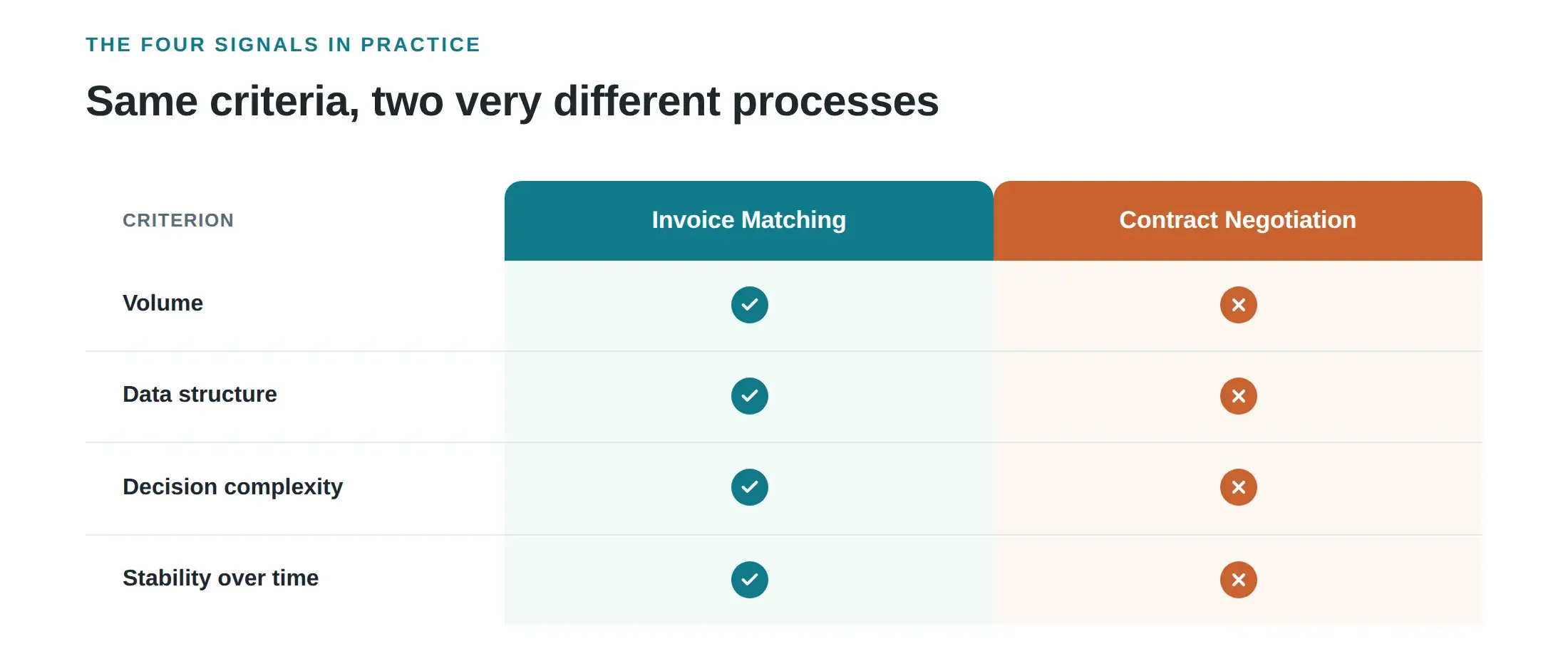
To see how this looks in practice, take a process most finance teams will recognize: matching supplier invoices against purchase orders in accounts payable. Thousands of invoices move through the process every month, so volume is high. Each one carries amount, vendor, and approval status in defined fields, which keeps the data reliable. Matching an invoice against a purchase order takes little more than confirming a match or raising a flag, and the process itself has barely changed in years. All four signals line up at once, which is what makes invoice matching a defensible starting point, not just a guess.
Run the same analysis against contract negotiation process and it fails on every count: low volume, unstructured inputs, heavy judgment, and constant change. Neither analysis came from a workshop opinion. Both came from tracing what the process actually does.
How to Identify Processes That Are Not Ready for AI or Automation
Qualification only tells half the story. Knowing which processes to rule out, and why, protects an AI roadmap from the candidates that look promising on a slide and unravel in practice. Disqualification deserves the same rigor as selection.
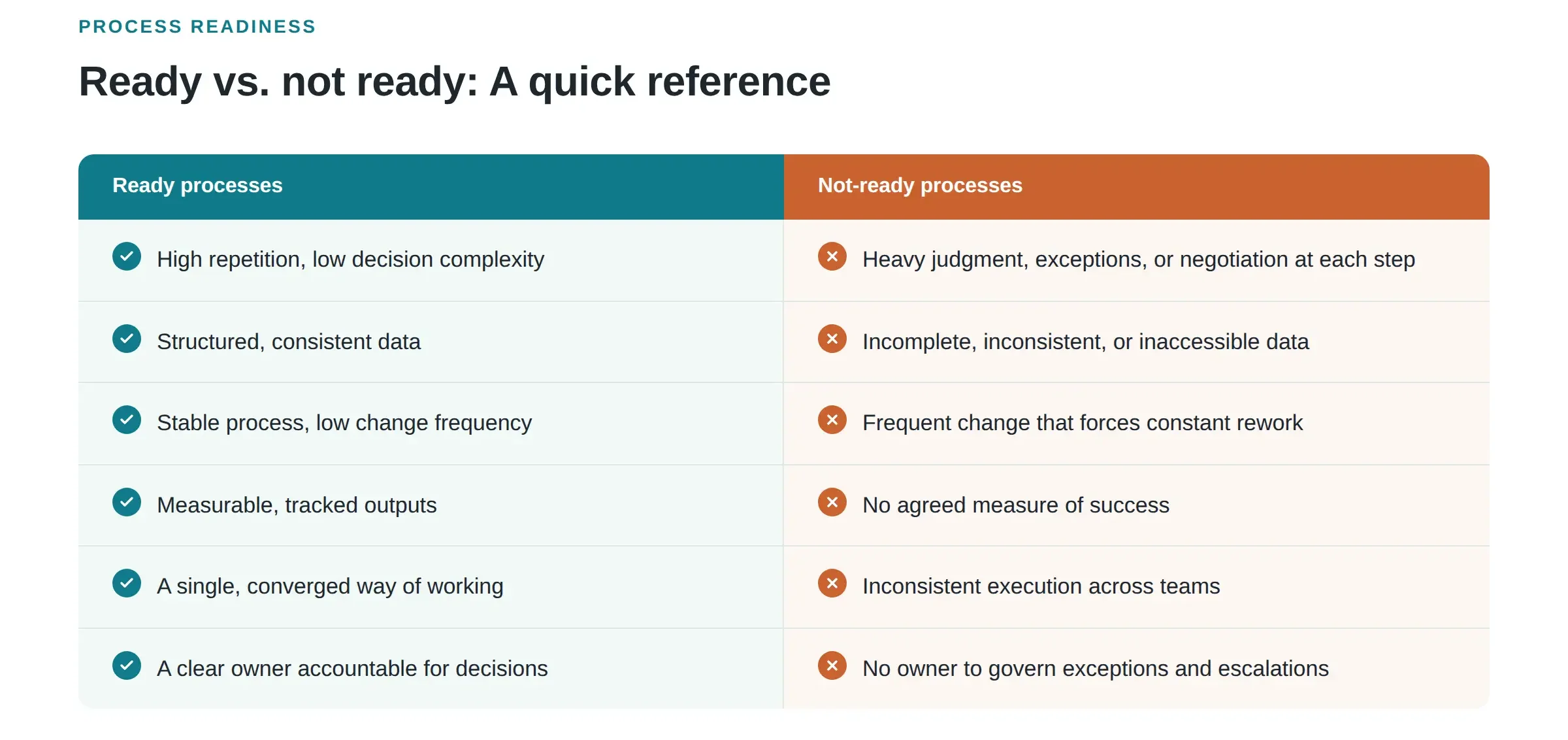
Inconsistent Execution Across Teams
When the same process runs differently across teams, there is nothing consistent to automate. Pointing automation at it means picking one team’s version and quietly overriding all the others. What follows is not automation, it is standardization by force, and that usually only becomes visible after the project is already funded and running. A process has to converge on a single way of working before there is anything coherent for AI to take over. Process Standardization comes before Process Automation, not after it.
In ADONIS Process Mining Essentials (PME): Variant analysis makes divergence between teams visible, turning “we think execution differs” into a documented set of variants you can compare. That comparison is what tells you whether a process is one process or several competing versions wearing the same name.
Processes That Change Too Frequently
A high rate of change means any automation built on the process will need constant rework to stay accurate. The instinct is to automate first and adjust later, but in a volatile process that adjustment never ends. Mapping the rate of change, not just the current shape, tells you whether an automation will hold or whether it will need rebuilding before it has earned its cost back.
Poor Data Quality or Availability
AI can only be as good as the data the process feeds it. A process that produces incomplete, inconsistent, or inaccessible data does not just limit what AI can do, it makes the output unpredictable in ways that are hard to detect until something goes wrong. This is where timing matters: data gaps that surface on a process model before any build starts are cheap to find and straightforward to fix. The same gaps found after deployment are expensive, disruptive, and take far longer to unwind than anyone expects.
Processes Without a Clear Owner
A process with no clear owner has no one to govern what the AI does once it is running. Decisions about exceptions, escalations, and acceptable behavior need a person accountable for them, and an unowned process leaves that authority vacant. Ownership has to be established and explicit before any automation is committed to, not assigned retroactively once something goes wrong. For agentic AI the stakes are higher still, because systems that act autonomously compound the consequences of unclear ownership faster than traditional automation does.
Hint: For a closer look at what that requires, see our blog on agentic AI implementation.
How to Turn Process Maps Into a Prioritized AI Roadmap
A set of qualified and disqualified processes is not yet a roadmap. The value of mapping comes from turning those judgments into a defensible sequence, so the work can move from a wish-list to a plan that holds up under scrutiny.
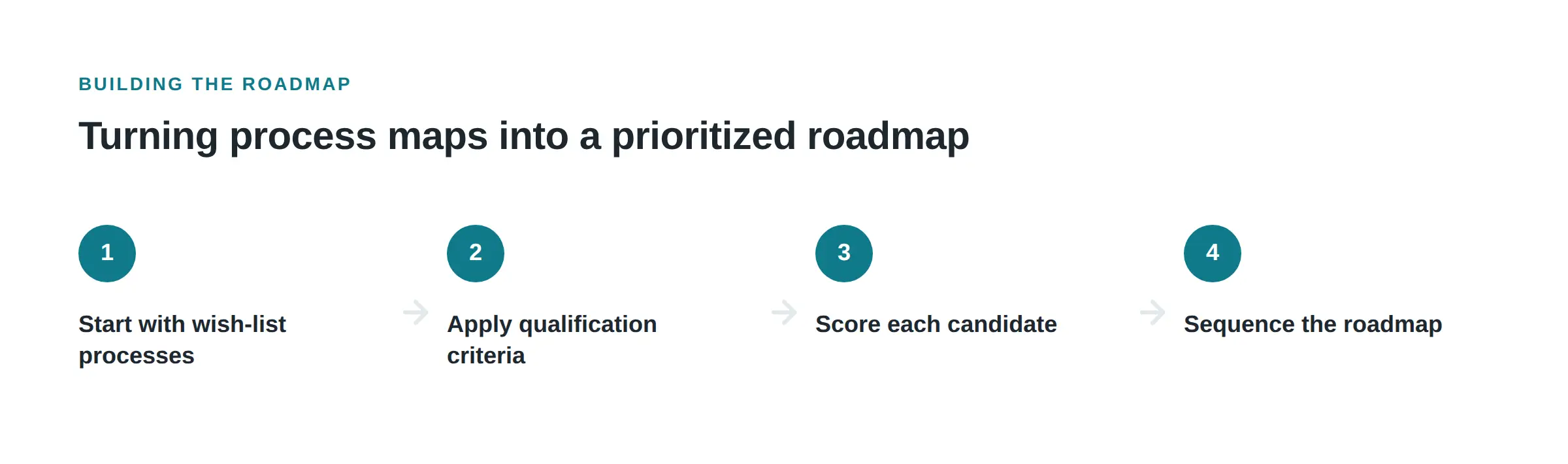
A workable approach runs in a consistent order:
- Start with the processes that appear most often on the organization’s AI wish-list, since these carry the most expectation and the most risk of being chosen for the wrong reasons.
- Apply the qualification and disqualification criteria to every candidate the same way, so the comparison is fair rather than favorable to whoever proposed it.
- Score each candidate across impact, standardization, stability, and data quality, which makes trade-offs explicit instead of intuitive.
- Use the result to sequence initiatives, not merely to approve or reject them, because order of delivery is usually where the real value decisions sit.
Treated this way, the exercise stops being a one-off gate and becomes a standing input to process optimization. When stakeholders push back on the sequencing, the model becomes the evidence base for the conversation. A prioritization grounded in how processes actually run is far harder to override with a louder opinion than one assembled from preferences.
Where Process Mapping Stops
Mapping only helps if the map itself is honest. A model that captures the tidy workshop version, not the messy real path, can mislead a prioritization decision just as confidently as skipping the exercise altogether.
Maps age too, and a process that qualified last year can quietly drift out of shape. The candidate list needs revisiting on a regular cycle, not mapped once and left untouched.
Process mining narrows that gap between design and reality, but only for processes that already generate event data, and plenty don’t.
Mapping reduces the guesswork without eliminating it, and it makes the uncertainty that remains something people can actually see and argue about.
Where Organizations Typically Find the Highest-Value Candidates
Across most organizations, the strongest candidates cluster in a few recognizable places. They are worth knowing, because they give a mapping effort somewhere concrete to start.
- High-volume transactional processes with structured inputs and outputs, such as supplier invoice matching in accounts payable or order confirmation in order-to-cash, where the same operation repeats thousands of times against consistent data.
- Processes with frequent exceptions that follow recognizable patterns, such as insurance claims triage or returns handling in retail, where most exceptions are not truly unique and can be classified before a person ever sees them.
- Cross-functional handoffs where delay and rework are measurable, such as the credit check between sales and finance, or the handover from order entry to fulfillment, where time lost between roles is easy to quantify and hard to defend.
- Compliance and monitoring processes, such as transaction screening in financial services or document checks in onboarding, where AI can flag anomalies for review faster and more consistently than manual sampling.
What these have in common is not the technology but the fact that each one is repetitive, measurable, and grounded in data the process already produces, which is exactly what mapping is designed to reveal.
Using ADONIS to Model, Evaluate, and Prioritize AI and Automation Candidates
Doing this consistently across a portfolio of processes is hard to sustain on documents and spreadsheets. It needs an environment where the models, the criteria, and the evidence live in one place. This is where a dedicated Business Process Management (BPM) platform supports the work rather than adding to it, and where ADONIS addresses exactly that problem.
Structured process maps and models give the qualification and disqualification criteria something concrete to evaluate against, so suitability becomes an assessment rather than a debate. Process mining closes the gap between how a process is designed and how it actually runs, which is exactly where automation business cases most often quietly break. Variant analysis makes the inconsistency between teams visible, surfacing the cases where execution differs enough that a process is not ready to automate yet.
The three work in sequence: modeling creates the foundation for assessment, process mining validates whether the model reflects how the process actually runs in practice, and variant analysis surfaces where that foundation is not yet solid enough to automate. Taken together, the output is a ranked, evidence-based candidate list rather than a wish-list that reshuffles every time leadership changes its mind.
Your First Steps Toward a Process-Based AI Prioritization Approach
Getting started does not require launching a transformation program. It requires putting process evidence at the center of the prioritization decision, and doing that consistently every time.
- Take the processes your organization most wants to automate and map them before any budget is committed, so the decision rests on what the maps show rather than on enthusiasm.
- Apply disqualification as rigorously as qualification, and treat a clearly ruled-out process as a useful result, not a failure.
- Treat process mapping as the foundation of the business case, not a parallel workstream that runs alongside it and gets forgotten.
- Review and update the candidate list regularly. Processes mature, AI capabilities expand, and what fails the criteria today may qualify sooner than expected.
This discipline matters even more as AI moves from isolated pilots toward agents that act on their own, because the cost of betting on the wrong process grows with every degree of autonomy you give it. The organizations that get the most from AI are the ones that can say, with evidence, which processes are ready and which are not. AI prioritization done well is less a matter of ambition than of knowing your processes well enough to bet on the right ones.




Already got our weekly updates?