Enterprise ArchitEcture

Found this helpful? Share it with peers.
Why Most EA Repositories Fail
Most EA repositories end up as documentation tools. That’s not worthless, but it’s not enough. A well-organized collection of diagrams and objects won’t get used if it doesn’t help people understand how the organization actually works.
The problem is usually missing connections. System software supports applications. Those applications are used by specific departments to enable certain capabilities. Those capabilities exist to help the organization achieve its goals. When the repository doesn’t reflect these relationships, it becomes an archive — somewhere people store things, not somewhere they go to understand anything.
People need to be able to start from a business goal and trace how capabilities, applications, and technologies contribute to it — a core principle of enterprise architecture. That requires the repository to make sense at a higher level, not just catalogue what exists.
It also needs to stay current. Organizations change, priorities shift, and a repository that doesn’t keep up loses credibility fast. Without clear ownership over who maintains what, information becomes patchy and unreliable, and once people stop trusting it, they stop using it.
What an Effective EA Repository Should Achieve
An EA repository is not a storage system. It should be the central reference point for your portfolio — a key enabler of EA in business transformation — something stakeholders actually consult when they need to understand how strategy, capabilities, applications, and technology fit together.
That means being able to answer practical questions:
- Which applications support a specific capability?
- What happens if a system is replaced?
- Which goals are affected by a change in a certain process?
Another important goal is transparency. Different stakeholders look at the organization from different perspectives. Since no perspective is necessarily more important than the other, your repository should provide views tailored to different stakeholders' needs. Executives may focus on goals and capabilities, while IT teams will probably be interested in applications and infrastructure. A well-structured repository connects these perspectives instead of treating them as separate worlds.
Keep the Repository Structured
As the organization changes, so does the architecture landscape. Applications get retired, goals shift, and new initiatives appear. Those changes need to show up in the repository, and without structure in place, things get messy very quickly. New elements are added, old ones become irrelevant, and relationships between them need to be updated.
At the same time, structure is not just about keeping things tidy — it also helps people find their way through the repository. Different stakeholders come with different entry points: some are interested in strategy and goals, others in data, applications, or technology. A well-structured repository makes these perspectives visible and easy to navigate, allowing users to start from what matters most to them. From there, the relationships between layers should remain transparent, so users can follow how strategy connects to capabilities, applications, and underlying technology when they need to.
That’s why it is extremely important to keep your repository structured. This doesn’t imply a particular structure. But it does imply one you will stick to.
Structuring Objects and Their Relationships
Individual elements like applications, capabilities, or technologies — including those captured in a data catalogue — have limited value on their own. What makes a repository genuinely useful is how those elements are connected:
- Capabilities linked to the goals they support
- Applications mapped to the capabilities they enable
- Technologies tied to the applications they run on
This lets users move between high-level strategy and technical detail without losing the thread. It also makes impact analysis more practical. When something changes, you can trace what else is affected, and that’s what separates a repository that informs decisions from one that just records them.
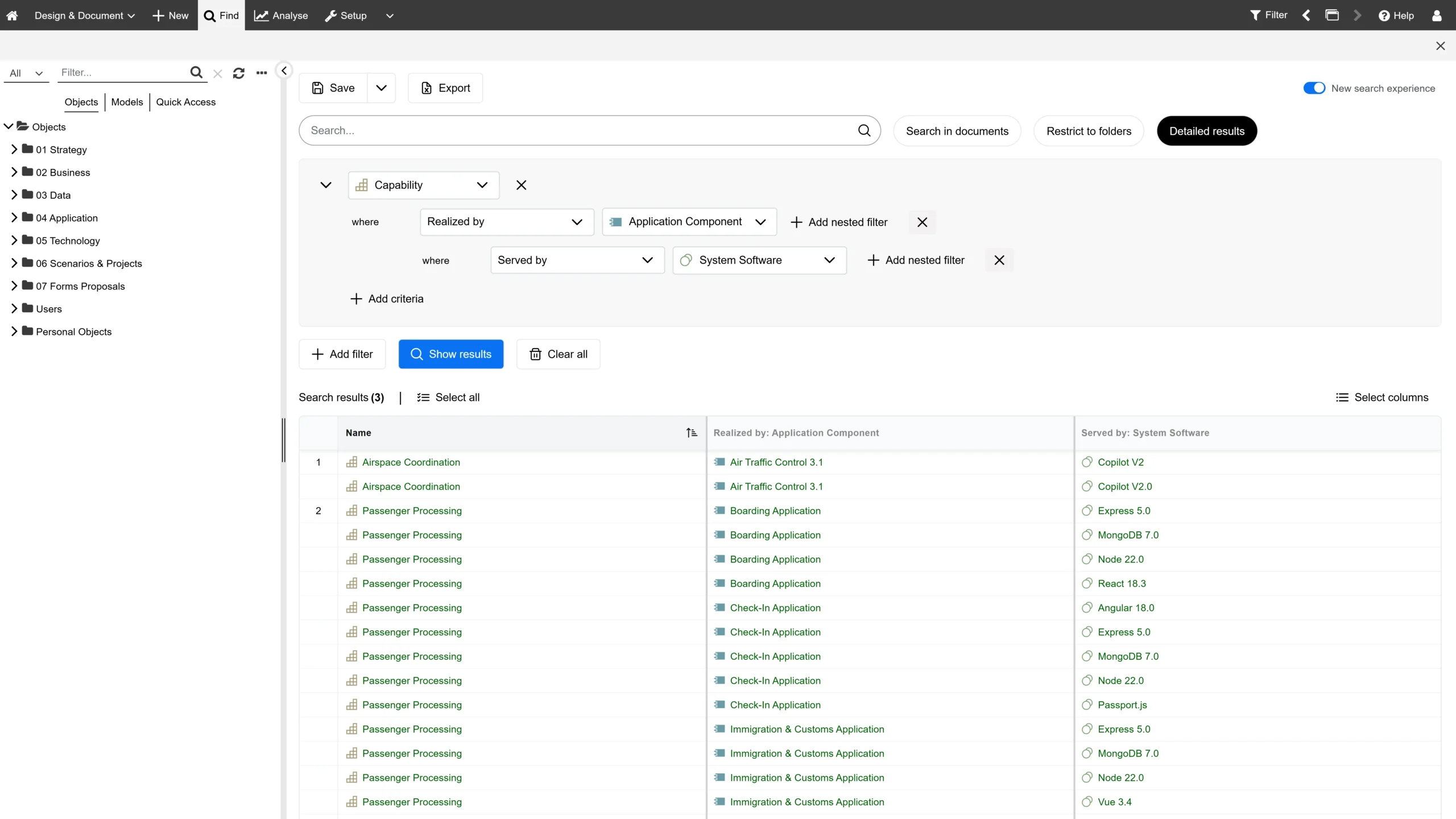
Example of a structured repository in ADOIT
Assigning Clear Ownership and Governance
More people contributing to the repository is a good thing, but broader participation needs clear ownership behind it. Without it, things get inconsistent fast. Different domains, like business capabilities, applications, and technology components, should each have someone responsible for keeping them accurate.
This doesn’t mean centralizing all updates within the architecture team. Instead, responsibility should be distributed to the people who know the domains best, with the EA team providing guidance and governance. This ensures that information stays accurate and up to date while still following consistent standards.
Governance also plays a key role in defining how changes are introduced. When new applications are added or existing ones are modified, the repository should be updated as part of the process rather than as an afterthought.
Hint: See how Workspaces in ADOIT democratize EA collaboration in our free webinar.
Keeping the Repository Relevant Over Time
The repository needs to evolve alongside the organization. Capabilities change, strategies shift, and a picture that was accurate six months ago may already be misleading. Regular reviews keep outdated elements from accumulating and make sure new developments get reflected before they become gaps.
People use tools they trust, and that trust comes from the repository consistently reflecting reality.
Driving Adoption Across Stakeholders
A repository is only valuable if people actually use it. To achieve this, it has be understandable and accessible to different stakeholder groups. Overly technical views may discourage business users, while overly abstract views might not help IT teams.
The good news is that tailored perspectives can coexist in one repository. Executives navigate capability maps linked to strategic goals, architects drill into application dependencies, and neither has to compromise.
Usage also strongly depends on visibility. When people see the repository informing a real decision or surfacing a dependency nobody had noticed, they start to see the point of it. That’s what turns occasional users into regular ones.

From Static Documentation to Decision Support
The question a useful repository answers is not "what do we have?" but "what should we change and why?" — the same question that drives effective Application Portfolio Management.
That requires focusing on relevance over completeness. Key relationships and dependencies need to be clear and current; every minor detail does not.
This is exactly what makes the difference between a repository people ignore and one they actually use. When stakeholders can use the repository to understand the consequences of a change before committing to it, it becomes part of how decisions get made rather than a record of decisions already taken. People will naturally turn to it when they need to run analyses, assess impacts, or prepare decisions because they know it helps them understand the bigger picture and make more informed choices.
Final Thoughts
Building a repository people actually use comes down to one thing: making it worth their time. That means keeping it connected, current, and accessible to more than just the architecture team.
Most repositories start well and gradually drift. Maintenance gets deprioritized, ownership becomes unclear, and at some point the repository stops reflecting how the organization actually works.
That’s where the right tooling makes a real difference. ADOIT is built to support exactly this kind of practice — structured object relationships, clear ownership, governance workflows, and views tailored to different stakeholder groups. It doesn’t replace the organizational discipline required, but it makes that discipline considerably easier to sustain at scale.





Already got our weekly updates?