Enterprise ArchitEcture

Found this helpful? Share it with peers.

Roles and responsibilities in Application Portfolio Management
Effective Application Portfolio Management requires clearly defined roles and responsibilities. Without ownership, portfolio information becomes outdated, decisions lose consistency, and architectural governance breaks down.
Within Enterprise Architecture, the following roles are central to decision-oriented APM:
Enterprise architect
Owns the overall structure and governance of the application portfolio. This role defines evaluation criteria, ensures consistency across domains, and uses portfolio insights to support enterprise-wide decisions and transformation initiatives.
Business unit architects
Contributes application and capability-level insights within a specific domain or business area. Business Unit Architects help contextualize portfolio decisions and ensure alignment between enterprise standards and local requirements.
Application owners
Is accountable for the lifecycle, quality, and performance of individual applications. Application Owners provide essential input on costs, risks, technical fitness, and future plans, enabling informed portfolio evaluations.
IT Operations and Technical Stakeholders
Support the portfolio with technical data related to infrastructure, integrations, stability, and operational constraints. Their input is critical for assessing feasibility and risk.
CIO / CDO
Act as key decision-makers and consumers of portfolio insights. They use APM results to prioritize investments, approve transformation initiatives, and balance innovation with operational stability.
Clear role definition ensures that application portfolio decisions are based on reliable data, shared accountability, and transparent governance. It also enables Enterprise Architecture to function as a coordination layer between business strategy and IT execution.
Application Portfolio Management Process: Key Steps Explained
APM can be described as a cyclical procedure model that can be roughly divided into four steps. The steps do not necessarily have to be processed in the order suggested here. In some cases, they also run in parallel:
Record
In the first step, applications must be recorded with the most necessary properties. Here, it is recommended to limit the amount of information to the most essential attributes. Less is more! To capture the applications, an enterprise architecture tool such as our leading enterprise architecture suite ADOIT can be used.
Evaluate
Afterwards, the applications can be evaluated. Here, the criteria to be assessed, such as business or IT fitness, must be defined. The evaluation itself can then be done with the help of questionnaires. The result of this is an application’s investment strategy. If you would like to read more on the topic of APM investment strategy or application portfolio assessment, we recommend reading our related blog posts.
Identify
Based on this assessment and the defined investment strategy, improvement potentials can be identified and analyzed.
Derive measures
Last but not least, concrete measures can be derived based on the insights from previous steps.
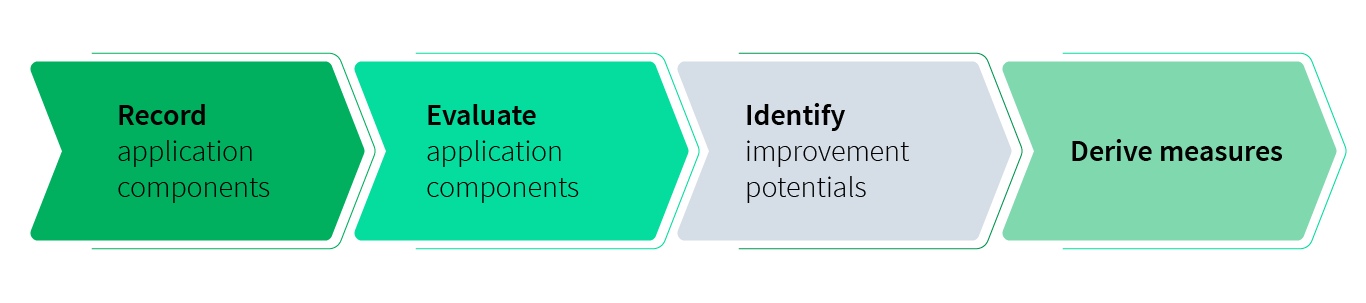
Cyclic APM Procedure Model
Just a few years ago, a common recommendation was to perform annual APM cycles. Today, this no longer seems fitting. In particular, innovative applications, which are characterized by short development cycles so that companies can react quickly to changing market needs, would not even be considered in APM. It is therefore advisable to understand APM as a continuous process, which can have an impact on the investment strategy of the application portfolio.
Key inputs are existing documentation on applications, e.g. in the form of tables, application manuals (text document) or in an EA tool. Key results are the evaluated applications, identified weaknesses and optimization potentials, and the resulting requirements and measures. These in turn trigger transformation projects or are taken into account in ongoing transformation projects.
Application roadmaps: planning change across the application landscape
Application roadmaps translate portfolio decisions into a clear, time-based view of how the application landscape evolves. They show when applications are invested in, modernized, replaced, or retired—and how these changes align with transformation initiatives.
In ADOIT, application roadmaps make these decisions visible across the enterprise. Lifecycle states and investment strategies are directly reflected in the roadmap, allowing Enterprise Architects to understand when change happens, not just what should change.
This enables organizations to:
-
align application changes with business initiatives,
-
identify overlaps or conflicts in transformation planning,
-
and communicate future states clearly to stakeholders.
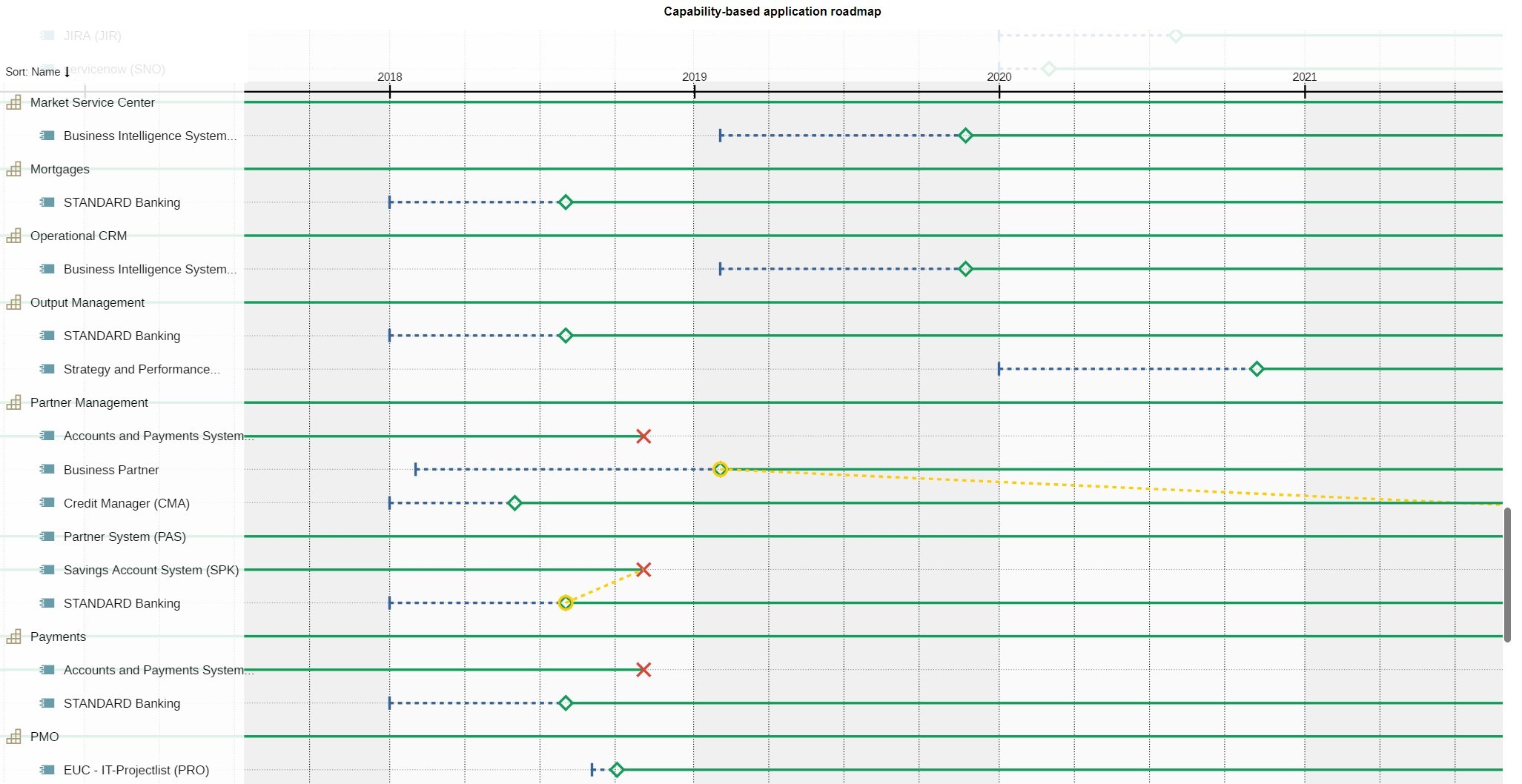
Example: Application roadmap in ADOIT illustrating lifecycle changes and planned transformations across the application portfolio.
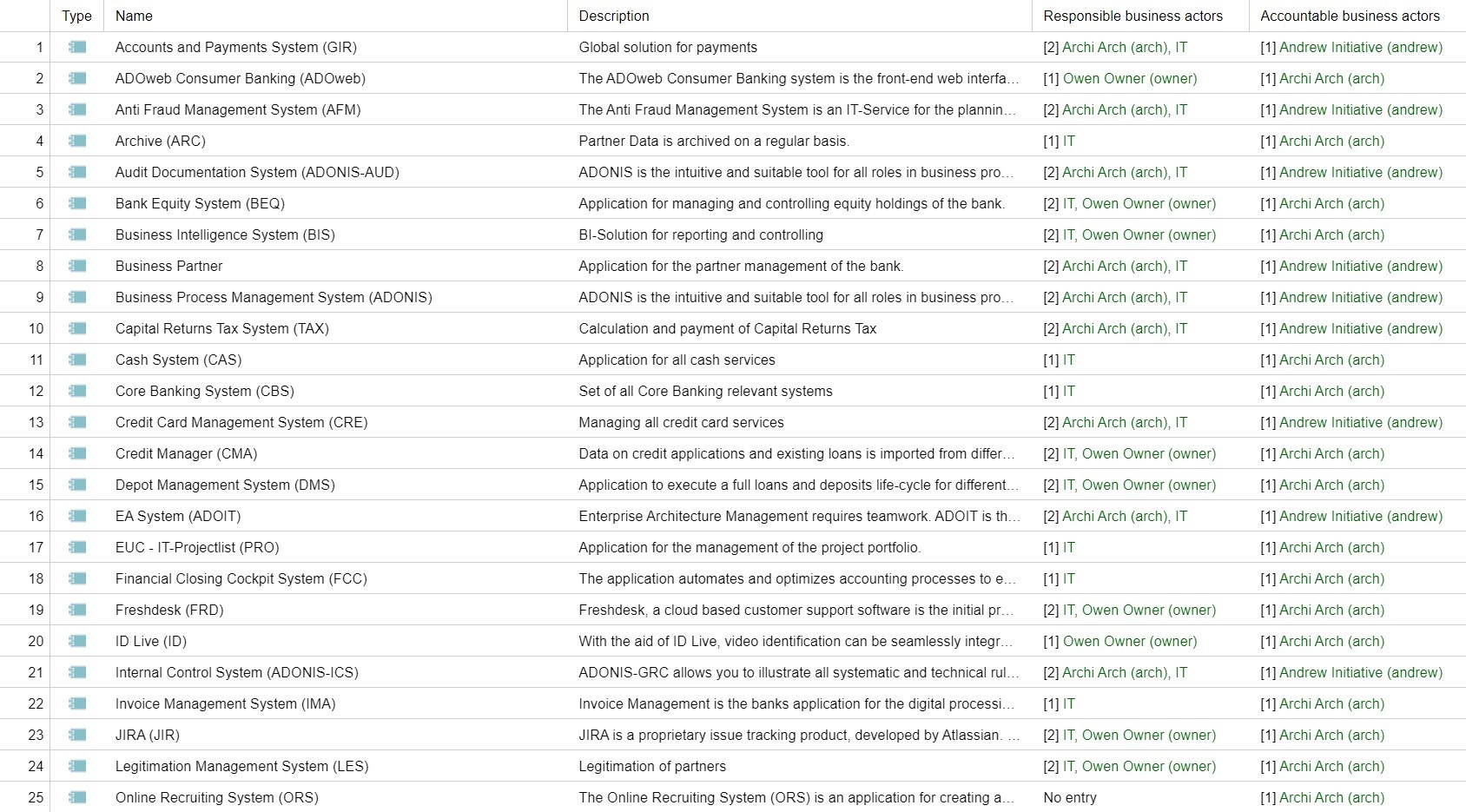
Example of an application portfolio in the EA suite ADOIT
Cluster maps and dependency views: understanding portfolio complexity
As application landscapes grow, complexity increasingly arises from dependencies rather than from individual systems. Cluster maps and dependency views help make these relationships visible and manageable at an enterprise level.
Cluster maps group applications based on evaluation criteria such as business value, risk, or technical fitness. This makes structural patterns, redundancies, and concentrations immediately visible across the portfolio—highlighting where action is needed.
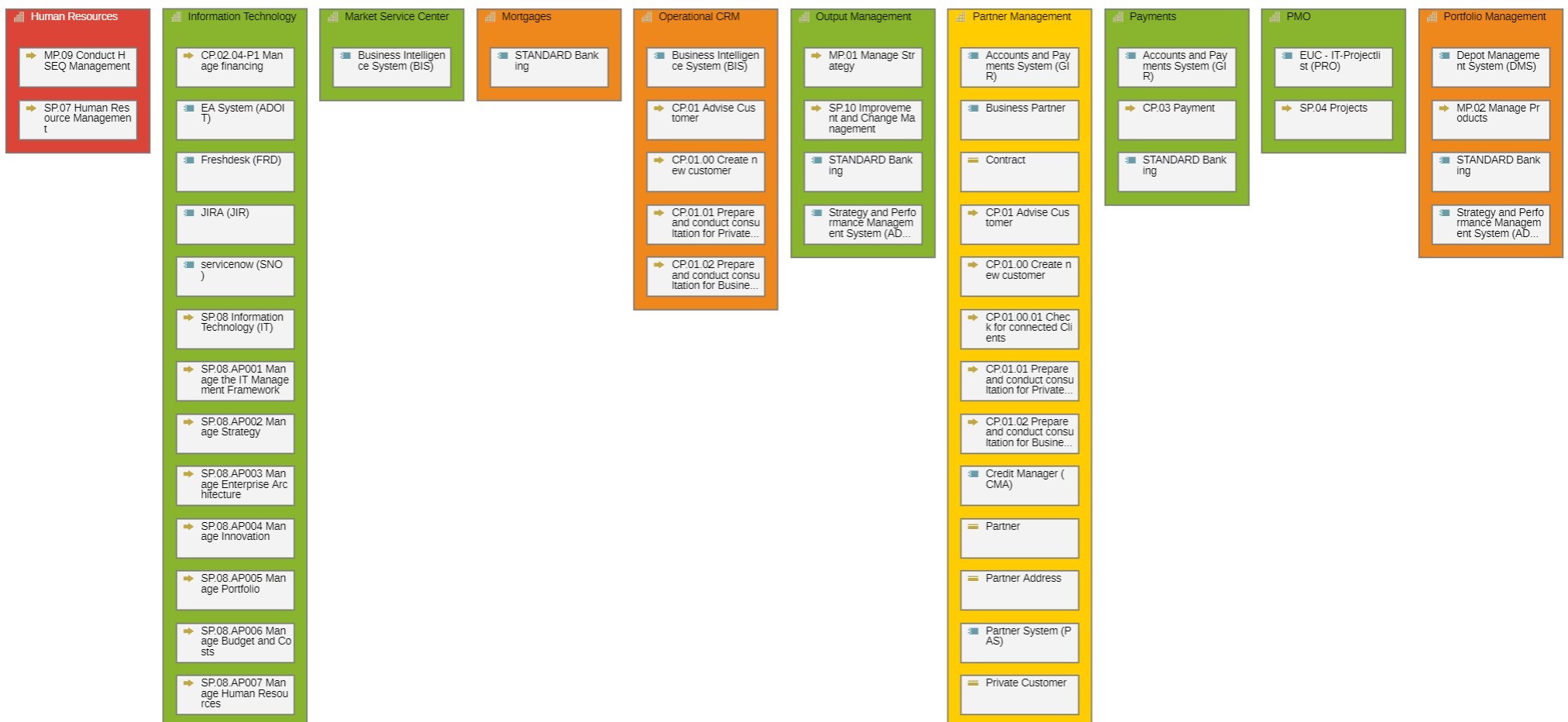
Example of a cluster map in the EA suite ADOIT
Dependency views complement this perspective by showing how applications interact with business capabilities, processes, data, and underlying technologies. They help Enterprise Architects understand the downstream impact of change and assess architectural risk.
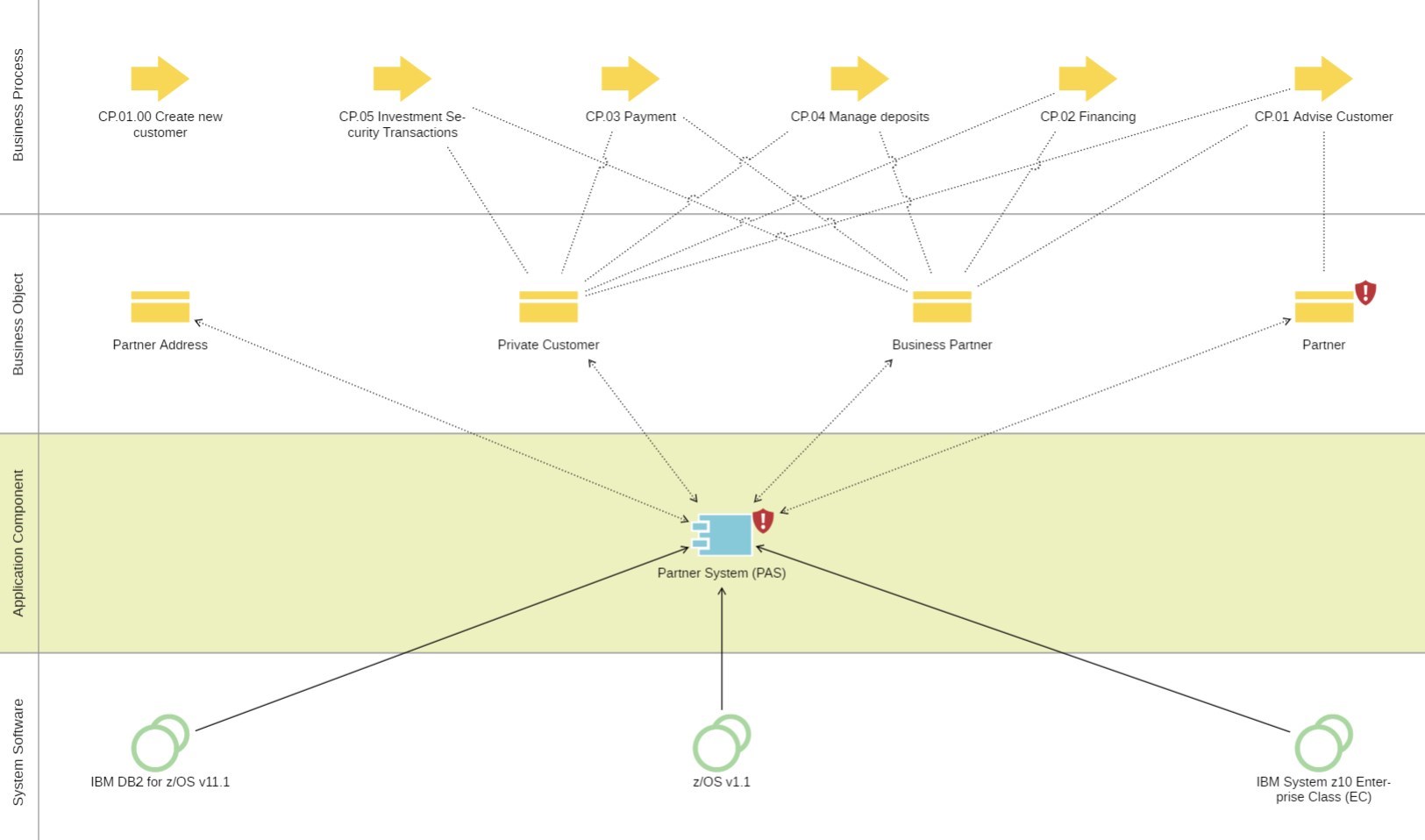
Example of a dependency diagram in the EA suite ADOIT
Summary
Application Portfolio Management is a core decision-making discipline within Enterprise Architecture. When applied consistently, it enables organizations to understand their application landscape, assess trade-offs transparently, and align application-level decisions with long-term business and transformation goals.
By combining structured evaluations, clear investment strategies, and architecture-level views such as roadmaps and dependency maps, APM turns fragmented application data into decision-ready insights. This allows Enterprise Architects and IT leaders to move from reactive application management to proactive, strategically guided change.
Most importantly, Application Portfolio Management is not a one-time initiative. As business priorities, technologies, and risks evolve, the application portfolio must evolve with them. Treating APM as a continuous, architecture-driven practice ensures that decisions remain traceable, coherent, and aligned with the digital twin of the organization over time.
To deepen your understanding of APM, explore our free Application portfolio management e-Learning, or apply these concepts directly using our free Enterprise architecture tool to assess your application landscape and define your investment strategy.





Already got our weekly updates?