Enterprise ArchitEcture

Found this helpful? Share it with peers.
Why Strategic Planning Feels So Complex
Most organizations don’t struggle with strategy because they lack ideas. They struggle because everything around those ideas has become harder to align.
Today’s planning environment is dense. Capabilities depend on applications, applications depend on data, and processes cut across everything. On top of that, external pressures keep shifting – regulatory requirements, technological change, competitive dynamics. Even when all of this is documented, it rarely comes together in a way that is easy to act on.
You open your architecture repository, your process models, your roadmaps, and the information is there. But turning that information into a clear, confident decision is still surprisingly difficult.
Because strategic planning today is less about finding answers and more about connecting the right pieces at the right time. That means aligning perspectives, validating assumptions, tracing impacts, and often revisiting the same questions from different angles.
In practice, a lot of time is spent simply reaching a shared understanding before decisions can even begin. The real bottleneck isn’t data. It’s clarity.
What If You Didn’t Have To Do It Alone
This is where a meaningful shift is starting to emerge. Not through more dashboards or more reports, but through something fundamentally different: AI that doesn’t just present information, but actively helps you think through it.
Until now, most tools have supported planning in fragments – leaving you to piece everything together yourself.
Instead of treating AI as a feature that speeds up isolated tasks, organizations are beginning to explore a new role for it, one where it participates in the planning process itself.
From Tools To AI Agents
For a long time, enterprise architecture tools have followed a clear pattern: you interact with them, and they respond. You search for information, build models, run analyses, and interpret the results. They are powerful, but the responsibility for connecting everything – understanding relationships, evaluating impact, making decisions – remains entirely with you.
What’s changing now is not just what these systems contain, but how they behave. Instead of waiting for input, they can actively engage with context, exploring relationships, surfacing what matters, and helping structure the problem before you begin to solve it.
In that shift, AI is no longer just a capability inside a tool. It becomes part of the process itself, not replacing human judgment, but extending it.
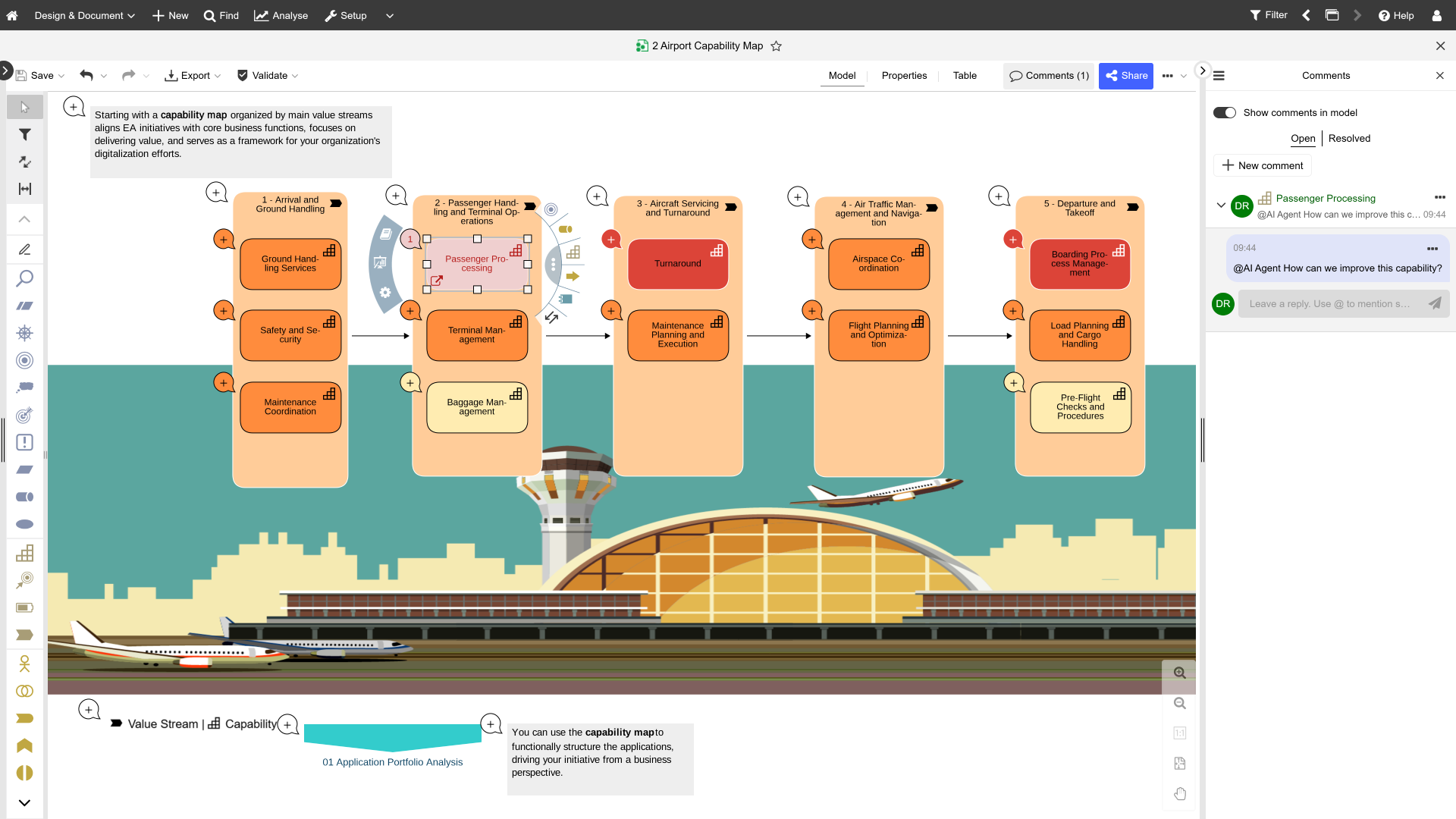
ADOIT AI: Get tailored guidance for improving selected capabilities – click on the image to explore more.
How It Works In Practice
To understand the impact, it helps to step away from theory and look at how this plays out in a real planning moment. Imagine starting with a simple question: How can we improve this capability?
There’s no predefined workflow, no need to manually navigate through layers of models. You ask the question, and instead of you beginning the analysis, the system does.
It starts by building a picture of how the capability actually works today. It maps the processes that support it, the applications involved, the data that flows through them, and the relationships that connect everything. What you get is not a list of elements, but a structured view of how things fit together.
From there, the focus shifts. Not everything is equally relevant for every decision, and this is where a lot of planning effort is typically lost. The AI evaluates strategic drivers, constraints, and performance signals, but instead of surfacing everything, it narrows the view to what actually matters in this context. Only then does it start to look ahead.
Drawing on structured approaches such as PESTLE or system dynamics, it outlines a set of plausible futures. These are not predictions, but ways of making uncertainty tangible – highlighting where external forces, risks, or opportunities could influence the capability.
And finally, those scenarios are translated into concrete requirements for how this capability needs to evolve. What needs to change? What should the organization start preparing for?
These suggestions are not final answers. They are starting points; something you can react to, challenge, refine, or discard.
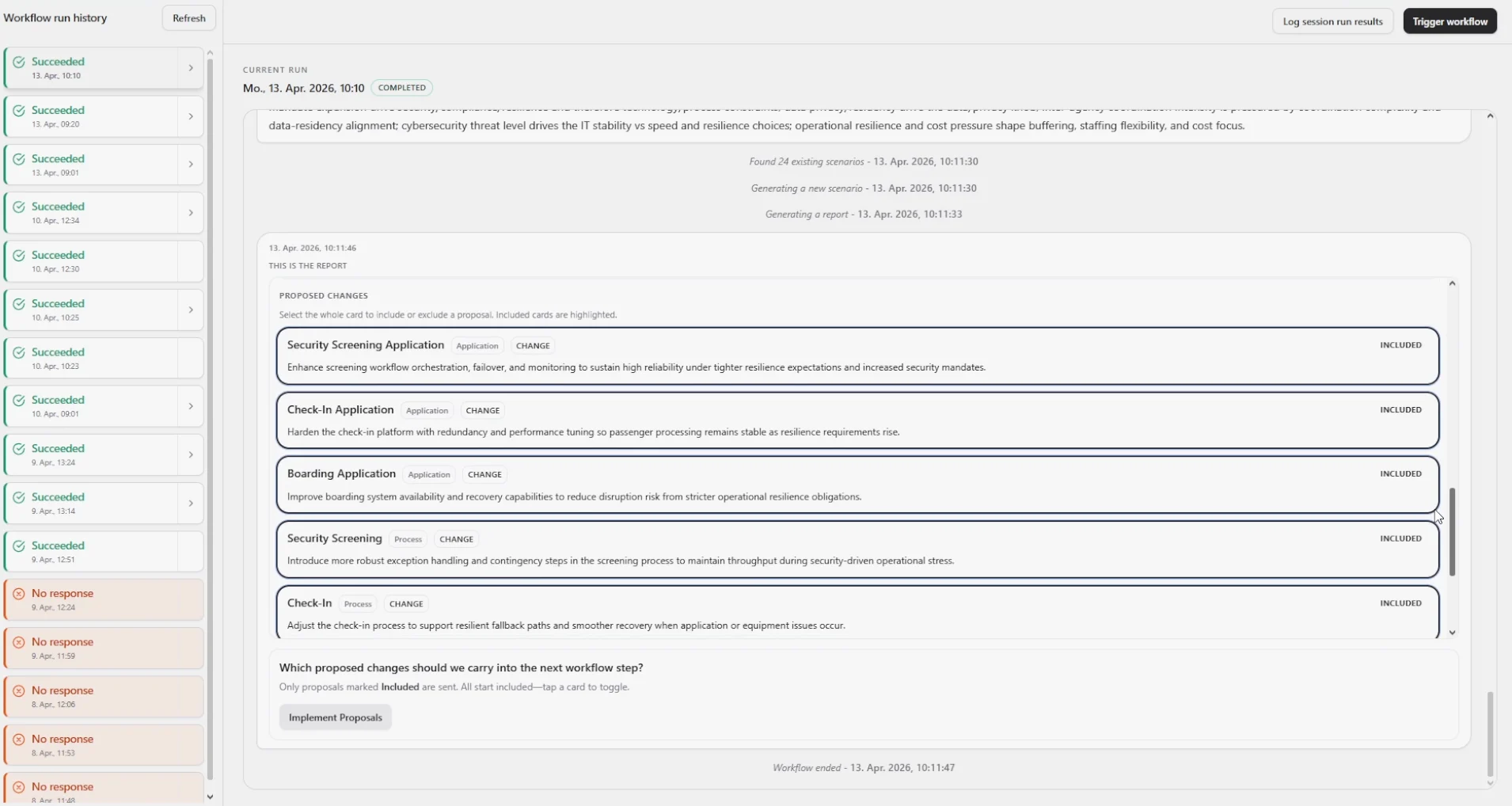
AI-generated next steps to review, select, and implement (future use case)
– click on the image to explore more.
Human Judgment Still Leads
At every stage, people remain in control. What changes is not who decides, but how much effort it takes to get there.
Instead of spending time assembling and validating information, teams can focus more on evaluating options and understanding consequences. The role of human judgment becomes sharper, more concentrated, and ultimately more impactful.
Different teams will find different balances. Some will rely more heavily on AI support, others will stay more hands-on. Most will operate somewhere in between.
But the key point remains: the level of autonomy is determined by trust, and that stays firmly in human hands.
From Discussion To Testable Change
One of the biggest limitations of traditional strategic planning is that decisions often remain abstract. They live in presentations, documents, or meeting notes, but are not always connected back to the system they are meant to change.
This is where the integration into a digital twin of the enterprise architecture becomes powerful.
Scenarios, requirements, and proposed changes are not just described – they are reflected in a living model of the organization. From there, you can start exploring how those changes would actually play out.
What happens if a key application is replaced? How do dependent processes react? Where do bottlenecks appear, and where do they disappear?
Instead of reasoning in isolation, you are reasoning within the system itself.
Why This Shift Matters
This is not simply about making planning faster. It changes the nature of the work.
The core challenge of strategic planning has always been understanding relationships, anticipating consequences, and aligning decisions across a complex environment. AI does not remove that complexity, but it makes it more navigable.
As a result, planning becomes less about working through static phases and more about continuous exploration and refinement. Instead of moving from analysis to decision to documentation, teams can iterate, adjust, and evolve their thinking in a more fluid way.
Rethinking Strategic Planning
If you zoom out, the change is not just technological – it is conceptual.
We are moving away from static plans toward living models. Away from manual analysis toward guided exploration. And away from isolated tools toward systems that actively participate in the process.
Perhaps most importantly, we are moving from planning alone to planning with intelligence that helps us see the system more clearly than we could on our own.
Summary
We often think of AI as something that provides answers. But in strategic planning, its real value may lie in something else entirely: helping us ask better questions, explore more possibilities, and understand the organization as a connected whole.
The result is not just a more efficient process. It is a more capable one, better suited to the complexity that strategic decisions now demand.




Already got our weekly updates?