Enterprise ArchitEcture

Found this helpful? Share it with peers.
In an increasingly connected and threat-exposed IT landscape, Swiss Life, the Swiss insurance company, is tackling a challenge many organizations recognize: too many applications, too little visibility, and as a result, too much risk.
In this article, you will learn how Swiss Life is using a clear methodology, a powerful EA tool, and consistent internal collaboration to reduce complexity and bring it under control.
Starting Point: Too Many Applications, Too Little Visibility
Swiss Life is one of Europe’s leading financial and pension companies, helping private and corporate clients take control of their financial future.
Behind that promise lies a complex IT ecosystem. In Switzerland alone, around 1,000 applications are in use, each carrying its own dependencies, responsibilities, and potential exposure to cyber threats.
“1,000 applications is too many to manage manually. The first step was understanding which ones truly matter and which ones don’t,” says Kreutzberg.
Solution: The Path to Transparency with ADOIT
Joachim Kreutzberg and his team decided to address the problem systematically through enterprise architecture, using the EA suite ADOIT.
“We started by looking at our core processes, the ones essential to the business, and derived from there which applications were truly necessary. This allowed us to reduce the number of applications from over 1,000 to under 100. Everything is traceable, transparent, and justified,” explains Kreutzberg.

From Sprawl to Structure
Instead of mapping their IT landscape in Excel spreadsheets and PowerPoint, Swiss Life now models it in ADOIT, bringing processes, applications, and risks together in a single central model. This created a clear picture of the IT landscape:
- Which systems are business-critical?
- Where do dependencies and risks exist?
Swiss Life defined six application classes ranging from cloud solutions to specialized applications. Within these classes, risks could be assessed in a targeted way and remediation measures derived.

Dr. Joachim Kreutzberg
Head of Enterprise Architecture
Swiss Life
A Common Language Between Business and IT
In parallel, a shared domain and data model was developed, establishing for the first time a common language between business units and IT. This enabled traceable relationships between business objects, processes, and applications, replacing ad hoc representations. The methodological clarity this brought became a catalyst for structured thinking and decision-making.
“ADOIT surfaced gaps and overlaps that had previously gone unnoticed,” says Kreutzberg.
Results and Achievements: From Complexity to Clarity
For Swiss Life, the impact was clearly felt across three areas: measurable cyber resilience, tangible governance, and more transparent collaboration.
“We were finally able to address cyber resilience systematically,” says Kreutzberg. “The enterprise architecture information that ADOIT provides allowed us to structure the problem in a traceable way and solve it step by step.“
1. Transparency as a Security Enabler
By classifying the application landscape, Swiss Life was able to clearly identify for the first time which systems are business-critical and which are not. The result:
- Clear priorities for security measures.
- Better preparedness for cyber incidents.
- Reduced complexity in assessing the landscape.
- Faster response capability when disruptions occur.
This transparency built trust both internally and externally, and shifted risk discussions from gut feeling to data-driven evidence.
“Some applications simply cannot be down for more than two days. Others can wait a month, and now we know exactly which is which,” explains Kreutzberg.
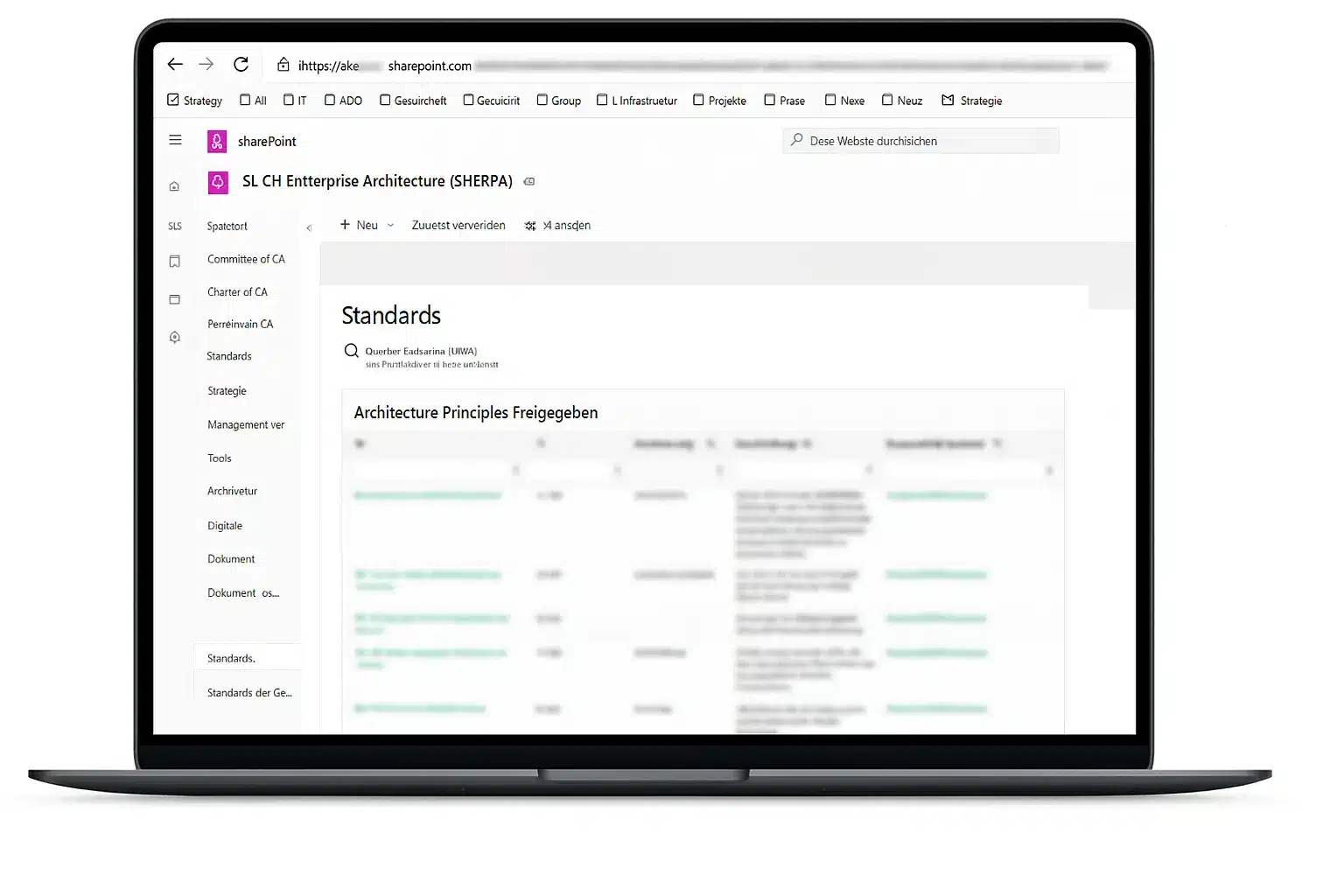
Architecture information integrated into SharePoint
2. Structured Governance for Trusted Information
A further achievement is the establishment of discipline and governance. ADOIT became the authoritative platform on which business and IT collaborate. Business units that previously worked with Excel and PowerPoint now maintain their artifacts directly in ADOIT.
„Working in ADOIT means everyone sees the same diagrams and uses the same terminology,” says Kreutzberg. “That sounds trivial, but it is decisive for truly bringing business and IT together.“
This created a governance mechanism that introduced structure without coercion, ensuring that information remains consistent, current, and trustworthy:
- No more duplicate entries.
- Consistent terminology and definitions.
- Clear accountability.
- Automatic consistency checks enforced by the tool.
Through this consistent governance, architecture information was not only centrally captured but made reliable, and therefore decision-relevant. What were once scattered documents now form a solid knowledge foundation that both management and business units can depend on equally.
3. From Project to Learning Process
Swiss Life recognized early on that introducing ADOIT meant more than implementing a tool; it required a fundamental process of organizational development.
“The tool acts as a catalyst. It helps the organization think and act more consistently. But the real learning happens in people’s minds,” says Kreutzberg.
The project changed ways of thinking. Architecture is no longer viewed as an end in itself, but as a method for governing risk and investment decisions.
4. Democratizing Knowledge
The availability of trusted information is an often underestimated success factor. Kreutzberg and his team understood that enterprise architecture delivers its greatest impact when information is accessible. For this reason, they integrated ADOIT with SharePoint to make architecture knowledge available across the organization.
“Through SharePoint, everyone can find the information they need without having to go into the tool themselves,” says Kreutzberg.
In this way, architecture is no longer experienced as an abstract concept, but as a practical instrument in everyday work.
Looking Ahead: Architecture as a Strategic Steering Instrument
Having gained new transparency across processes, data, and applications, Swiss Life is ready to take the next step. The goal is to systematically connect strategy, business capabilities, and projects within ADOIT.
“Going forward, we want to link our capabilities and project portfolio in ADOIT with our business processes and applications. That way we can see systematically which projects truly contribute to the corporate strategy,” explains Joachim Kreutzberg.
The vision is an architecture that serves as a navigation system for decision-making. Once all elements are connected in ADOIT, Swiss Life will be able to identify:
- which projects strengthen which capabilities,
- where resource conflicts arise, and
- which investments deliver the greatest strategic impact.
In this way, enterprise architecture management evolves from a reactive inventory exercise into an active governance instrument.
Swiss Life also plans to further integrate ADOIT with governance and security tools, gradually building an ecosystem that connects cyber resilience, data management, and business steering on a single consistent information base.
Summary
The Swiss Life journey shows that cyber resilience is about far more than technology. It is a process of understanding: understanding your own IT landscape, the interdependencies within it, and the accountabilities that govern it. With ADOIT, Swiss Life has established a tool that makes this understanding possible, gives it structure, and embeds it in the organization.
“You can’t argue with the tool. Either something fits, or we haven’t modeled it cleanly,” says Joachim Kreutzberg.
Swiss Life has not only streamlined its application landscape but built a culture of architecture discipline. Today, business units and IT work on a shared platform, speak the same language, and make decisions based on valid, consistent data. The result is less complexity, and more control, resilience, and focus.