BUSINESS PROCESS MANAGEMENT

Found this helpful? Share it with peers.
Growing Hype Around Process Mining
Process mining is slowly moving from being a niche capability to a mainstream discussion topic. The pressure of digital transformation pushes leaders to look for tools that provide fast insights into how their organizations actually operate. As companies become increasingly overwhelmed by operational complexity, process mining is often seen as a shortcut to clarity.
The narrative around process mining has gradually shifted from a simple analysis tool to a transformation enabler. However, the mix of hype, optimism, and vague understanding around how process mining actually works creates a gap between what decision makers imagine and what the technology truly delivers.
Framing expectations early helps prevent disappointment later. Understanding what process mining can and cannot do is essential for setting realistic expectations and unlocking its full value.
Setting Realistic Expectations
“See how your processes truly run” is a strong promise. Messaging often suggests complete and objective transparency about operations. On top of that, vendors frequently emphasize real-time visibility, AI insights, and automated process optimization.
This is precisely why expectations should be approached with a degree of caution.
False Expectations
Of course, these capabilities are appealing to many organizations struggling with fragmented systems and unclear ownership. However, they can also create the expectation that process mining will automatically:
-
identify root causes
-
turn insights into improvements
-
fix processes without organizational change or friction
The truth is that case studies often present mining outcomes without showing the real effort behind them. Buyers rarely see the steps required before meaningful insights can emerge: identifying the right business processes, determining which systems contain relevant data, extracting event logs, and preparing them for analysis.
Transparency depends heavily on data quality, coverage, and interpretation. Not all processes leave clean digital footprints, which means visibility is always partial and context-dependent.
Focusing on Wrong Outcomes
There are also problematic patterns in how process mining outcomes are evaluated. Some organizations focus only on efficiency metrics such as cycle time or throughput while ignoring qualitative aspects like customer experience. Others expect a “perfect process model” instead of embracing the variability inherent in real operations.
Deviations revealed through process mining should therefore not automatically be treated as negative outcomes. Instead, they can serve as valuable learning signals that feed into a continuous improvement capability.
Core Value of Process Mining
The core value process mining delivers is evidence-based visibility into process behavior. By revealing patterns and bottlenecks, it supports better questions rather than providing final answers and helps prioritize where deeper investigation is needed.
It does not replace domain expertise. Instead, it provides insights that enable transformation initiatives.
Process mining is also increasingly viewed as a foundational capability for building a Digital Twin of an Organization (DTO). A DTO aims to create a living, data-driven representation of how an organization operates, and process mining contributes by providing evidence of real operational behavior.
Hint: Explore our DTO study to learn more about its potential, benefits, and implementation challenges.
What Process Mining CAN Do
Reconstruct Real Process from System Data
As mentioned earlier, the core capability of process mining is making processes visible and allowing organizations to see how work actually flows across systems. By reconstructing processes from the digital footprints left in IT systems, process mining enables organizations to move from assumptions to actual behavioral data.
This makes it possible to reveal differences between designed processes and how they are executed in reality. Teams can then investigate gaps between documentation and real operations.
Process mining provides an objective, data-backed representation of operational reality and helps reduce bias in decision-making.
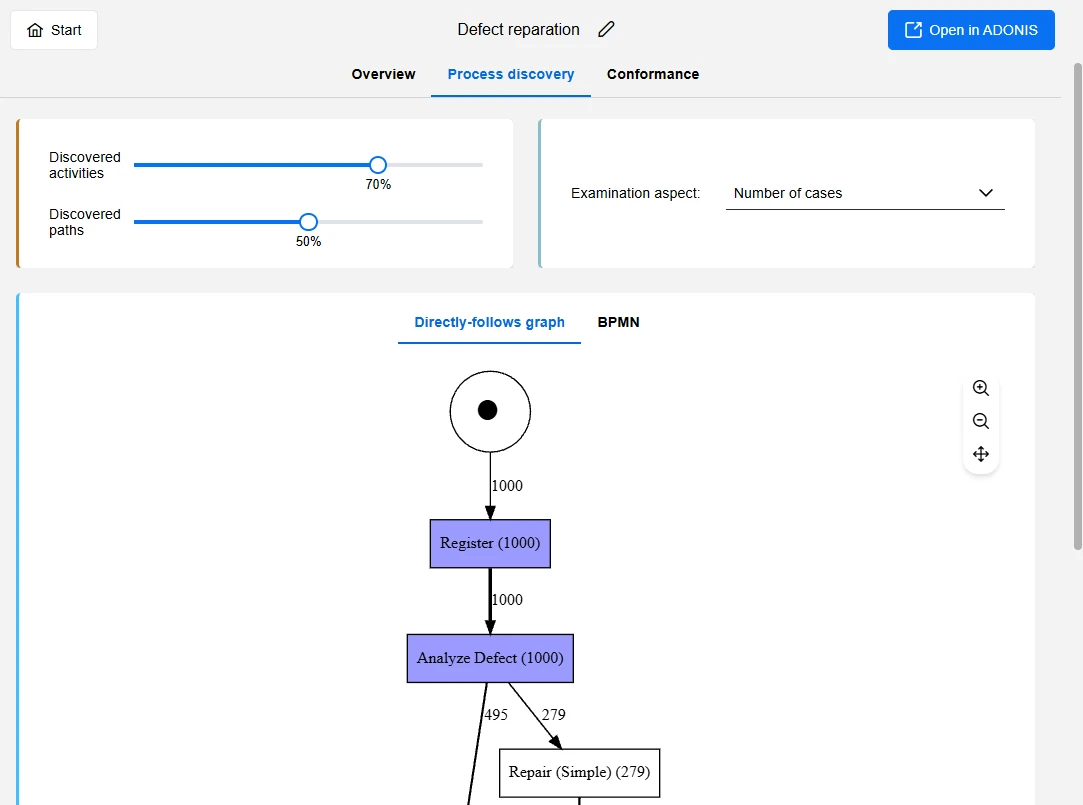
Process discovery in ADONIS Process Mining Essentials
Detect Variants and Hidden Complexity
In practice, processes rarely follow a single execution path. Process mining helps organizations understand the diversity of execution by revealing the different paths that cases actually follow and quantifying how frequently each variant occurs.
This makes it easier to expose unnecessary structural complexity and understand where execution diverges from design, for example through loops, rework, missing steps, or additional tasks.
By enabling comparison of performance metrics across these variants, process mining provides a foundation for deciding which variants should be optimized, standardized, or accepted.
Measure Process Performance Objectively
Process mining provides data-driven performance KPIs based on actual execution data. For example, it enables precise measurement of how long cases take from start to completion and distinguishes between active processing time and waiting time.
This produces more accurate and objective insights than manual estimates and helps organizations understand where time is actually spent within a process.
Process mining can also identify cases that exceed defined thresholds and quantify how often service level agreements (SLAs) are violated. By enabling continuous monitoring of performance trends over time – rather than one-time analyses – it helps organizations move toward continuous improvement practices and more proactive performance management.
Enable Conformance and Compliance Analysis
One of the core capabilities of process mining is conformance checking, which enables systematic comparison between documented process models and real-life execution.
By aligning event data with the designed process flow, organizations can determine whether cases follow the intended sequence of activities and where deviations occur. This makes it possible to distinguish between occasional exceptions and systemic issues that may indicate process weaknesses or control gaps.
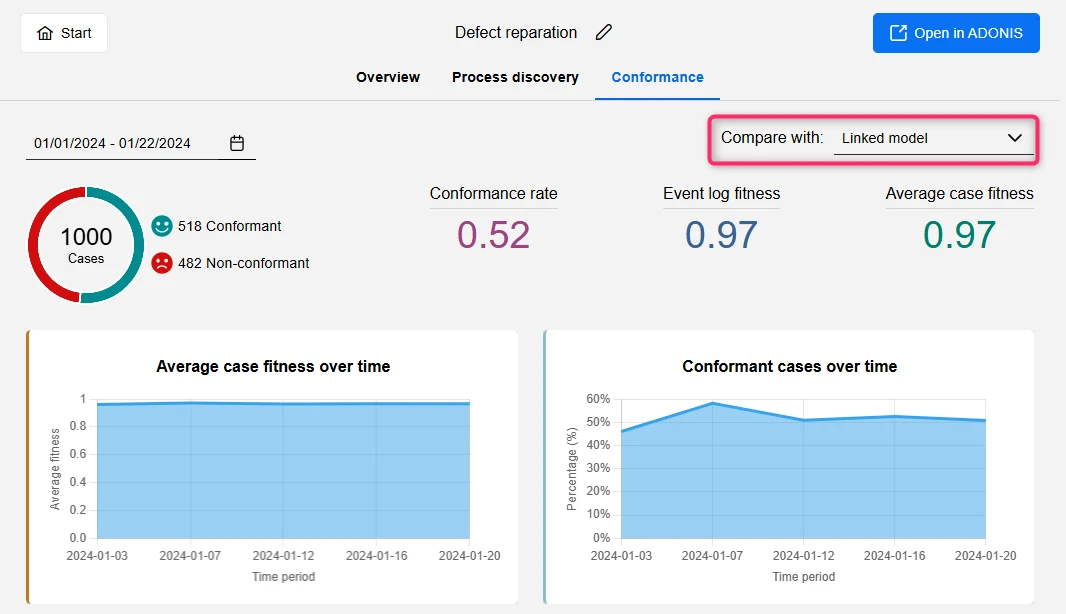
Conformance checking with linked Business Process Diagram in ADONIS PME
Conformance checking can also reveal execution sequences that violate internal policies, regulatory requirements, or business rules. This helps organizations maintain alignment between process design, operational execution, and governance requirements.
Beyond operational insight, conformance checking also strengthens audit and compliance activities by enabling:
-
faster and more efficient audit preparation
-
reduced reliance on manual sampling
-
documented evidence of control effectiveness
-
demonstrable adherence to policies and procedures
ADONIS Process Mining Essentials supports model-based conformance checking by comparing execution data with designed Business Process Diagrams in ADONIS.
Provide Data-Driven Basis for Optimization
Process mining helps identify bottlenecks and operational inefficiencies such as delayed handovers, repeated rework, unnecessary activities, or redundant steps. By quantifying how strongly different issues affect process performance, organizations can prioritize improvement initiatives more objectively and based on measurable impact.
These insights support decisions related to process redesign, standardization, and automation. By highlighting repetitive or rule-based activities, process mining can also help identify candidates for automation.
Once improvements are implemented, process mining can be used again to evaluate whether the expected outcomes were achieved. By comparing performance metrics before and after the changes, organizations can assess whether delays and variability have actually been reduced.
What Process Mining CANNOT Do
It Cannot Automatically Fix Processes
Process mining does not redesign processes by itself. It supports decision-making but does not replace it. Improvement decisions require strategic considerations beyond data patterns, and domain expertise is necessary to interpret findings and propose meaningful changes.
Even smaller redesign initiatives often require cross-functional alignment and stakeholder input. Changes may involve system configuration, policy adjustments, or organizational changes.
This technology ultimately provides direction, not design, and improvement initiatives still require ownership and accountability across the organization.
Emerging AI capabilities may increasingly support improvement analysis – for example by suggesting optimization opportunities or simulating potential scenarios. However, even with AI assistance, decisions about trade-offs, risks, and priorities still require human judgment.
To explore the AI use cases currently supported by ADONIS, visit our ADONIS AI page.
It Cannot Replace Process Ownership or Governance
Process mining tools do not define who owns a process or how improvement initiatives should be governed.
Clear process ownership must exist independently of the technology. Process owners understand the broader business context and coordinate improvement efforts across organizational boundaries, while process mining tools provide data-driven insights but not the full business perspective.
Process mining also does not establish governance models or operating principles. These are defined by organizational frameworks such as BPM governance and lifecycle management practices.
Instead, process mining strengthens these practices by providing objective visibility into how processes actually run.
It Cannot Compensate for Poor Data Quality
Process mining relies entirely on digital footprints captured in IT systems. The quality of insights therefore depends directly on the quality of the underlying data.
If events are missing or incorrectly recorded, the reconstructed process will also be incomplete. Partial or inconsistent event data can make it difficult to reconstruct end-to-end flows and may hide important variants or bottlenecks, or even produce misleading conclusions.
In short, data quality determines the level of confidence organizations can place in the findings.
It Cannot Interpret Strategic Business Context
Process mining analyzes operational behavior, but it does not understand organizational priorities or strategic trade-offs.
Data patterns alone cannot explain why certain operational choices exist. What may appear inefficient in the data could reflect deliberate strategic decisions related to customer experience, compliance, or risk management.
For example, when process mining reveals a bottleneck, multiple improvement options may exist. Data alone cannot determine which path best aligns with long-term strategic goals or how such decisions might affect other processes, systems, or parts of the organization.
AI agents may increasingly combine process data with broader organizational knowledge to provide more context-aware recommendations. However, strategic priorities, trade-offs, and long-term objectives still require human interpretation and leadership judgment.
It Cannot Generate ROI Without Organizational Action
Observing inefficiencies is not the same as resolving them. Insights represent potential value rather than realized outcomes.
Data-driven insight is an input to improvement, but real impact depends on whether organizations act on the findings. Turning insight into operational change – moving from informational insight to transformational impact – requires coordination across teams, leadership commitment, and structured execution.
Even after improvements are implemented, value realization takes time. Continuous monitoring helps track realized benefits and ensure improvements are sustained over time.
When Process Mining Delivers the Most Value
In Data-Rich, System-Driven Environments
Process mining performs best when organizations operate systems that reliably capture event data such as case identifiers, timestamps, and activity keys. Good practices that support accurate process reconstruction include:
-
high levels of system usage, reducing reliance on manual tracking
-
automated event logging
-
linking multiple systems to create end-to-end visibility
-
standardized activity naming
-
sufficient timestamp resolution
-
avoiding batched logging
These conditions increase confidence in the resulting insights.
In Complex, Cross-Functional Processes
Process mining demonstrates its greatest value when processes span multiple teams or departments. In such environments:
-
dependencies between teams significantly influence performance
-
variability increases as processes move across organizational units
-
stakeholders often have only partial visibility into the full process
-
end-to-end ownership may be unclear
Process mining helps establish a shared understanding of process behavior across teams and creates transparency that supports more effective collaboration.
When Combined with BPM or Automation Initiatives
Process mining complements structured improvement programs. While process mining identifies opportunities, BPM frameworks provide the structure for acting on them. Together, they connect process design, execution, and continuous optimization.
Within the Process Management Lifecycle, process mining strengthens several important connections:
-
between Design & Documentation and Analysis & Optimization, by validating process models with real execution data
-
between Execution & Operation and Feedback & Controlling, through continuous monitoring rather than periodic reviews
-
between Feedback & Controlling, Strategy & Conception, and Design & Documentation, by turning insights into redesign initiatives
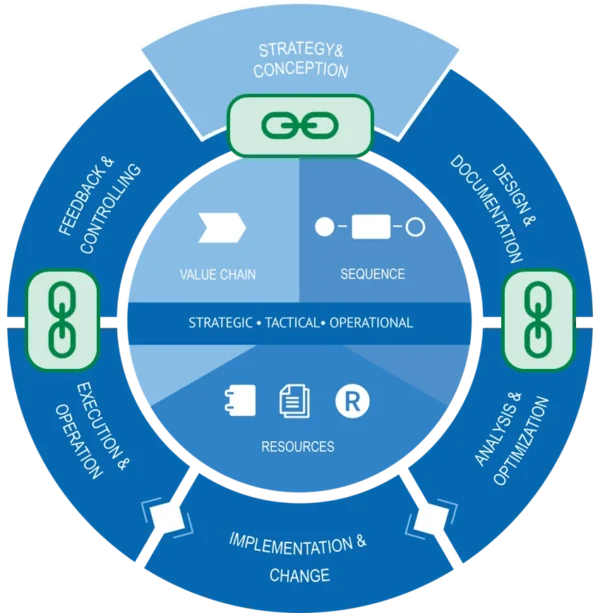
BOC Group’s Process Management Lifecycle framework
Process mining also complements process automation initiatives. By identifying repetitive or rule-based tasks, it helps validate automation potential using real operational data and prioritize automation candidates based on measurable impact.
See how ADONIS Process Mining and Process Automation work together in our case study From Process Insight to Intelligent Automation in ADONIS.
When Combined with Task Mining
Task mining adds a more granular perspective by analyzing user-level activities within individual tasks. While process mining provides end-to-end visibility across processes, task mining explains what happens within specific steps. Together, they combine breadth and depth of operational insight and help explain the reasons behind certain execution patterns.
When Supported by Executive Sponsorship
Successful initiatives require leadership alignment and commitment. Executive sponsorship helps:
-
prioritize improvement initiatives
-
secure resources for transformation programs
-
overcome organizational resistance
-
embed insights into strategic decision-making
Without leadership support, even the most valuable insights may remain unused.
How to Look at Process Mining
As a Diagnostic Instrument
Process mining helps organizations understand how processes actually behave by revealing patterns that traditional analysis may not detect.
As a Prioritization Tool
It helps identify which issues have the greatest operational impact and align stakeholders around improvement priorities.
As a Decision-Support Tool
Process mining supports decision-making but does not replace it. Its value depends on how insights are interpreted and applied.
As a Transparency Enabler
It provides a shared view of process behavior across departments and helps establish a common, fact-based foundation for improvement discussions.
Not as a Silver Bullet for Transformation
Process mining provides insight but does not deliver transformation on its own. It requires complementary capabilities such as governance, expertise, and execution.
Turning Process Insight into Operational Impact
Process mining provides powerful visibility into how processes actually operate. By analyzing system event data, it reveals execution patterns, bottlenecks, and deviations that are often invisible through traditional analysis.
When organizations act on these insights, process mining becomes a powerful driver of continuous improvement. Embedded within a broader process management approach, it enables teams to identify priorities, guide improvement initiatives, and monitor whether changes deliver the expected results.
Used in this way, process mining becomes more than an analysis tool – it becomes a foundation for understanding, improving, and governing how work actually happens across the organization.


Already got our weekly updates?