BUSINESS PROCESS MANAGEMENT

Found this helpful? Share it with peers.
Why AI-Assisted Process Optimization Matters
Process optimization has always depended on business professionals who combine deep domain knowledge with BPM skill. That expertise still sits at the center of the work. What has changed is how far a single expert can see, and how fast AI is making that possible.
Its biggest contribution is pulling scattered process knowledge into one place. Details that normally sit buried across departments and systems, locked in formats that rarely talk to each other, can be gathered into a single analytical context ready to fuel serious improvement work. This kind of AI-driven insight is quickly becoming standard practice. McKinsey found that AI high performers are nearly three times more likely to have fundamentally redesigned their workflows than their peers.
That finding points to a two-sided risk. Redesign without AI leaves too much in the dark: opportunities stay buried in operational data and cross-system dependencies slip past unnoticed, with warning signs accumulating quietly until they surface as a crisis. But agentic AI and automation applied to a poorly designed process do not fix it. Without a solid process foundation for AI, they scale the flaws instead of eliminating them.
This is why the organizations pulling ahead treat AI and structured BPM as one practice rather than two. This blog walks through exactly what that looks like in practice: from identifying which processes to target, through AI-assisted diagnosis and redesign, to governed execution that keeps optimization running long after implementation.
Start Where the Problem Shows Up
Effective process optimization does not start with a tool or a technology, it starts with a question: where is business performance falling short, and which processes are responsible?
In ADONIS, the process landscape is where that question gets its first concrete answer. It maps organizational performance and segments processes by business value: mission-critical ones in red, important ones in yellow. Not every underperforming process carries the same weight, and this view makes that immediately visible. The ones flagged in red are core to how the business operates and delivers value to customers.
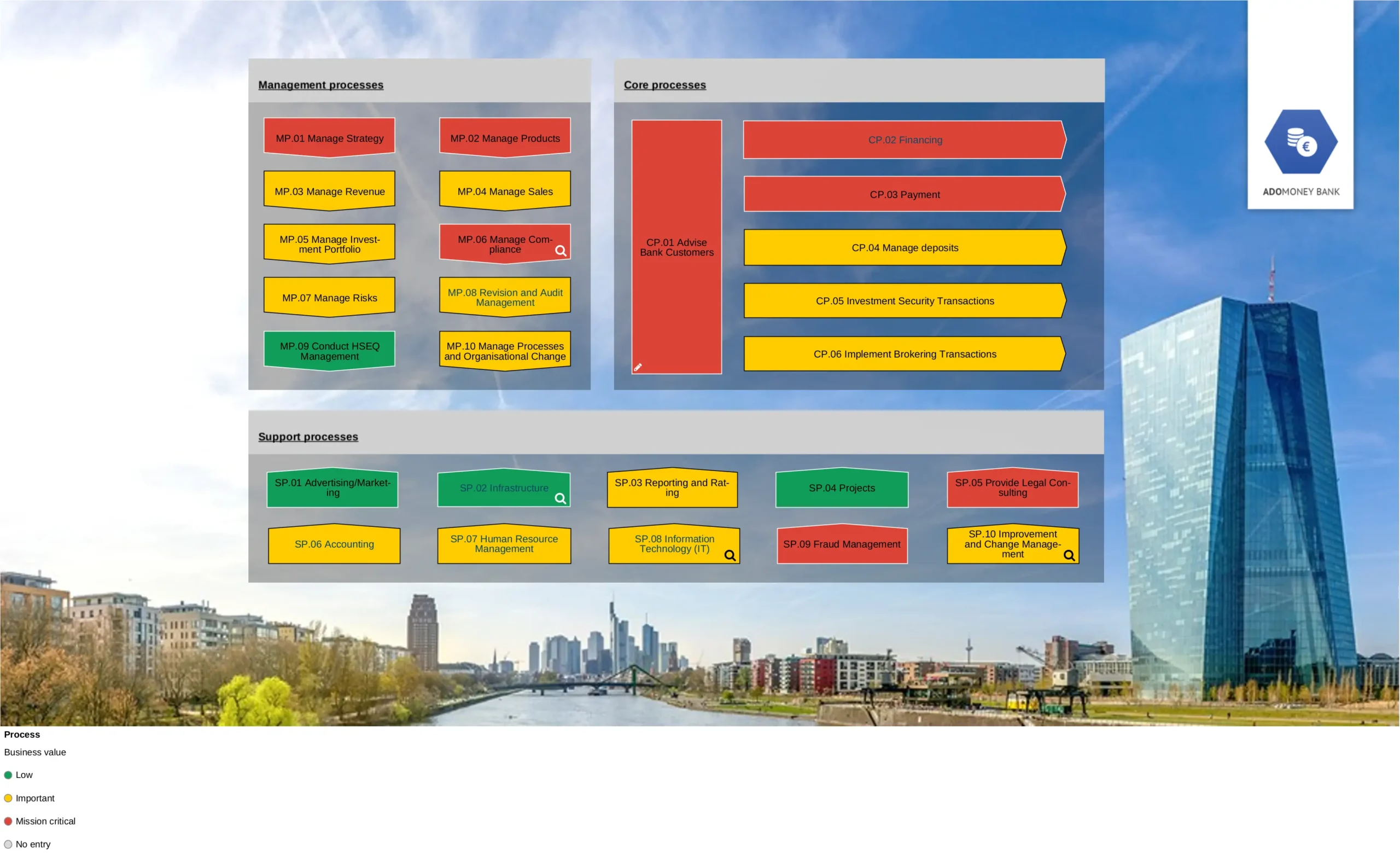
Business Value Segmentation of Process Landscape
CP.01 Advise Bank Customers is one of them. To understand why it is underperforming, a second layer of evidence is needed: KPIs. The KPI Status & Processes view connects performance indicators directly to strategic initiatives, making it visible when a single process is pulling multiple targets off track at once. Cycle time for “Create new customer” is flagged in red, and several Customer Service KPIs tied to the same process are falling short as well.
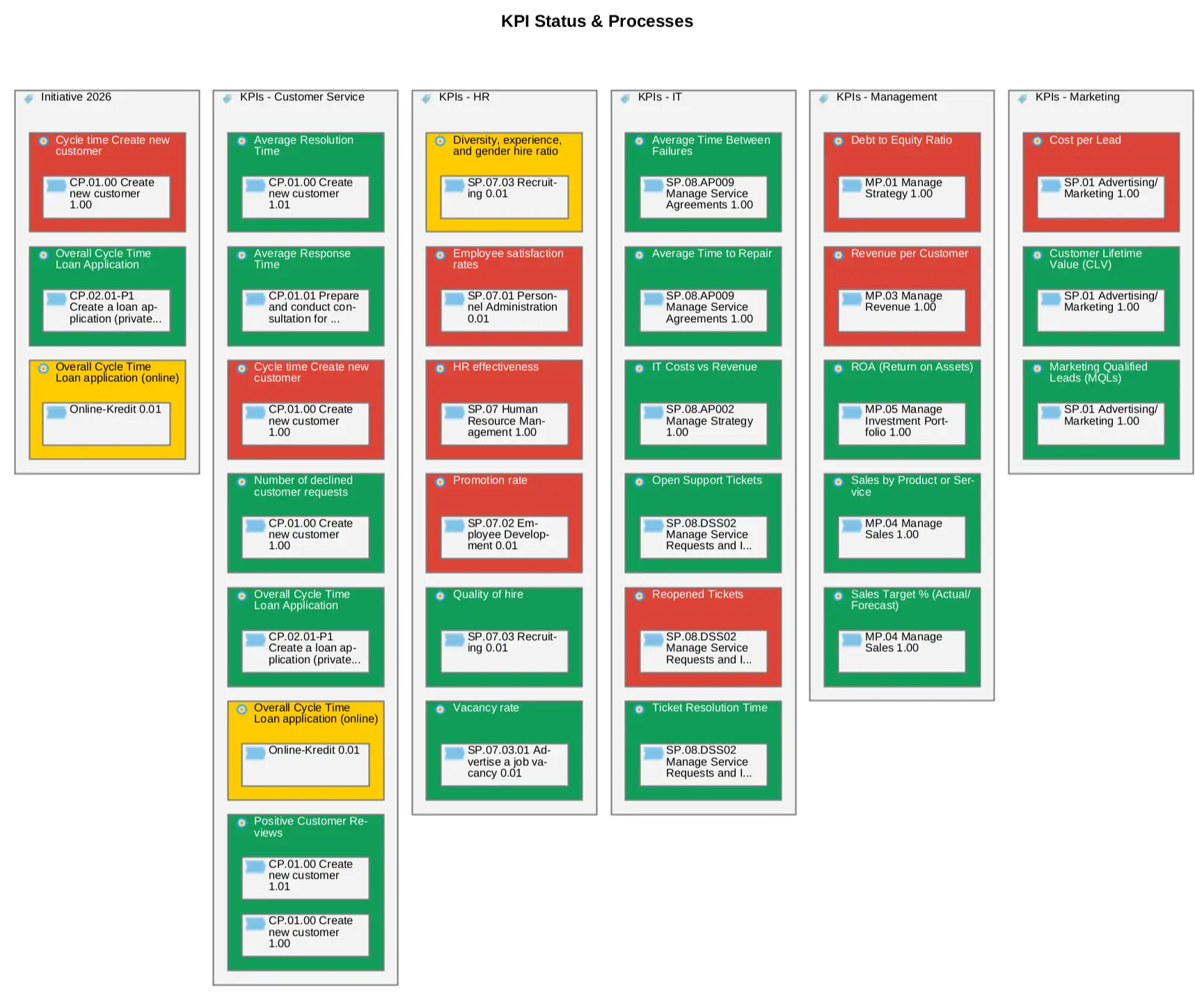
KPI Assessment
With the target confirmed, the Performance Improvement Dashboard makes the full picture concrete. The “Create new customer” process is rated high complexity, its cycle time gauge sits firmly in poor territory, resolution times are above target and costs per lead are over budget. Each metric adds a different dimension to the same underlying problem, and together they make the case specific enough to act on.
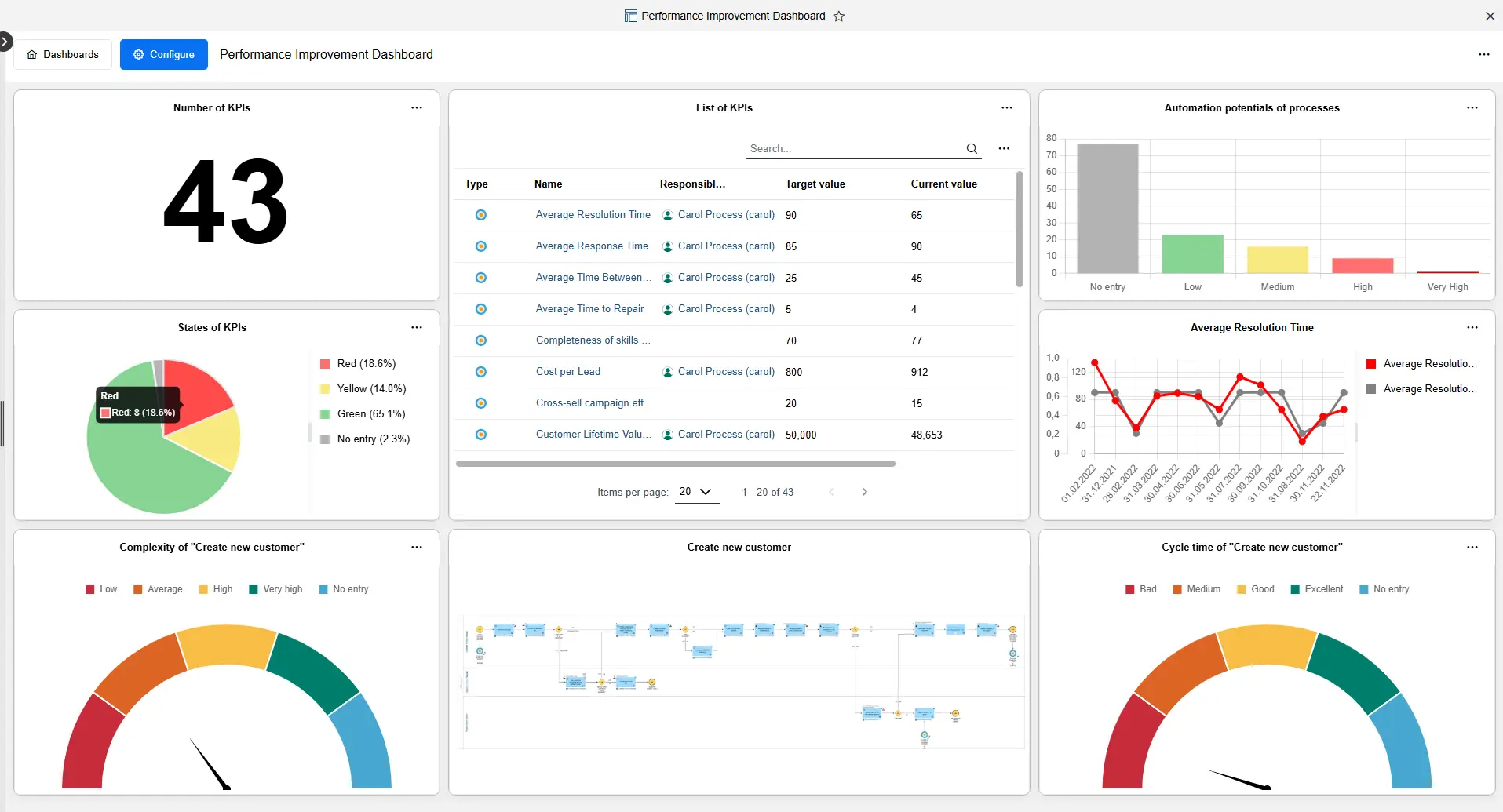
Perfomance Improvement Analysis Dashboard
This is what structured process management enables before AI analysis even begins: a clear, evidence-backed starting point rather than a consensus reached in a meeting room. The optimization work that follows is only as good as the foundation it starts from.
AI-Assisted Process Analysis
Once the target process is identified, diagnosing what is wrong with it used to mean getting the right people in a room. Today, that starting point has shifted. A process owner working with AI can build a more complete diagnostic picture than any group could assemble together, because AI draws from the full process context at once: task attributes, role assignments, compliance documentation, linked policies and risks, pulled from across systems and formats that would otherwise take weeks to consolidate manually.
When stakeholder alignment still requires a workshop, this changes what it is for. The discovery phase happens before anyone enters the room, turning a lengthy effort to piece together what is actually going on into a focused validation session.
In ADONIS, the AI Assistant works directly from the full process context stored in the BPM suite, always available and always drawing from the same single source of truth. A process manager can select from a predefined set of analysis questions or run a custom request and get back structured findings immediately. One concrete example is a fishbone analysis: a structured breakdown of root causes across people, systems, controls, and process design, drawn directly from what is documented in the process.
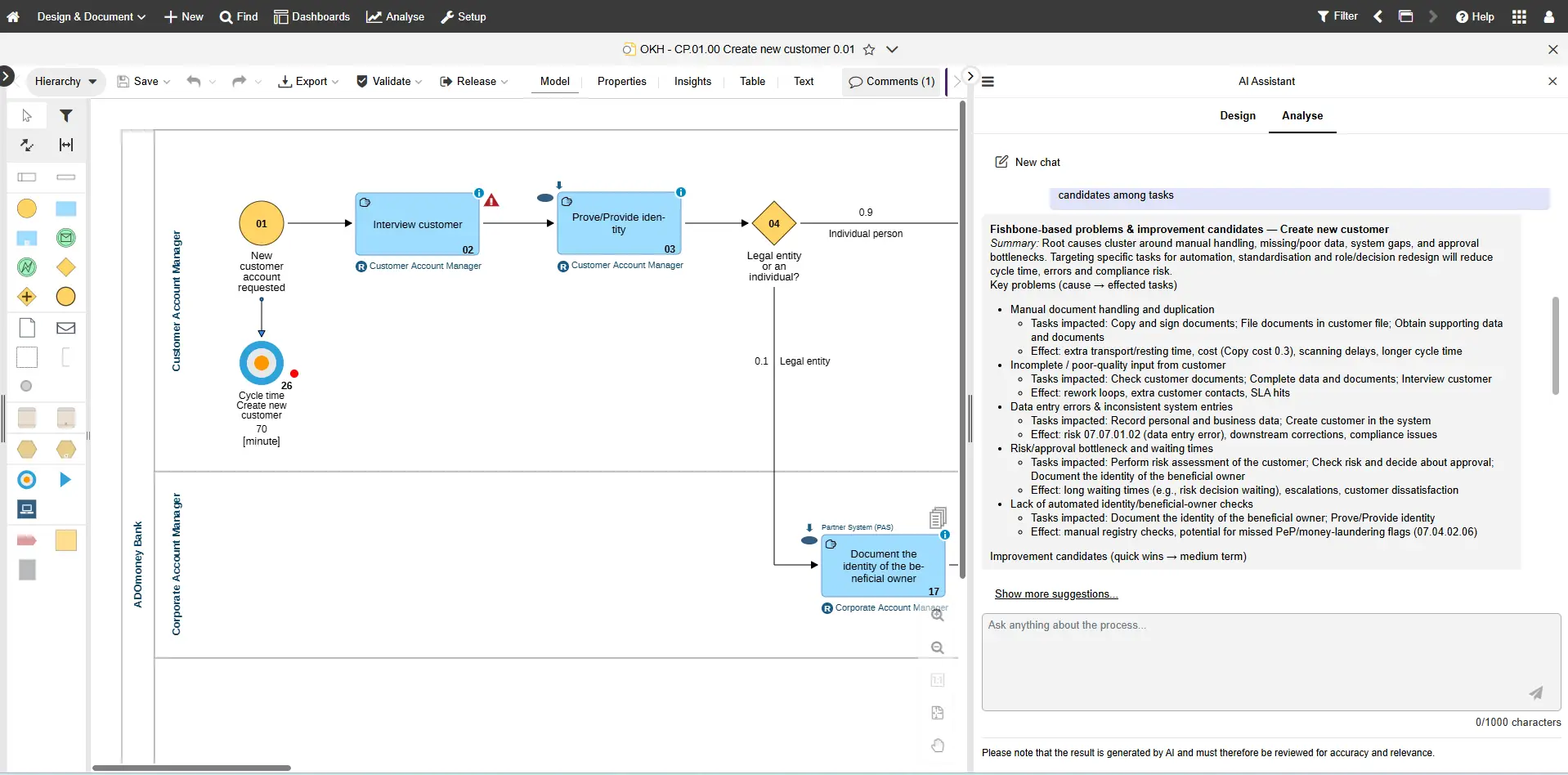
AI Assistant: Fishbone Cause-Effect analysis
The analysis output should not stay in the tool. Process managers can use it as a foundation for presentation materials, ready to bring into workshops, management meetings, or stakeholder reviews without rebuilding the narrative from scratch.
In practice, a process manager working with AI analysis gains:
- Complete model context: tasks, roles, gateways, risks, KPIs and performance objectives in one analytical view
- Structured analysis capabilities: bottlenecks, performance inefficiencies, improvement zones all at one request distance
- Speed: diagnostic work that previously required days of preparation and multiple sessions done in seconds
From Diagnosis to Redesign – Designing the TO-BE
With the analysis complete and the problem zones confirmed, the next question is straightforward: what should the process look like instead?
The answer starts to take shape during the analysis itself. The AI Assistant does not stop at diagnosis: working from the same process context, it generates optimization suggestions directly tied to what the analysis uncovered. For each suggested change, it explains why it matters, which performance problems it addresses, and what risks it mitigates. Suggestions connect back to KPIs, compliance requirements, and process-specific constraints, with quick wins separated from longer-term structural changes and implementation sequenced across phases with suggested ownership.
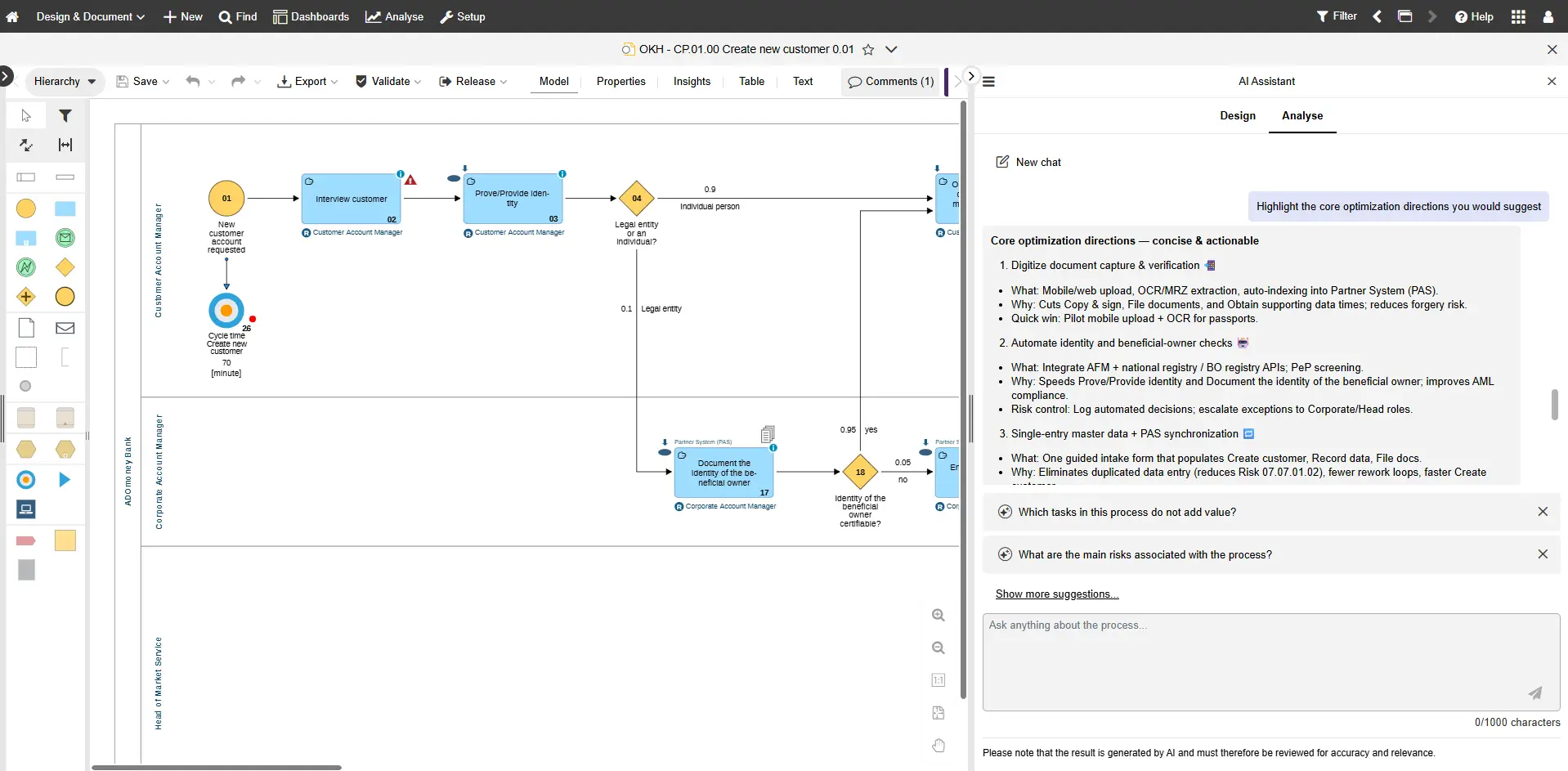
AI Assistant: Optimization suggestion
At this point, the process manager faces a design decision: refine the existing process following the AI-suggested guidelines, or use AI to design a new TO-BE process from scratch. For those who choose the latter, the process manager provides the AI Assistant with a combination of inputs:
- The AS-IS business process diagram
- Human-expert-validated findings from the analysis stage
- Additional context such as workshop outputs, management summaries, compliance requirements, or regulatory guidelines
From this input, the AI Assistant extracts a TO-BE process proposal: a process structure, its description, and a list of tasks, presented in a validation screen where the process manager can review and refine the output before finalizing it in the modelling editor.
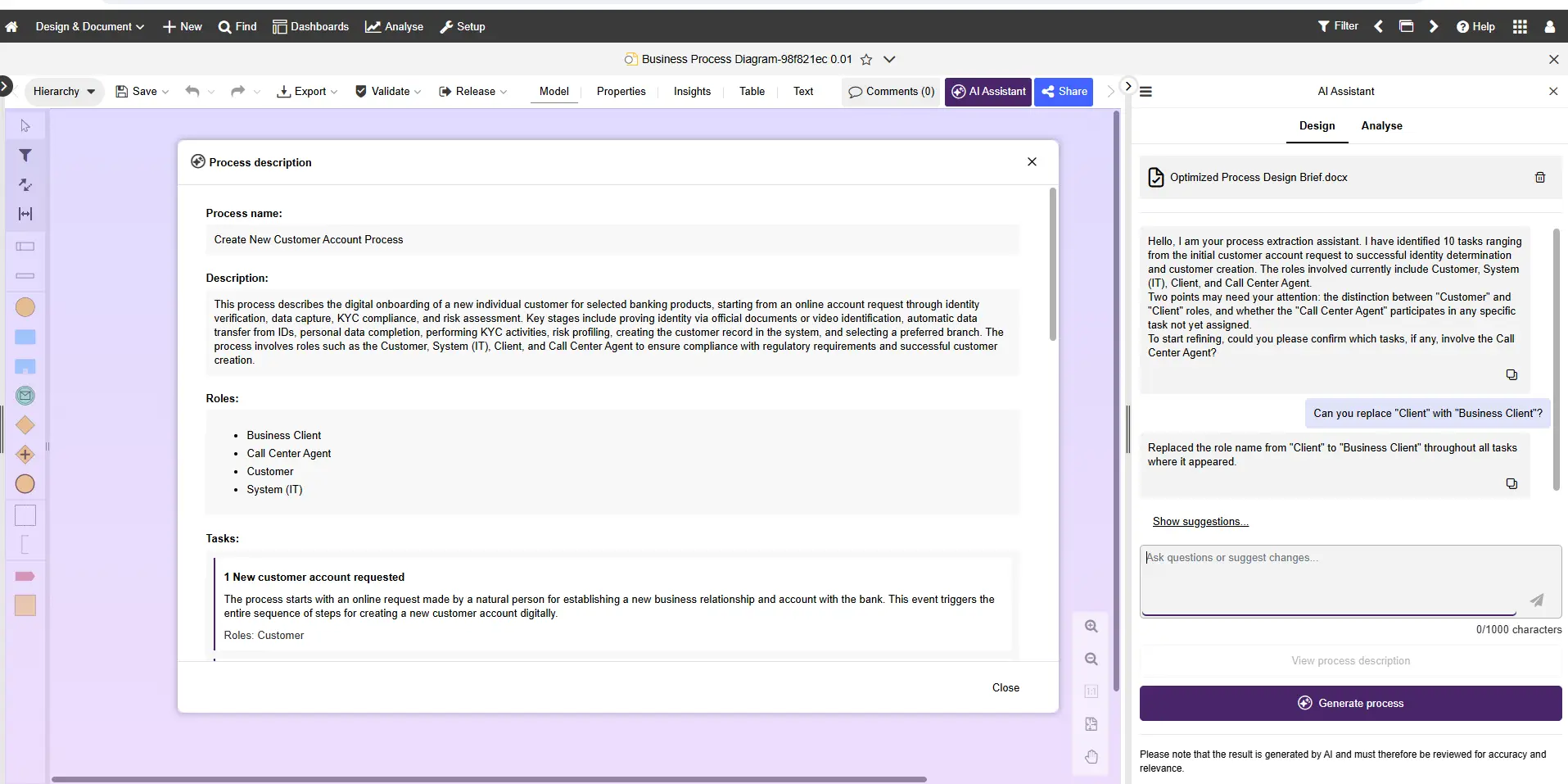
AI Assistant: Process Extraction and Refinement
What the process manager brings to this stage is irreplaceable. The organizational context, the judgment calls, the process knowledge that no model can fully capture are what turn a proposal into something executable. AI removes the blank-page problem and processes the inputs into a workable structure, but every meaningful decision about how the process should actually work belongs to the human expert. Edge cases that exist nowhere in the documentation get surfaced, integration assumptions get pressure-tested against what the systems can actually support, and automation potential gets evaluated against real infrastructure constraints.
Once the design is in place, the process manager can run a simulation, comparing the optimized process against the AS-IS baseline across execution time, waiting time, and cost projections. If the results fall short, another iteration follows: adjusting the design, re-running the simulation, and validating again. The final sign-off happens only when the evidence supports it.
Operationalizing the Optimized Process
A validated process design is the starting point, not the finish line. The real work is ensuring it becomes how work is genuinely done across teams and systems, not just a document sitting in a repository.
This is where well-documented, validated processes in a BPM platform become the foundation for reliable agentic automation. Agents do not operate on general knowledge, but rather act within the governed process boundaries defined in the BPM suite. The structured context built during analysis and redesign directly informs how agents behave, what rules they follow, what systems they communicate with, and where human oversight is required.
MCP is what makes this connection practical. It gives agents direct access to the process repository alongside the enterprise systems already in use: document management, content platforms, project management tools, and BPM suites. With that connected view, agents continuously monitor across systems, track organizational changes, and flag where those changes affect the process design. Optimization does not stop after implementation: it becomes a continuous practice embedded in how the organization runs.
Hint: Learn more about the role of MCP in making AI a true process partner.
What This Means for Process-Driven Organizations
AI-assisted process optimization has moved past the experimental stage. The question for most organizations is no longer whether to adopt it, but how well their process foundation can support it.
What separates the organizations getting real value from those still running pilots is not the number of AI tools deployed. It is whether strategy, diagnosis, redesign, and execution are connected through a single, governed practice rather than handled in isolation. Structured BPM is what holds that connection together.
ADONIS continues to evolve along that same axis to enhance you process optimization and management experience:
- Variant Analysis as a part of Process Mining Essentials) surfacing how processes are actually executed versus designed
- Enhanced configurable dashboards: giving every employee even clearer visibility into what they own and are accountable for
- AI-assisted text editing: keeping process documentation enriched and elaborative as processes evolve
- Expanded AI process generation: lane-based modelling for richer, deployment-ready output
And much more to ensure successful process optimization across your organization.



Already got our weekly updates?