BUSINESS PROCESS MANAGEMENT

Found this helpful? Share it with peers.
Introduction – Why Compliance Can’t Live in Silos Anymore
Compliance? Compliance!
Some people might not want to hear it anymore. But the critical question for any organization today is simple: can you afford to be non-compliant?
Today, non-compliance goes far beyond fines or formal sanctions. It affects how smoothly operations run and how much trust customers, partners, and regulators place in a company. Every missed requirement can ripple through daily work and create uncertainty.
For a long time, compliance lived mainly within audit or legal teams. That separation no longer reflects how organizations actually operate. Today, compliance shows up everywhere – in day-to-day decisions, in systems and handovers, and in how work is actually done. Every employee, every system, and every workflow plays a role in meeting regulatory and internal requirements.
And anything that shapes daily work needs to be managed consistently. That’s why modern enterprises are increasingly connecting policies, controls, and risks directly with their business processes – so compliance isn’t verified after the fact, but built into execution from the start.
This is where Process Compliance comes into focus. Process Compliance ensures that business processes are designed, executed, and continuously updated in line with internal policies, regulatory requirements, and risk obligations. When compliance is anchored in processes, organizations can respond faster to regulatory change, adapt workflows without breaking rules, and maintain clear traceability from requirements to execution.
In this article, we take a closer look at what Process Compliance really means, why it matters in 2026, and how BPM and GRC tools work together to make compliance reliable, scalable, and auditable.

What Is Process Compliance?
Process Compliance often also called Business Process Compliance, focuses on ensuring that business processes follow applicable regulations, internal policies, standards, and control requirements as work is actually carried out.
Rather than treating compliance as a separate activity, Process Compliance connects obligations directly to operational workflows. It links how work happens with what must be followed, making compliance part of execution instead of a downstream check.
Many compliance obligations originate from external regulations and standards. Depending on industry and region, these can include:
-
Financial and investment regulations (e.g. SOX, MiFID II, Basel III)
-
Data protection and privacy requirements (e.g. GDPR)
-
Information security standards (e.g. ISO/IEC 27001, NIST CSF, SOC 2)
-
Quality, safety, and environmental standards (e.g. ISO 9001, ISO 14001, ISO 45001)
The specifics differ, but the underlying expectation is always the same: organizations must be able to show that regulatory and policy requirements are reflected in how work is actually performed.
At the same time, Process Compliance is not limited to external rules. Internal policies, procedures, and standard operating protocols play an equally important role. They translate strategic intent into concrete controls that guide everyday behavior.
Put simply, Process Compliance weaves compliance requirements into business processes themselves. Operational activities are directly linked to the rules and controls that govern them, creating a compliance framework that is practical, transparent, and part of daily work – not an afterthought.
This also marks a clear shift from traditional compliance approaches. Conventional compliance models tend to focus on audits and reviews after execution. Process Compliance, by contrast, aims to ensure conformity during execution by embedding controls directly into processes.
From this perspective, two goals come together:
-
Compliance by Design, supported by BPM tools such as ADONIS, where processes are modeled and checked against requirements upfront
-
Evidence and control assurance, supported by GRC tools such as ADOGRC, where execution, assessments, and monitoring provide audit-ready proof
Working together, BPM and GRC close the compliance loop and enable consistent, end-to-end compliance documentation that stands up to audit scrutiny.
Why Process Compliance Matters in 2026
Process Compliance is more critical in 2026 than ever before. Regulatory, technological, and organizational environments are becoming more interconnected, faster-moving, and risk-exposed – making periodic checks insufficient. Compliance has to be operationalized, embedded into processes, and continuously monitored.
Key drivers include:
- Increasing regulatory pressure across data protection, cybersecurity, ESG, and financial reporting
- Growing cyber risks that exploit inconsistencies in process execution
- Rising audit expectations requiring traceability and evidence
- Remote and hybrid work models increasing execution variability
- Complex business models relying on automation, cloud services, and third parties
- Customer demand for transparency and responsible operations
- Economic uncertainty requiring stronger operational discipline
Taken together, these factors make it harder to control compliance through manual oversight alone, especially at scale.
As audit expectations rise, compliance is no longer a back-office obligation. It has become a strategic capability that supports resilience, transparency, and sustainable growth.
Organizations with strong process governance typically reduce audit efforts by 30-40%, lower compliance incidents, and gain visibility across teams and geographies. Achieving this requires aligning BPM and GRC capabilities, combining process design and governance with control management, monitoring and audit readiness.
Examples from organizations such as Helvetia and BKB show how integrating BPM and GRC supports reliable, auditable, and resilient operations.
The Core Pillars of Process Compliance
In practice, Process Compliance is a shared responsibility. While compliance teams define policies and controls, operational teams execute compliant processes every day. As a result, Process Compliance must be integrated into process performance and governance – not treated as a separate function.
Effective Process Compliance ensures that:
- controls are designed and operate effectively
- employees follow approved procedures
- compliance outcomes are visible to leadership
- transparency is increased through standardization and automation
Most Process Compliance initiatives are triggered by new or updated regulations, certifications (e.g. ISO standards), security requirements, or internal policies. Each change requires organizations to assess impact, update processes, and demonstrate compliance.
To do this efficiently, obligations must be translated into clear control objectives and mapped to processes, roles, and organizational units. This creates traceability from requirement to execution and ensures that compliance is embedded in how processes are designed, executed, and monitored.
Think of the following five pillars as a lifecycle: define what matters, embed it into execution, prove it with evidence, and continuously improve as requirements evolve.
Pillar 1: Governance & Scoping
Every Process Compliance initiative starts with clarity.
Governance defines who is responsible for what: ownership, approval workflows, review cycles, and escalation paths. Scoping determines which requirements apply and which processes are affected.
Together, they form the foundation for consistent, audit-ready compliance. Without this baseline, organizations risk unclear ownership, duplicated effort, or gaps between requirements and execution.
In practice, governance and scoping turn regulatory frameworks into something actionable. Requirements are translated into concrete control objectives and linked to the relevant processes. BPM platforms such as ADONIS help structure this step by making responsibilities transparent, managing versions and approvals, and visualizing the scope of compliance across the process landscape.
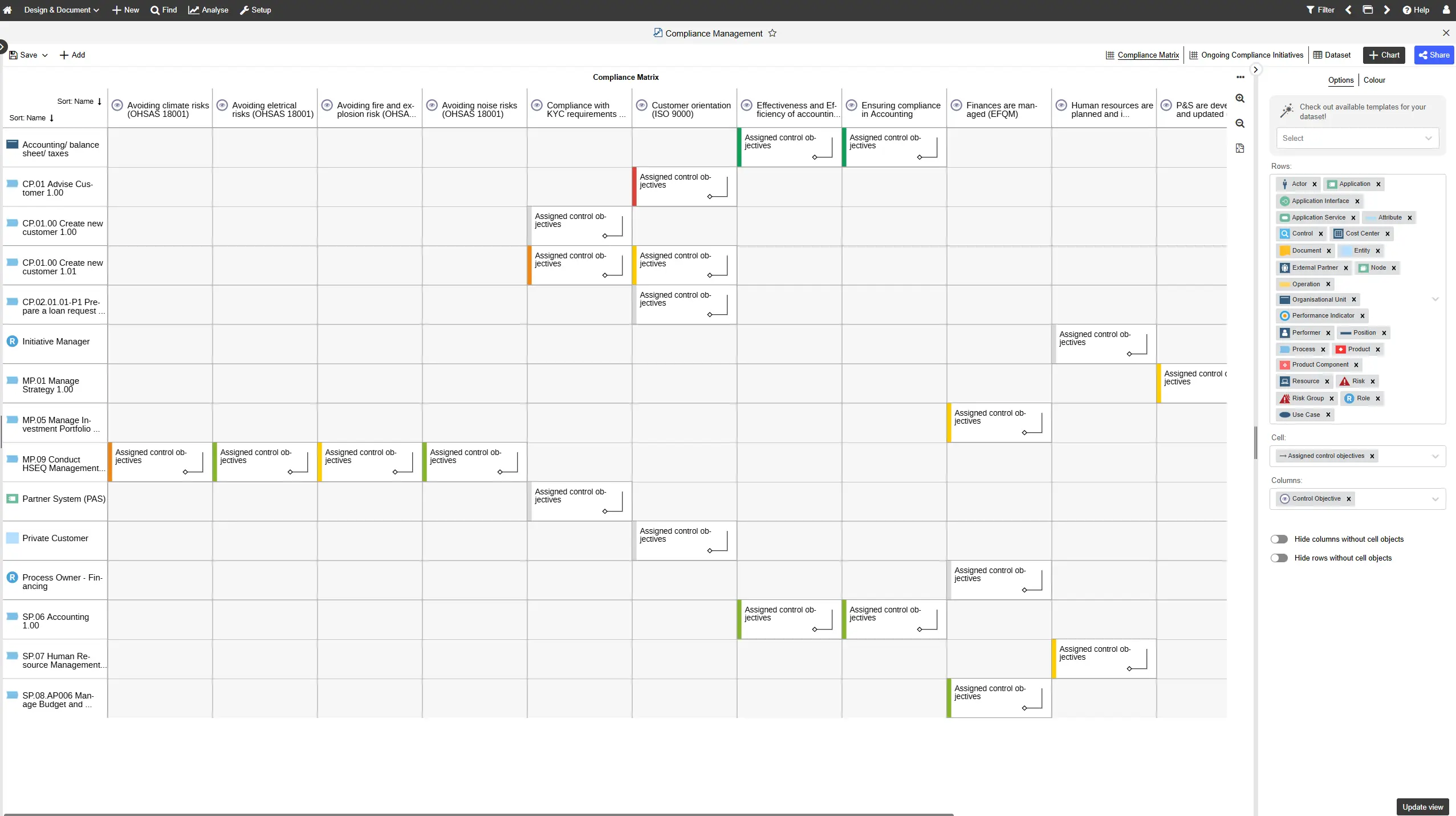
Example: Compliance requirements mapped to business processes in ADONIS
Once governance and scope are in place, compliance stops being abstract – and becomes operational.
Pillar 2: Assign Requirements & Define Target Maturity
With scope defined, the next step is to anchor compliance requirements in the operational reality.
Control objectives are assigned to the processes and assets where they actually apply – whether that’s a business process, an application, a product, or a service. This creates a clear link between obligations and execution.
At the same time, organizations define what acceptable compliance looks like in practice. Target maturity levels help clarify expectations and provide a shared reference point across teams. Rather than asking “Are we compliant?”, the focus shifts to “How mature is our compliance – and where do we need to improve?”

Compliance Dashboard showing requirements assigned to processes and assessed against defined target maturity levels in ADONIS
BPM and GRC tools such as ADONIS and ADOGRC support this by embedding control tasks into processes, maintaining maturity models, and making expectations explicit.
This pillar bridges the gap between knowing the rules and knowing how well they are implemented.
Pillar 3: Accessibility & Awareness
Even the best-designed controls fail if people can’t find or understand them.
Accessibility and awareness ensure that compliant processes are visible, understandable, and usable in everyday work. Employees need easy access to approved process versions and clear guidance – ideally without leaving the tools they already use.
Process Portals play a key role here. They provide a single, reliable entry point to released processes and compliance guidance, making it clear what applies now, not what existed in a draft or outdated document.
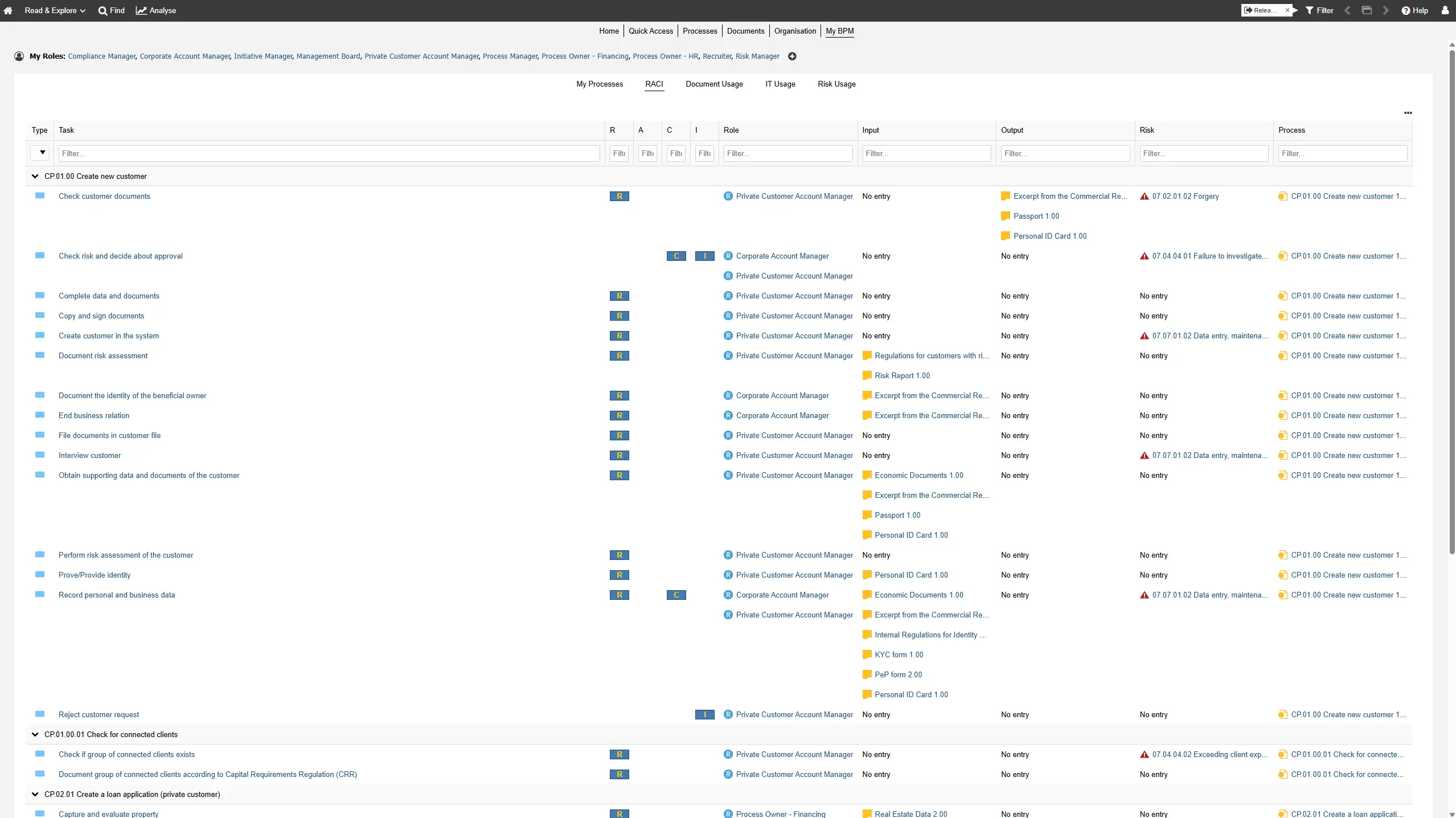
Process Portal as a single entry point for compliant processes in ADONIS
By integrating process content into platforms like SharePoint or Confluence, organizations reduce friction and ambiguity. The result is simple but powerful: one trusted version, available where work actually happens.
Pillar 4: Assessment, Monitoring & Evidence
Compliance doesn’t stop at design, it must be demonstrable.
This pillar focuses on proving that controls are implemented and working as intended. Execution logs, approvals, assessments, and audit trails provide the evidence auditors and regulators expect.

Control objective assessment and evidence overview in ADOGRC
GRC platforms such as ADOGRC support structured assessments and automated evidence collection, while BPM platforms provide the context by linking that evidence directly to processes and control objectives.
Regular assessments compare the current ‘as-is’ state against defined target maturity levels. Over time, this creates a clear picture of gaps, progress, and trends. Dashboards and reports then turn this information into actionable insight – for both management and auditors.
At this stage, compliance shifts from reactive audit preparation to continuous visibility.
Pillar 5: Continuous Improvement
Process Compliance is never finished. Regulations change. Risks evolve. Processes are optimized. This final pillar ensures that compliance keeps pace with that change.
Regular evaluations, historical assessment data, feedback from users, and, where available, process mining insights help organizations detect deviations early and refine controls over time.
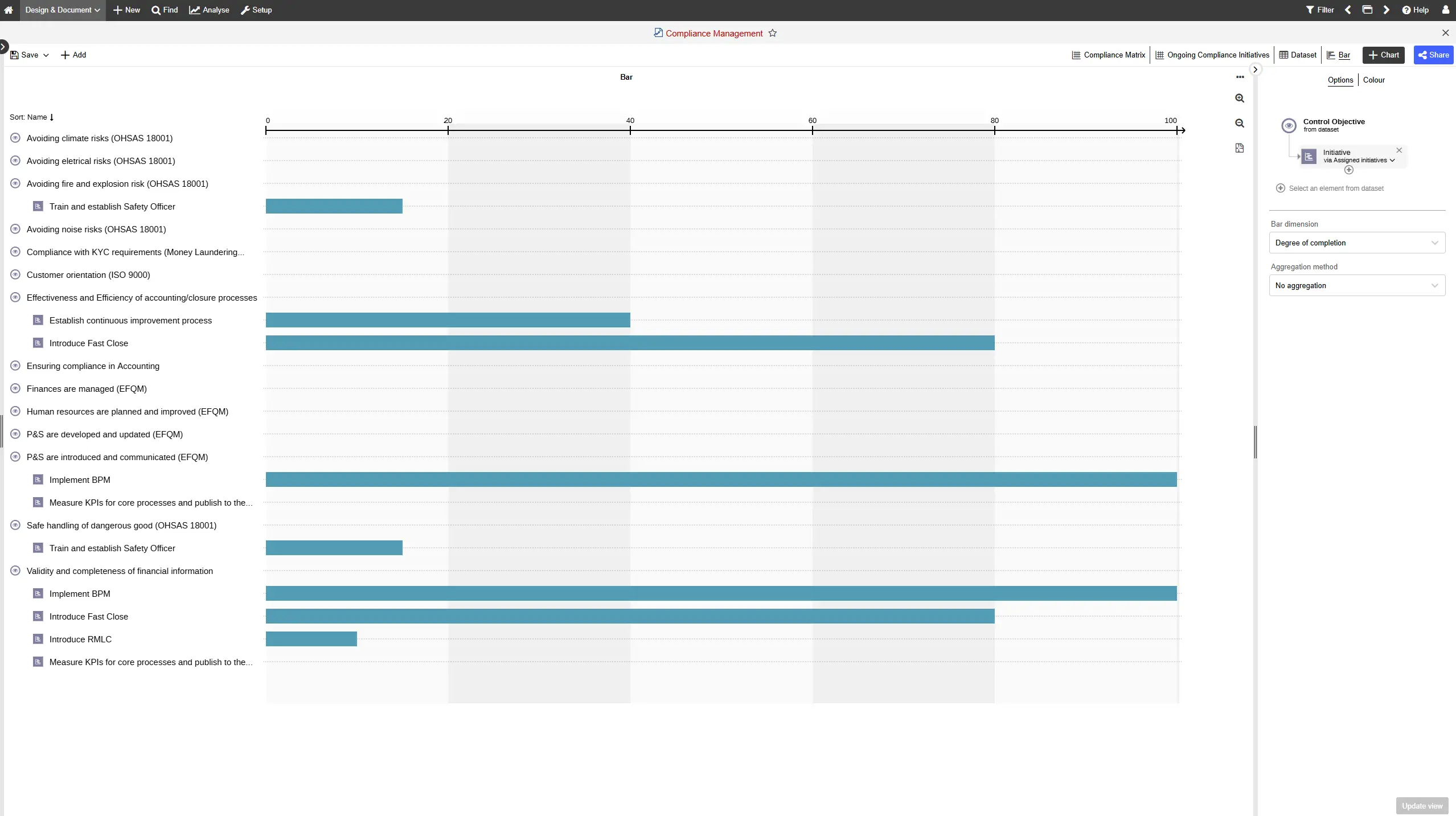
Example: Visualizing progress of compliance improvement initiatives over time
Common Process Compliance Challenges (and How to Overcome Them)
Even with the right pillars in place, organizations tend to encounter recurring challenges – particularly where ownership, transparency, and evidence start to break down. Common issues include:
-
Low process awareness → centralize documentation, simplify models, embed access into daily tools
-
Inefficient processes → simplify flows, automate manual steps, validate processes with real users
-
Outdated documentation → establish joint BPM–GRC governance and maintain a single source of truth
-
Fragmented ownership and traceability → use an integrated BPM–GRC repository
-
Resistance to change → communicate the why, involve users early, demonstrate quick wins
-
Reactive monitoring → define KPIs, use dashboards, conduct regular assessments
In many cases, these challenges arise where process management and compliance management are treated as separate disciplines – reinforcing the need for an integrated BPM-GRC approach.
Integrating BPM and GRC: Closing the Compliance Loop
Whether organizations begin with BPM or with GRC, real compliance effectiveness only emerges when both disciplines are brought together.
Most organizations already document processes, which provides a strong starting point for linking controls, risks, and requirements. Integration makes it possible to answer compliance-critical questions at process level, such as:
-
Where is requirement X addressed in the process?
-
How well is requirement Y fulfilled today?
-
What is the current compliance status across a process area?
ADONIS supports the governance and documentation of compliant processes, while ADOGRC focuses on control execution, monitoring, risk assessment, and audit readiness. Together, they cover the full compliance lifecycle, from defining requirements to execution and reporting.
With tool support such as ADONIS for BPM and ADOGRC for GRC, organizations can map requirements directly to process steps, monitor execution continuously, and provide audit-ready evidence without additional manual effort.
The Payoff: Reliable, Auditable, and Resilient Processes
When Process Compliance works the way it should, it stops being something teams scramble to prepare for. It becomes part of how the organization operates. The real value is not additional documentation, but the confidence that everyday work actually meets the obligations the organization is responsible for.
In practice, this leads to tangible benefits:
-
Faster and more efficient audits
-
Fewer compliance breaches
-
Clear accountability and ownership
-
Improved collaboration across departments
And when BPM and GRC work together, compliance becomes a living, data-driven part of operations – not just an annual checkpoint.


Already got our weekly updates?