BUSINESS PROCESS MANAGEMENT

Found this helpful? Share it with peers.
Why Organizations Still Struggle to Act with Confidence
You would think that with all the data, transparency, and AI support available today, making confident decisions would be straightforward.
Most of the pieces are already there: strategy is defined, processes are documented, systems are running, and data is constantly being generated. Organizations have invested heavily in making information more accessible, more structured, and more measurable. And yet, when decisions need to be made, teams still struggle to understand what will actually happen if something changes.
Not because information is missing – but because it remains disconnected.
Different parts of the organization reflect different versions of reality. Strategy defines intent, processes describe how work should happen, systems capture execution data, and governance adds constraints. Each of these perspectives is valid. But when they are not connected, decisions are made by interpreting fragments rather than understanding the whole.
This is exactly the gap the concept of a Digital Twin of an Organization (DTO) is meant to address: a connected representation of the organization that reflects how it actually operates, so teams can understand dependencies, explore change, and act with confidence.
What a Digital Twin of an Organization Really Is
So what does that mean in practice? A DTO is often described as a model, but that framing simply misses the point. A DTO is valuable not because it represents the organization, but because it connects it.
It creates a shared context where different perspectives – strategic, operational, and analytical – can be understood in relation to one another, rather than in isolation. This distinction matters. Traditional models describe parts of the organization. A DTO makes it possible to understand how those parts interact, how changes propagate across them, and what the likely consequences of decisions will be before they are implemented.
In that sense, a DTO shifts the role of models – from documentation to decision support. This is also why the concept resonates so strongly. It does not introduce a new problem, it responds to one organizations already experience.
Enterprise Architecture explains how the organization is structured. Process mining reveals how work behaves in execution. Governance defines control, accountability, and risk relationships.
Each discipline provides a valuable lens. But decisions are rarely confined to one perspective. A DTO becomes meaningful when these perspectives are connected into a single, coherent decision layer that reflects how the organization operates as a system.
Why Many DTO Initiatives Stall
This is also where many DTO initiatives begin to break down. Despite strong interest, most efforts struggle to move beyond isolated use cases or early pilots. The ambition is clear, but scaling that ambition into something operational proves difficult. And the reason is often misunderstood.
It’s not a lack of technology. It’s not modeling capability. And it’s not visualization. The problem is not that organizations lack models. It’s that they cannot rely on them.
A DTO can only support decisions if it reflects reality with sufficient accuracy and consistency. In many organizations, that foundation is not in place. Knowledge is distributed across tools, ownership is fragmented, and different representations of the organization evolve independently. As a result, dependencies remain unclear, execution data is only partially integrated, and models drift away from how work actually happens.
This gap between ambition and reality is also reflected in practice. Our research shows that while more than 80% of experts expect DTOs to become significantly more important, the concept remains unfamiliar in many organizations and management support is still limited.
This is why initiatives lose momentum. They attempt to build decision intelligence on top of knowledge that is not yet connected or reliable. A more practical starting point is not the twin itself. It is connected operational truth.
Why Process Knowledge Is the Foundation
If there is one layer that determines whether a DTO becomes usable, it is process knowledge. Processes don’t just connect information – they define how work actually flows across the organization. They show how strategy is translated into action, how systems are used in practice, and how decisions propagate through people, tasks, and outcomes.
Without this layer, the organization remains a set of structures and data points, but not a system that can be understood in motion. This is why process knowledge plays a central role. It provides the logic that links different perspectives together and anchors them in real behavior. It makes dependencies visible, exposes bottlenecks, and creates a foundation that can be validated against execution data.
This is not just a conceptual argument; it’s reflected in practice too. Our DTO research indicated that organisations see the highest potential value in DTOs for understanding and improving processes, while also reporting the largest gap between current capabilities and desired outcomes in this area.
In other words, organizations expect DTOs to improve how they adapt and optimize processes, but lack the structured foundation to do so. This is where many initiatives fall short. They start with the ambition to simulate and optimize, but without a reliable representation of how work actually flows.
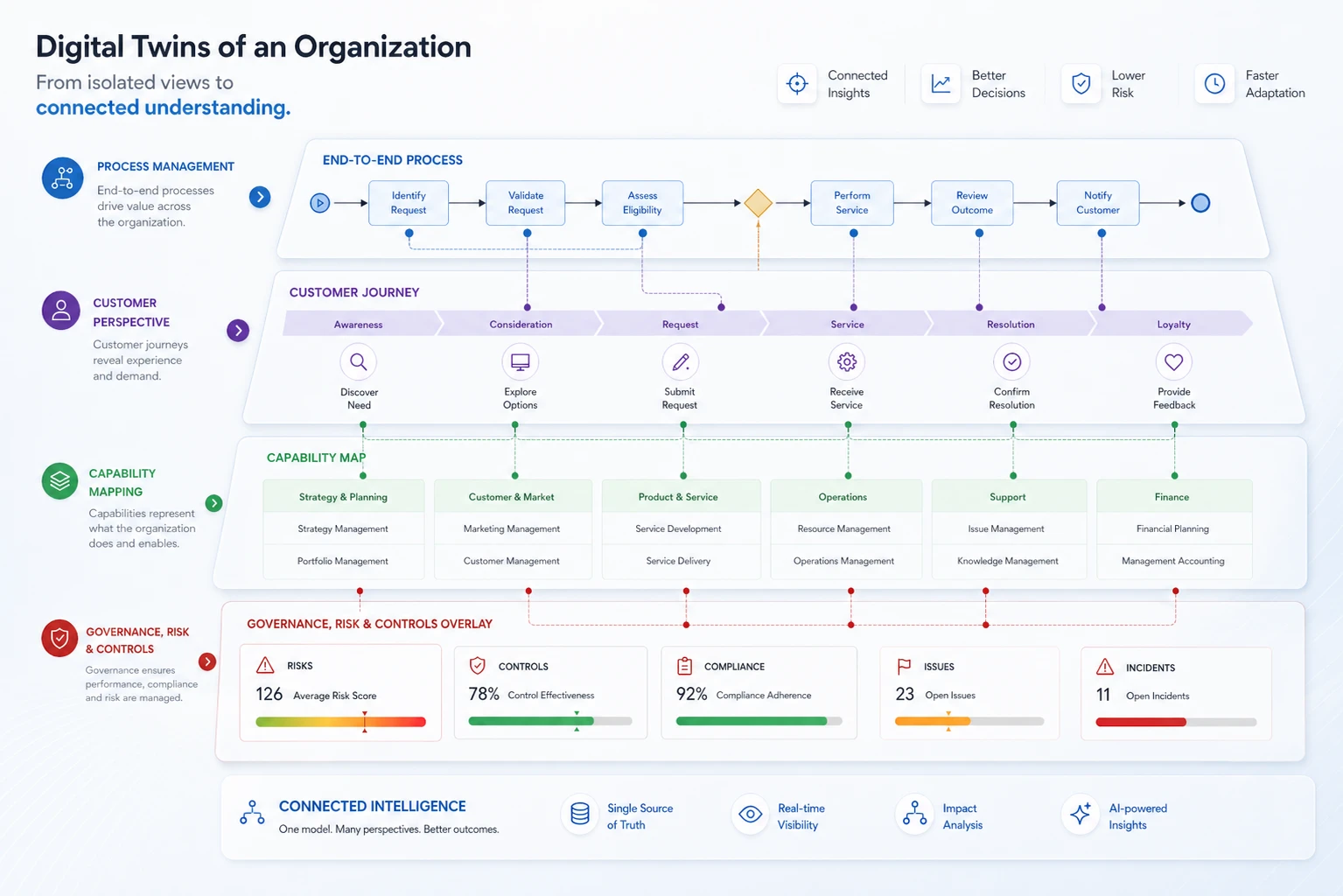
How a Digital Twin of an Organization connects isolated views of the organization to create a connected understanding – enlarge the graphic to explore in detail.
Connecting the Organization End-to-End
To make this work in practice, organizations need more than a concept, they need a way to operationalize it. A DTO only creates value when it connects the layers that shape how the organization actually works into a single, coherent system. This requires bringing together strategic intent, operational structure, execution insight, and governance into one integrated view.
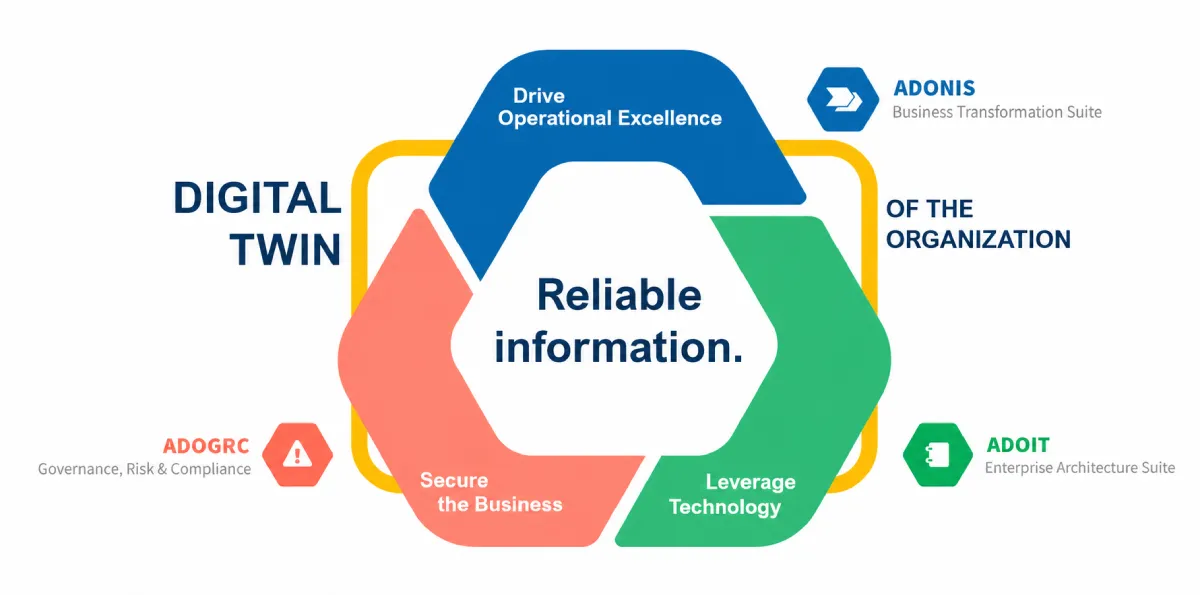
Establishing one integrated view by connecting ADONIS, ADOIT and ADOGRC
From our perspective, this is achieved by combining complementary capabilities.
- ADOIT provides the strategic and architectural context – capabilities, applications, technologies, and investment decisions.
- ADONIS anchors the DTO in operational reality by modeling how work is actually performed.
- Process mining adds evidence from execution, validating how processes behave in practice.
- Simulation and analysis make it possible to understand the impact of change before it happens.
- ADOGRC ensures governance, risk, and compliance are part of the same decision context.
Individually, these capabilities improve visibility. Connected, they enable something different: a representation of the organization that can be used to reason about change before it’s implemented.
This reflects a broader principle: Improving decision quality is not about adding more tools. It is about connecting the knowledge that already exists.
From Concept to Reality: DTO in Practice
The value of a DTO becomes most visible in environments where complexity and change are constant. This is what the MODAPTO project demonstrates.
In modular manufacturing, production systems are continuously adapted to new requirements. Machines are added or removed, workflows are adjusted, and entire production lines may be reconfigured. Decisions need to be made quickly – but also with a clear understanding of their impact.
In this context, digital twins provide the perfect way to explore scenarios, test adjustments, and assess consequences before changes are applied.
Within MODAPTO, ADONIS is used to model and validate production processes in digital twin-enabled environments. These models create a shared representation of how work is actually carried out, linking physical production with its digital counterpart. This is critical.
A digital twin is only as valuable as the reality it reflects. If process knowledge is incomplete or outdated, the twin may look convincing, but it cannot be trusted to support decisions.
→ See how MODAPTO brings digital twins into practice. Read the full story.
From Visibility to Better Decisions
A mature DTO does more than provide visibility. The difference is not visibility; it is predictability.
By connecting structure, behavior, and data, a DTO allows organizations to understand how changes will affect the system before they are implemented. This shifts decision-making from reactive interpretation to proactive evaluation.
It enables organizations to align strategy with execution, identify inefficiencies based on actual behavior, and evaluate trade-offs with greater clarity. Perhaps most importantly, it creates a shared understanding of reality across stakeholders.
Business, IT, and governance no longer operate on separate views, but on a connected model of how the organization actually works. This is the real shift. A DTO does not add another layer of abstraction. It reduces uncertainty.
Looking Ahead: DTO as a Foundation for Intelligent Organizations
As AI becomes more embedded in operations, the importance of DTOs will continue to grow. AI does not resolve fragmentation. It makes its consequences more visible.
Intelligent systems depend on context. Without a connected understanding of how the organization operates, AI amplifies inconsistencies, reinforces incomplete views, and introduces new risks into decision-making. A DTO provides the structured context that AI requires.
It enables simulation, supports scenario evaluation, and creates a shared foundation for both human and machine-driven decisions. In this sense, the DTO evolves beyond a model.
It becomes a decision intelligence layer that supports continuous, data-driven improvement.
Final Thought
A Digital Twin of an Organization becomes valuable when it helps organizations move from fragmented visibility to confident action. That shift does not start with technology. It starts with building a trusted, connected understanding of how the organization actually works.
And that understanding begins with process truth.



Already got our weekly updates?