Enterprise ArchitEcture

Found this helpful? Share it with peers.
Introduction
Application landscapes do not become inefficient overnight. Instead, inefficiencies build up quietly over time through overlapping tools, legacy systems that never got retired, and contracts that outlive their original purpose. Costs accumulate in the background, often hidden inside bundled agreements and shared services.
So when organizations try to answer what seems like a straightforward question:
“How much does each application actually cost us?”
… they often realize they don’t have a clear answer.
And without that clarity, effective cost management is almost impossible.
Three Steps to Application Cost Clarity
Understanding what each application truly costs starts earlier than most teams expect. Before costs can be allocated meaningfully, you need a clear picture of your application landscape: what each application does, how well it serves the business, and what the plan is for its future. That foundation is what makes financial visibility actionable rather than just informative.
Step 1: Setting the Foundation
The starting point is a structured evaluation of each application across two dimensions:
- Business fitness – How well does the application support current and future business needs?
- IT fitness – How healthy, maintainable, and future-proof is the underlying technology?
Together these give a balanced read on both value and viability. From this evaluation, a clear investment strategy emerges, often structured around four categories:
- Tolerate – Keep the application as is
- Invest – Strengthen and enhance it
- Migrate – Move to a more suitable solution
- Eliminate – Retire it
Known as the TIME model, this framework turns assessment into a clear directional decision for every application in the landscape. Decisions at this stage are based on structured analysis rather than gut feel, which matters when you're dealing with hundreds of applications across departments, regions, and business functions.
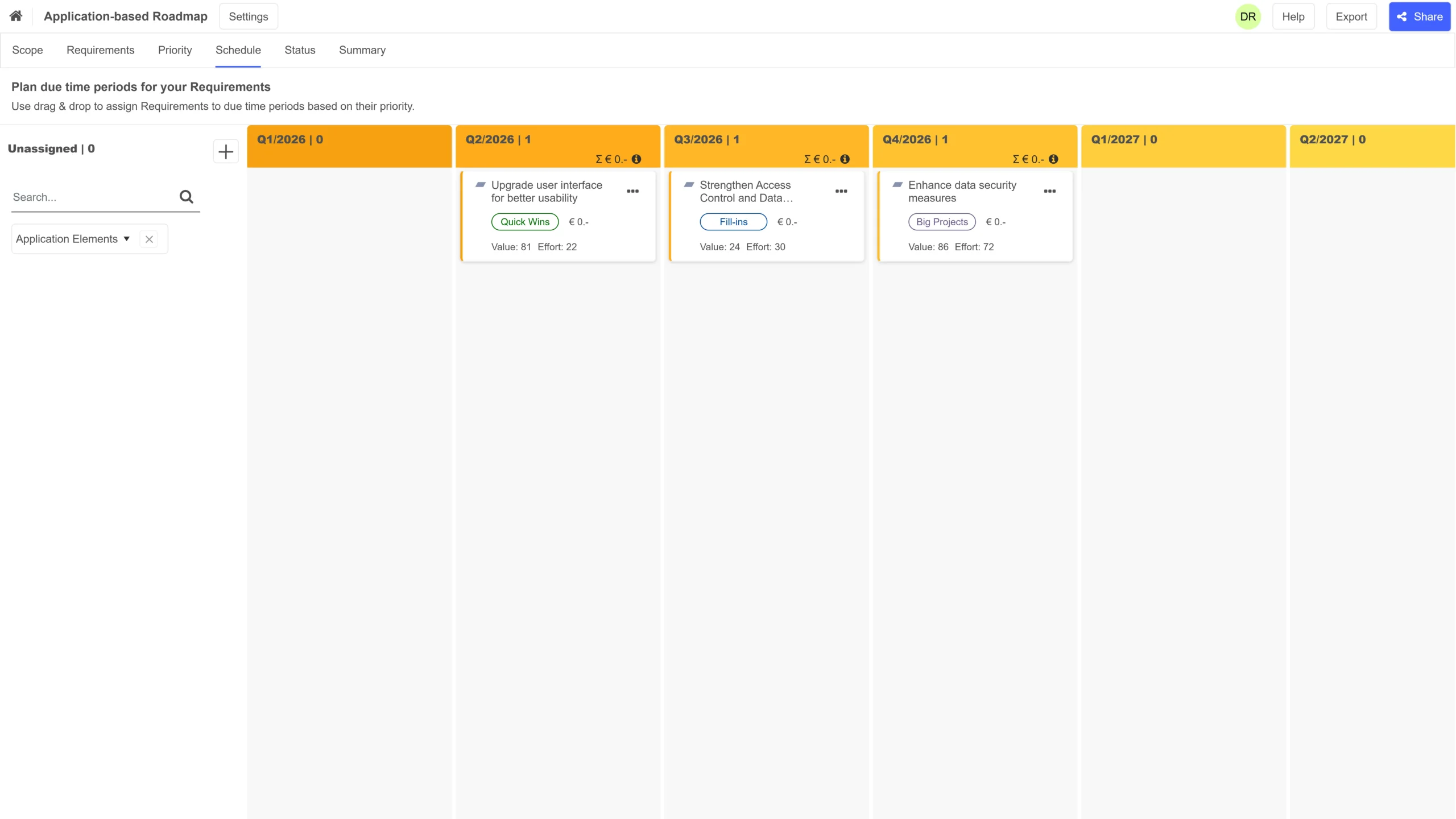
Application-based roadmap in ADOIT
Step 2: Turning Strategy into Change
A TIME model categorization tells you what should happen to each application. Roadmapping works out how and when. This is where strategic intent becomes an actual plan of action.
In practice that means taking the decisions from Step 1 and translating them into dated, sequenced initiatives.
- Which legacy systems get retired first?
- Which migrations need to happen before others can start?
- Which investments require infrastructure changes as a prerequisite?
Roadmapping surfaces those dependencies and puts them in order. The output is a visual picture of how the application landscape will look at different points in time, not just where it is today. That matters because transformation rarely happens all at once. Projects run in parallel, timelines shift, and the roadmap becomes the reference point that keeps different teams aligned on what is changing and when.
Hint: Explore how strategic roadmapping helps enterprise architecture teams turn transformation goals into clear, actionable plans.
What it doesn’t capture on its own yet is the financial weight behind those decisions. Two applications might both be marked for investment, but one could be consuming three times the budget of the other. Without that layer, prioritization is still incomplete.
Step 3: Making Costs Visible
This is where many organizations hit a wall. The strategy is clear and the roadmap is in place, but when finance teams are asked what a specific application actually costs, the answer comes back in the wrong unit. They can report what was spent on a vendor contract, a hosting platform, or a support agreement. What they can’t easily report is what any individual application consumed from those totals.
The Hidden Challenge: Shared Costs
That gap exists because most IT costs are shared by nature. One contract covers a suite of applications, one infrastructure platform hosts dozens of systems, and one support agreement runs across an entire department. The cost exists at the aggregate level while the decisions that need to be made exist at the application level. Some applications look cheaper than they are because shared costs get absorbed elsewhere, others appear expensive for the same reason, and budgeting works from distorted baselines. When someone asks whether a particular application is worth keeping, there is no clean answer.
The Turning Point: Cost Allocation
Cost allocation is what resolves this. It means taking those bundled, shared costs and distributing them logically across the applications that actually consume them, based on drivers such as:
- Usage volume
- Number of users
- Technical dependencies
- Contractual attribution
Once that allocation is in place, the unit of analysis changes. You are no longer looking at what you spent on IT but at what each application costs. And from that point, the connection between the TIME model, the roadmap, and the budget becomes something you can act on.
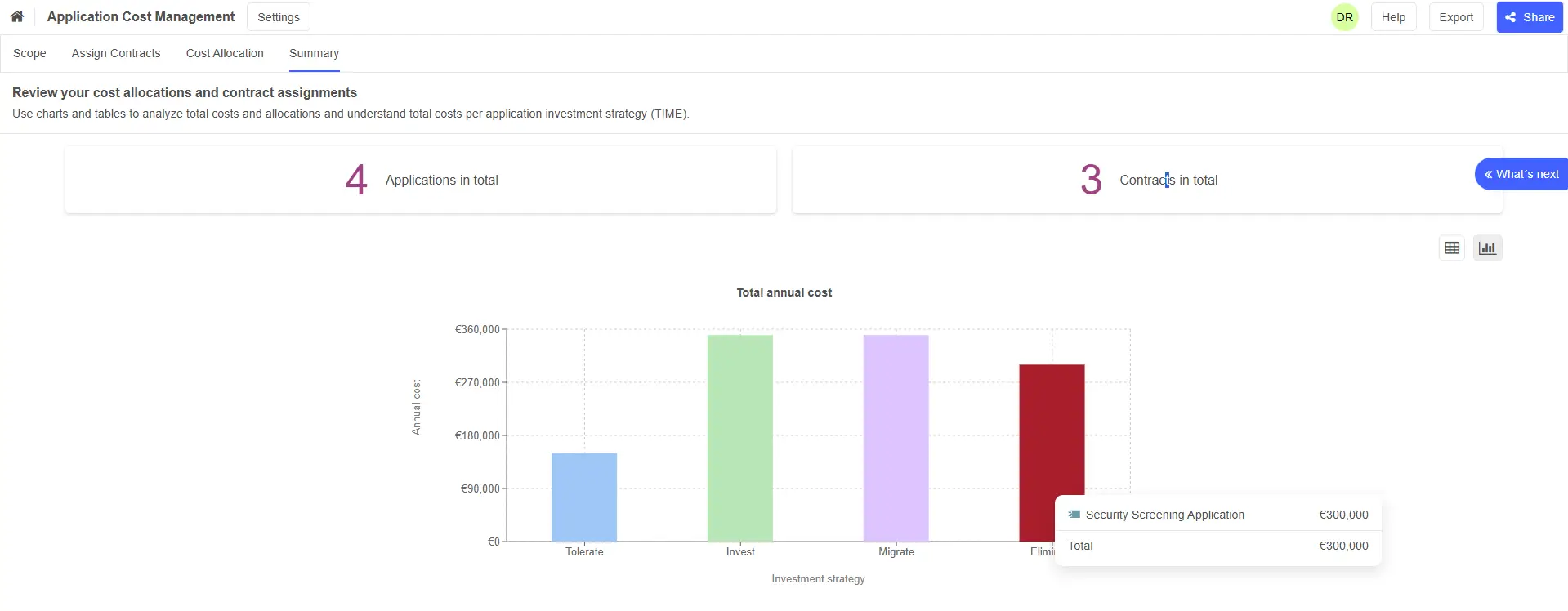
Application cost allocation in ADOIT
From Transparency to Better Decisions in Practice
When cost data sits alongside TIME model categorizations and roadmap timelines, decisions that previously required lengthy internal debate tend to resolve quickly. An application earmarked for elimination but carrying significant allocated costs becomes an immediate priority rather than a backlog item. One flagged for investment that is already consuming a disproportionate share of the budget prompts a harder look before further spend is approved. Where multiple applications overlap in functionality, cost allocation makes the consolidation case in numbers rather than opinions.
This is what application cost management enables at its core: not just visibility into spend, but the ability to make strategic decisions with financial confidence.
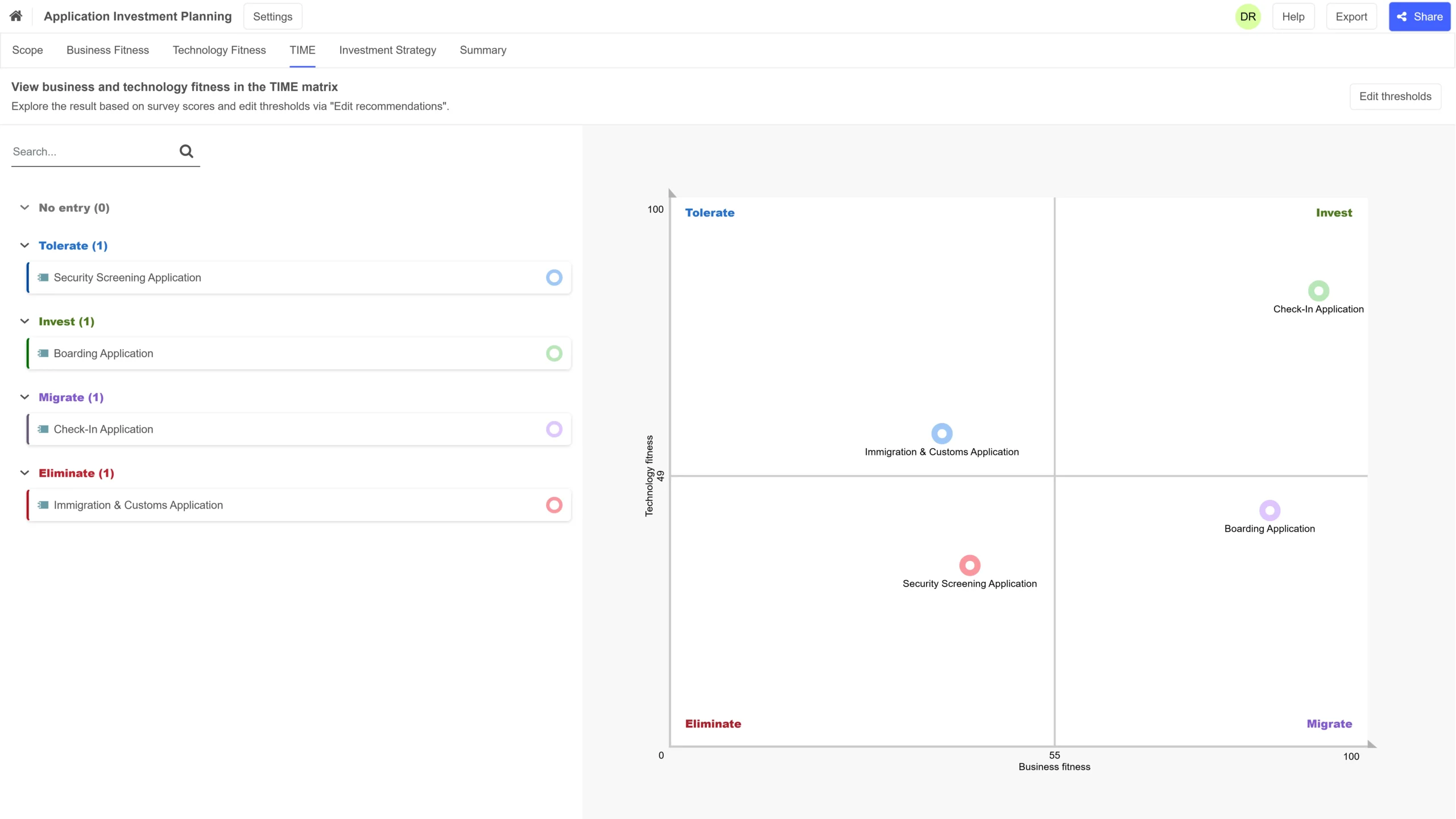
Application investment planning based om TIME model in ADOIT
The Real Benefit: Control and Confidence
When you understand application costs at this level, the nature of portfolio conversations changes. IT and finance stop working from different baselines. Budgets become more precise, vendor negotiations are better informed, and investment cases are easier to build because the financial and strategic rationale sit in the same place.
What organizations tend to find is that the value isn’t just in the individual decisions that become easier. It’s in the shift from reactive cost management to something more deliberate, where spend is actively shaped by strategy rather than inherited from past contracts and legacy commitments.
Summary: Taking Control of Your Application Costs
Getting application costs under control starts with having the right pieces in place. Each of the three steps covered in this blog addresses a distinct part of the picture.
- Application Investment Planning – A structured evaluation of every application across business and IT fitness dimensions, resulting in a clear strategic direction for each one through the TIME model.
- Roadmapping – The translation of those strategic decisions into a dated, sequenced execution plan that shows how the landscape will evolve and keeps teams aligned on what is changing and when.
- Application Cost Management – The financial layer that sits across both, attributing real costs to individual applications and making it possible to validate, prioritize, and act on strategic decisions with accurate data behind them.
Strategy without cost data leads to decisions that can’t be financially justified. A roadmap without cost visibility means priorities are set on incomplete information. And cost data without a strategic framework is just a list of numbers with no context for what to do with them.
When the three connect, the question that opened this blog finally has an answer: how much does each application actually cost us? And more importantly, is it worth it?




Already got our weekly updates?