Enterprise ArchitEcture

Found this helpful? Share it with peers.
A New Phase for Enterprise Architecture
Enterprise Architecture emerged in response to a fundamental challenge: growing organisational complexity. As businesses expanded, the number of supporting capabilities, applications, and technologies expanded with them. Over time, these elements formed dense networks of dependencies across the enterprise.
Enterprise Architecture (EA) evolved as a way to bring structure and transparency to this complexity. By mapping how different parts of the enterprise relate to one another, EA helps organizations understand how their business and IT environments function and evolve.
Today, however, the scale of enterprise landscapes has reached a point where manual analysis alone is no longer sufficient. Architecture repositories contain huge amounts of data about applications, technologies, capabilities and how they connect. Turning that information into meaningful insight, however, is still difficult.
This is where artificial intelligence starts to change the picture. AI-powered capabilities are already part of many EA tools, helping architects search repositories, analyze relationships, and generate architecture documentation more efficiently. Yet what we see today is likely only the first stage of a much larger shift.
As generative AI continues to evolve, its role in Enterprise Architecture will extend far beyond individual task support. Over the next five years, it is expected to reshape how architecture data is explored, how transformation decisions are prepared, and how organizations navigate complexity. The following sections explore where this evolution may lead.

Why Generative AI Is a Natural Evolution for EA
Enterprise Architecture manages one of the most valuable assets for AI: structured organizational knowledge. Architecture repositories capture relationships between business capabilities, applications, technologies, processes and data – effectively describing how the enterprise works. Taken together, these relationships reveal how systems interact and where dependencies really lie.
The challenge has rarely been capturing architecture information. The real difficulty lies in making that knowledge accessible and usable at scale.
As enterprise landscapes grow, extracting meaningful insights becomes increasingly difficult. Architects often spend significant time navigating repositories, interpreting dependencies, and compiling information for decision-makers. Generative AI fundamentally changes how teams interact with architecture insight.
Instead of treating architecture repositories as static sources of information, AI systems can interpret relationships, summarize insights, and generate explanations based on the underlying architecture data. Architecture knowledge can be explored dynamically instead of being manually pieced together.
More importantly, AI can analyze architecture data at a scale and speed humans simply cannot match. Complex dependency networks, thousands of applications, and evolving technology landscapes can be examined continuously rather than only through periodic manual analysis.
Generative AI does not make Enterprise Architecture obsolete. Instead, it amplifies the value of AI in enterprise architecture data – making it easier to interpret complex relationships, surface meaningful insights, and support decisions across the organization.
For a closer look at how AI is already changing Enterprise Architecture, see our blog: How AI Is Transforming EA as a Discipline
The Next Phase: Where GenAI Is Taking Enterprise Architecture
AI capabilities are already emerging in EA tools today. The next stage of development, however, will extend these capabilities far beyond isolated features.
As generative AI matures, Enterprise Architecture is moving toward a model where architecture knowledge becomes more interactive, more accessible, and more continuously analyzed. Several developments illustrate where this evolution is heading.
Conversational Enterprise Architecture
One of the most visible shifts will be how stakeholders access architecture information.
Traditionally, architecture repositories require specialized tools and modelling expertise to navigate. Generative AI is already enabling natural-language interaction with architecture repositories – a capability that is likely to expand significantly in the coming years.
Instead of searching manually through diagrams and models, stakeholders will ask questions such as:
- Which applications support our customer onboarding capability?
- Which systems depend on this technology component?
- What risks arise if we retire this application next year?
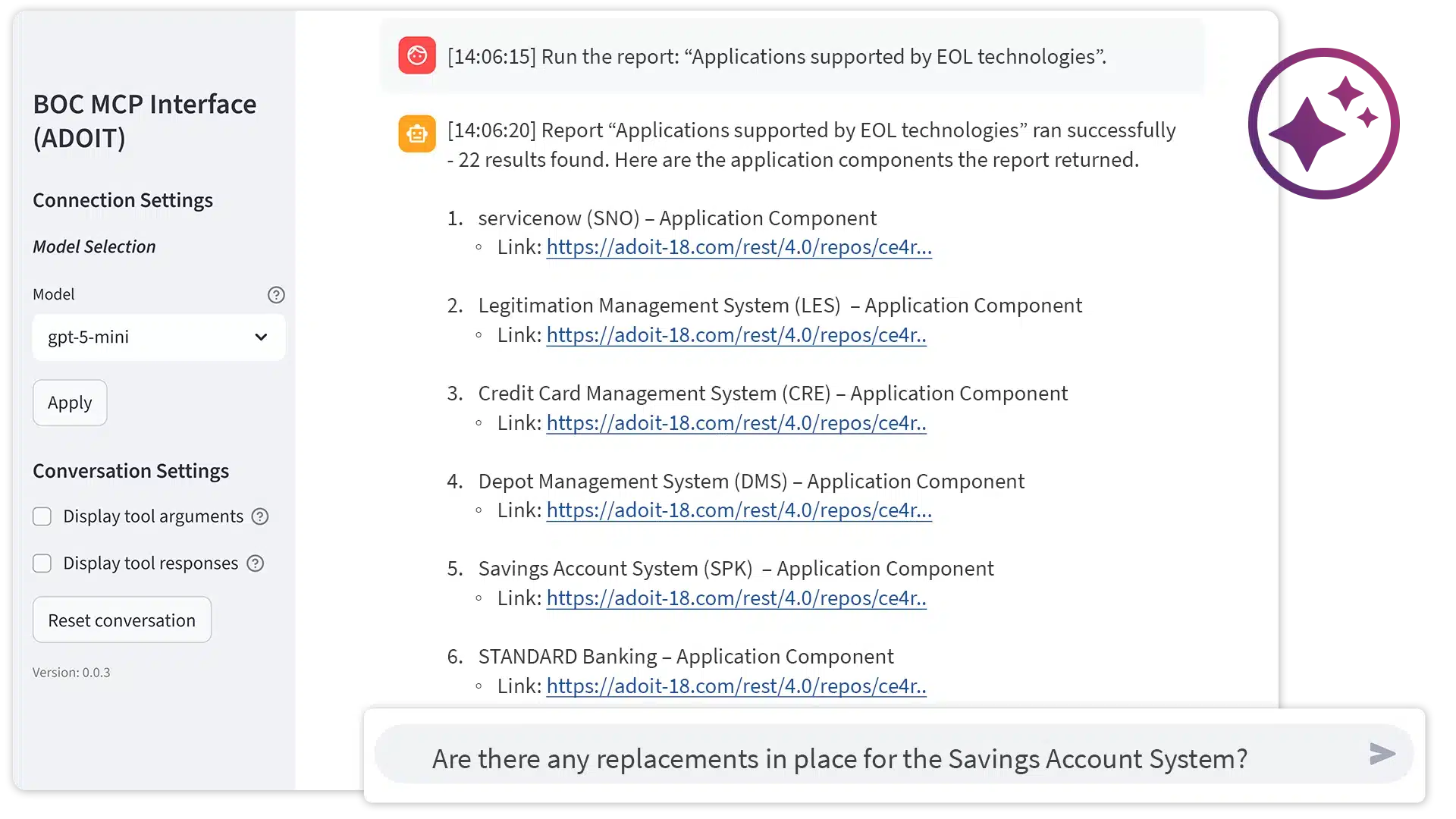
Natural-Language Queries in ADOIT MCP
AI systems can interpret these questions, query architecture repositories, and return answers in plain language, diagrams, or concise summaries.
This development has a broader implication: it democratizes Enterprise Architecture.
Architecture insights have traditionally been accessible mainly to trained architects who understand modelling languages and repository structures. Conversational AI removes that barrier, enabling business leaders, product teams, and transformation managers to access architecture insight directly.
Enterprise Architecture therefore evolves from a specialist discipline into a strategic intelligence layer that informs decisions across the enterprise.
AI-Assisted Architecture Design
Designing architecture solutions often requires evaluating multiple alternatives while considering dependencies across systems, technologies, and business capabilities.
Generative AI can significantly speed up this exploration phase. By analyzing existing architecture models, organizational standards, and known design patterns, AI can assist architects by:
- suggesting architecture patterns
- recommending technologies aligned with standards
- identifying missing dependencies or integration points
- even generating draft architecture models from requirements
Architects remain responsible for validating and refining these designs. However, AI significantly shortens the path from concept to structured architecture — including the definition of an AI roadmap for capability investment. Instead of starting with a blank canvas, architects can begin with AI-generated design proposals and refine them further.
Intelligent Impact Analysis
Understanding the consequences of change is one of the most valuable contributions of Enterprise Architecture. When organizations modernize applications, introduce new technologies, or restructure capabilities, architects have to evaluate the ripple effects across the enterprise landscape.
Generative AI expands this capability by analyzing architecture relationships across the entire landscape at once. AI systems can identify affected applications and processes, explain architectural consequences in plain language, and compare alternative transformation scenarios. They can also surface hidden dependencies that may otherwise go unnoticed.
By accelerating and clarifying impact analysis, AI strengthens Enterprise Architecture’s role as a strategic advisor for transformation initiatives.
Continuous Architecture Monitoring
Enterprise Architecture reviews have traditionally been conducted periodically as part of governance cycles. Modern enterprise landscapes, however, evolve continuously.
Generative AI enables architecture teams to move toward continuous architecture intelligence. Instead of manually reviewing architecture data at intervals, AI systems can continuously analyze the landscape and highlight emerging issues.
These insights might include:
- technologies approaching end of life
- redundant applications performing overlapping functions
- capability gaps affecting strategic initiatives
- deviations from architecture standards
This shift allows Enterprise Architecture to move from retrospective analysis toward proactive guidance for organizational change.
AI-Powered Architecture Knowledge Management
Architecture repositories contain a vast amount of knowledge about how the enterprise works. Yet much of this insight remains difficult to access for non-architect stakeholders. Generative AI changes how this information can be consumed.
AI can automatically summarize architecture documentation, generate stakeholder-specific reports, translate technical insights into business language, and connect information across architecture domains. As a result, architecture knowledge becomes easier to explore and communicate across the organization.
Instead of producing static documentation, architecture teams increasingly manage a continuously evolving intelligence base that supports enterprise decision-making.

Generative AI in EA: Today vs. Tomorrow
AI capabilities already appear in many Enterprise Architecture tools. Today, these features primarily accelerate specific activities such as searching repositories, generating descriptions, or suggesting modelling relationships. But the long-term potential goes far beyond these task-level improvements.
| Area | What AI Supports Today | What the Next Phase Enables |
|---|---|---|
| Repository access | Natural-language search across architecture repositories | Fully conversational architecture assistants |
| Documentation | AI-generated descriptions of architecture elements | Automatic documentation of architecture changes |
| Modeling | Suggestions for relationships or architecture patterns | AI-generated architecture models from requirements |
| Analysis | Impact analysis based on architecture data | Predictive simulations of transformation scenarios |
| Decision support | Insights from architecture queries | AI-assisted transformation planning and strategic evaluation |
The direction is clear: architecture knowledge is becoming increasingly interactive, intelligent, and predictive.
Challenges EA Teams Should Prepare For
While the potential of Generative AI in Enterprise Architecture is significant, several challenges must be addressed to realize its full value.
Architecture Data Quality
AI systems depend heavily on the quality of the underlying data they analyze. If architecture repositories contain incomplete or outdated information, insights generated by AI will be unreliable.
Organizations with well-governed architecture practices and high-quality repositories will benefit most from AI capabilities.
Governance and Trust
Architecture decisions often have long-term strategic implications.
While AI can assist with analysis and scenario exploration, responsibility for architectural decisions stays with human experts. Clear governance frameworks will therefore be essential to ensure AI-generated insights are transparent, explainable, and aligned with organizational policies.
Integration with Enterprise Data Ecosystems
To deliver meaningful insights, AI must interact with multiple enterprise data sources – including portfolio management systems, operational data, and transformation initiatives.
Connecting these information sources securely and effectively will become an important architectural challenge.
To learn how AI capabilities are already embedded into EA tools, check out our blog AI in ADOIT: How We Built Purposeful AI for Enterprise Architecture.
Why Early Exploration Matters
Enterprise Architecture is already widely recognized as a critical lever for managing enterprise transformation.
It helps organizations align business strategy with technology investments, manage complex application portfolios, and guide modernization initiatives across the enterprise.
Generative AI significantly strengthens this role. As architecture information becomes easier to explore, analyze, and communicate, Enterprise Architecture increasingly acts as an intelligence layer for enterprise transformation.
Instead of primarily describing the enterprise landscape, architecture teams interpret it – providing leaders with continuously updated insight into risks, dependencies, and opportunities.
Organizations that combine strong EA practices with emerging AI capabilities gain important advantages:
- faster preparation of transformation initiatives
- greater transparency across complex IT landscapes
- stronger alignment between strategy and technology investment
- more informed, data-driven decision-making
The Next Evolution of Enterprise Architecture
Generative AI will not replace Enterprise Architecture. What it will do is significantly expand what the discipline can achieve.
As architecture repositories become more intelligent and more accessible, generative AI enables Enterprise Architecture to deliver insight more continuously and at a much greater scale.
Architects will spend less time compiling information and more time interpreting it – guiding transformation initiatives based on continuously analyzed architecture insights.
Over the next five years, the combination of human architectural expertise and AI-powered insight will reshape how organizations understand complexity, plan change, and make strategic technology decisions.
Enterprise Architecture will remain the discipline that connects strategy, technology, and transformation. With generative AI, it gains a powerful new capability: helping organizations turn enterprise complexity into actionable insight.





Already got our weekly updates?