BUSINESS PROCESS MANAGEMENT

Found this helpful? Share it with peers.
Introduction
In Part 1 of this blog series, we explored how organizations can trace process challenges back to their architectural roots. By combining Business Process Management (BPM) in ADONIS with Enterprise Architecture (EA) in ADOIT, we saw how operational issues become opportunities for targeted, evidence‑based improvement.
This second part flips the perspective. Instead of starting with day‑to‑day processes, we begin at the strategic level — where goals are set, capabilities are defined, and priorities take shape. The challenge here is turning intent into action: connecting vision with the systems and processes that make it real.
It’s a shift in perspective that reveals the full strength of BPM and EA working together: strategy that reaches execution, and execution that continuously informs strategy.
Flipping the Perspective: Starting with Strategy
In this second scenario, we start at the strategic level, where the big questions are:
- What are our strategic goals?
- Which capabilities are needed to achieve them?
This reflects a familiar challenge. Many organizations clearly define what they want but struggle to translate strategy into reality. They often overlook the next layer of questions:
- What should change within our capabilities?
- Are there infrastructure issues that must be fixed first?
- How will these changes affect our business processes?
- How do we actually execute them?
Only by answering these questions can strategy turn into tangible results.
Here, Enterprise Architecture defines the “why” and the “what,” while Business Process Management delivers the “how.”
From Goals to Capabilities to Processes
Once the strategic direction is clear, the next step is to anchor it in architecture — to connect every goal with the capabilities that make it possible.
In ADOIT, this starts with goal maps, which illustrate how strategic objectives relate to each other and where they might create dependencies or trade-offs. Each goal is then linked to the capabilities required to realize it. This helps organizations identify the areas that need to evolve first.
Because ADONIS and ADOIT share a common repository, these links extend beyond strategy alone. Capabilities, applications, and processes are connected across both tools, so every potential change immediately reveals its downstream effect — all the way from the IT landscape to actual everyday processes.
This seamless traceability ensures that every strategic decision remains grounded in operational reality.
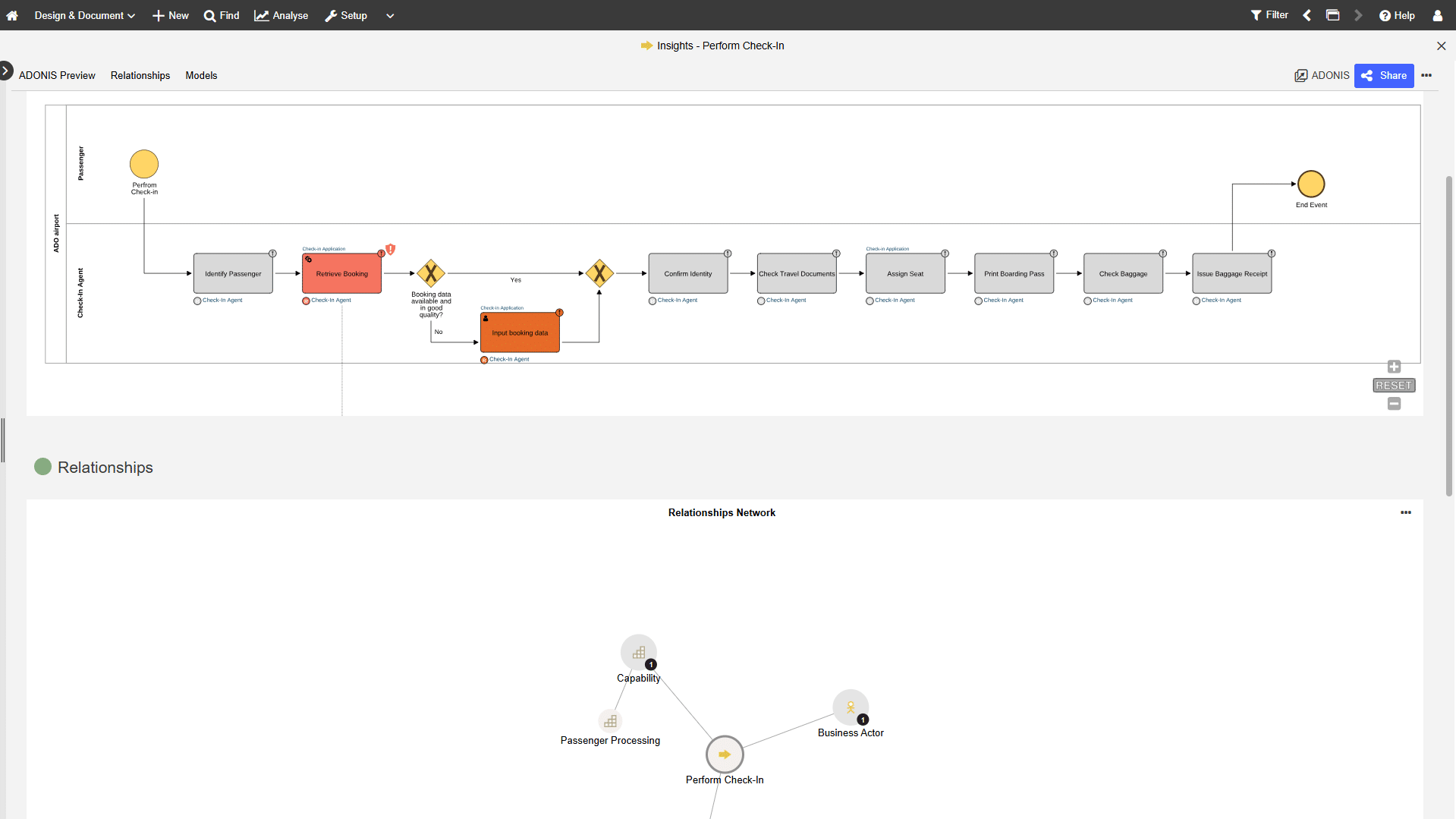
An example of an airport check-in process and its relationship network
Turning Strategy into Actionable Change
After identifying which capabilities and processes are affected, the question becomes: What comes next?
With Workspaces and Transformation Planning in ADOIT, strategies can be translated into concrete, manageable steps. You can:
- Define clear timelines and owners
- Set measurable milestones
- Prioritize and track initiatives
This collaborative setup ensures that even non-architect stakeholders can participate. Strategic goals stop being abstract visions and become tangible, trackable programs that drive measurable progress.
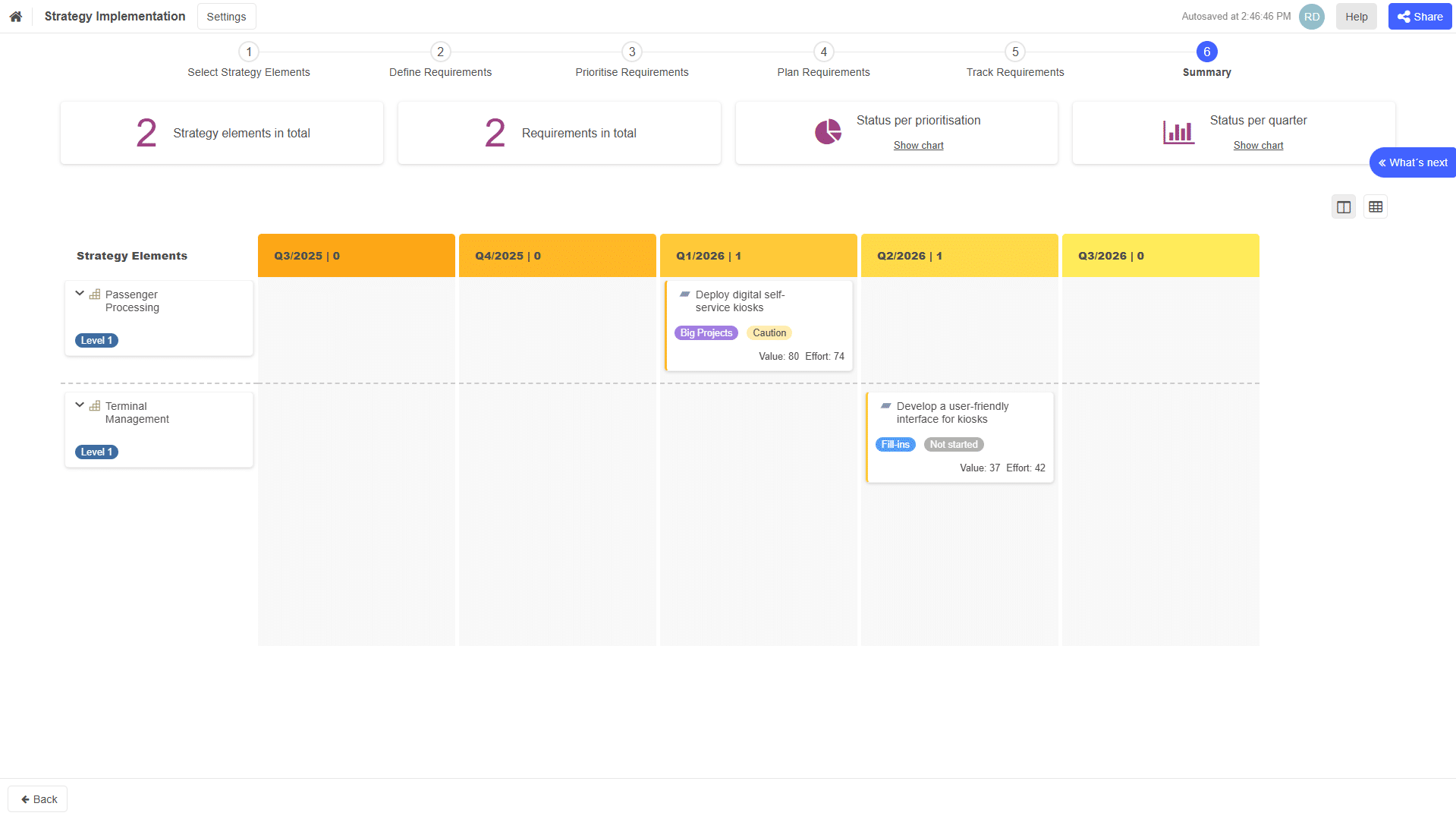
Transformation planning in ADOIT Workspaces
Immediate Visibility into Business Impact
Once change initiatives are defined, teams need to understand how they affect today’s operations. That’s where the shared repository between ADOIT and ADONIS becomes essential.
For example, improving a specific capability immediately shows:
- Which processes will be adapted
- Which applications will be affected
- Where potential risks or dependencies exist
The ability to navigate these relationships in just a few clicks provides instant visibility into consequences and dependencies, enabling faster, better-informed decisions and reducing the risk of unintended side effects.
Faster Process Design with AI Support
When it’s time to redesign a process, there’s no need to start from scratch. With AI-assisted process design in ADONIS, teams can automatically generate process models based on architecture data from ADOIT. This accelerates updates, ensures alignment with strategic goals, and reduces manual effort — without sacrificing flexibility.
Quickly generate and refine process models with the AI Assistant
The end result can still be refined manually or accepted as-is, depending on the complexity of the change. Either way, AI speeds up the transition from planning to implementation.
Hint: Learn more about AI in ADONIS and AI in ADOIT and how the intelligent features help you achieve more impact with less effort.
A Practical Example: From Vision to Results
Consider our airport example from Part 1. This time, the story begins with a high-level goal, for instance, reducing assistance costs, which leads leadership to introduce self-service kiosks.
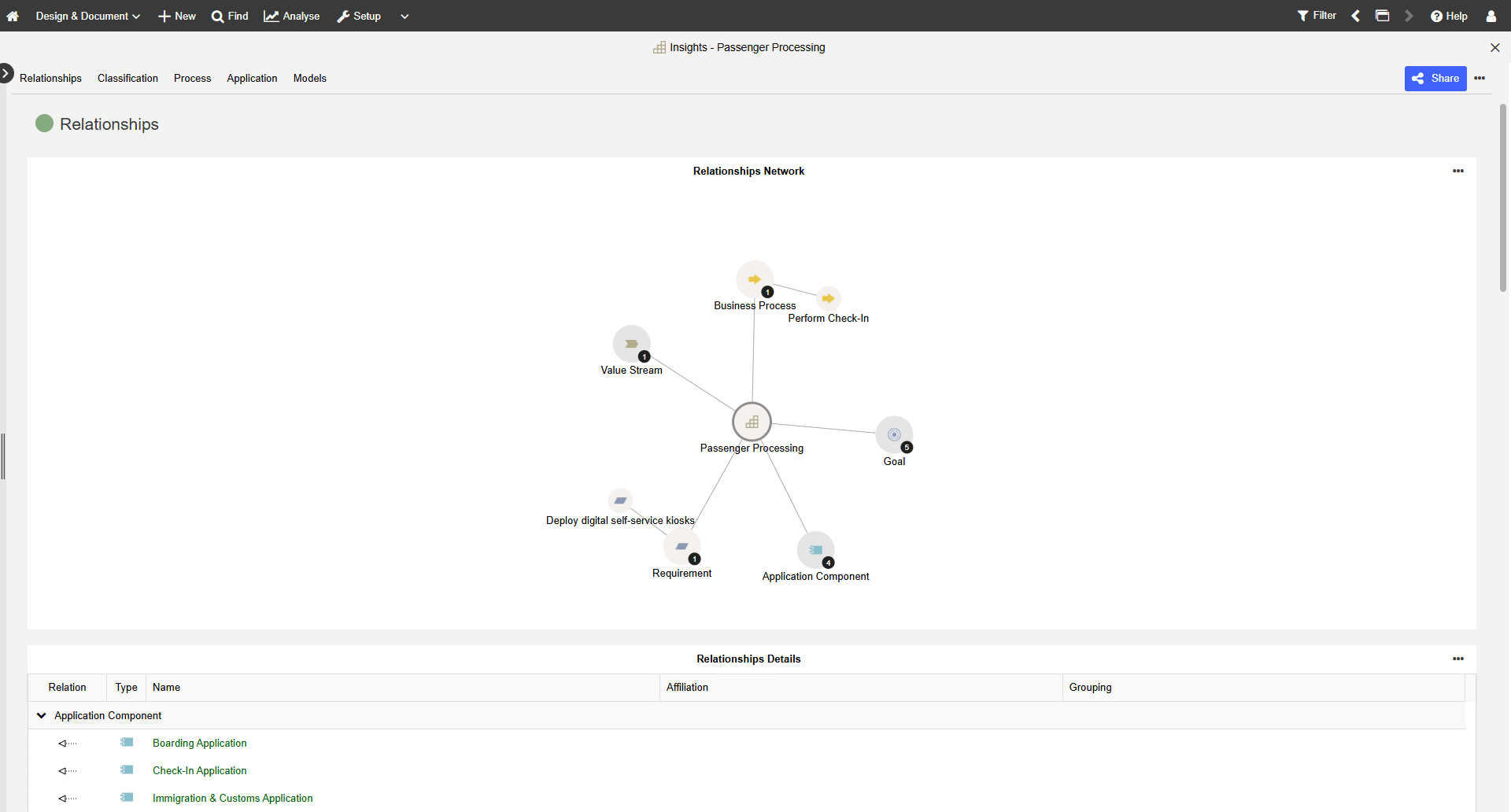
Architectural relationship analysis linking goals, requirements, applications, and processes
Through EA analysis, the required capabilities and affected applications are identified. BPM then takes these insights and translates them into new, optimized check-in processes that connected digital kiosks, human support, and IT systems seamlessly.
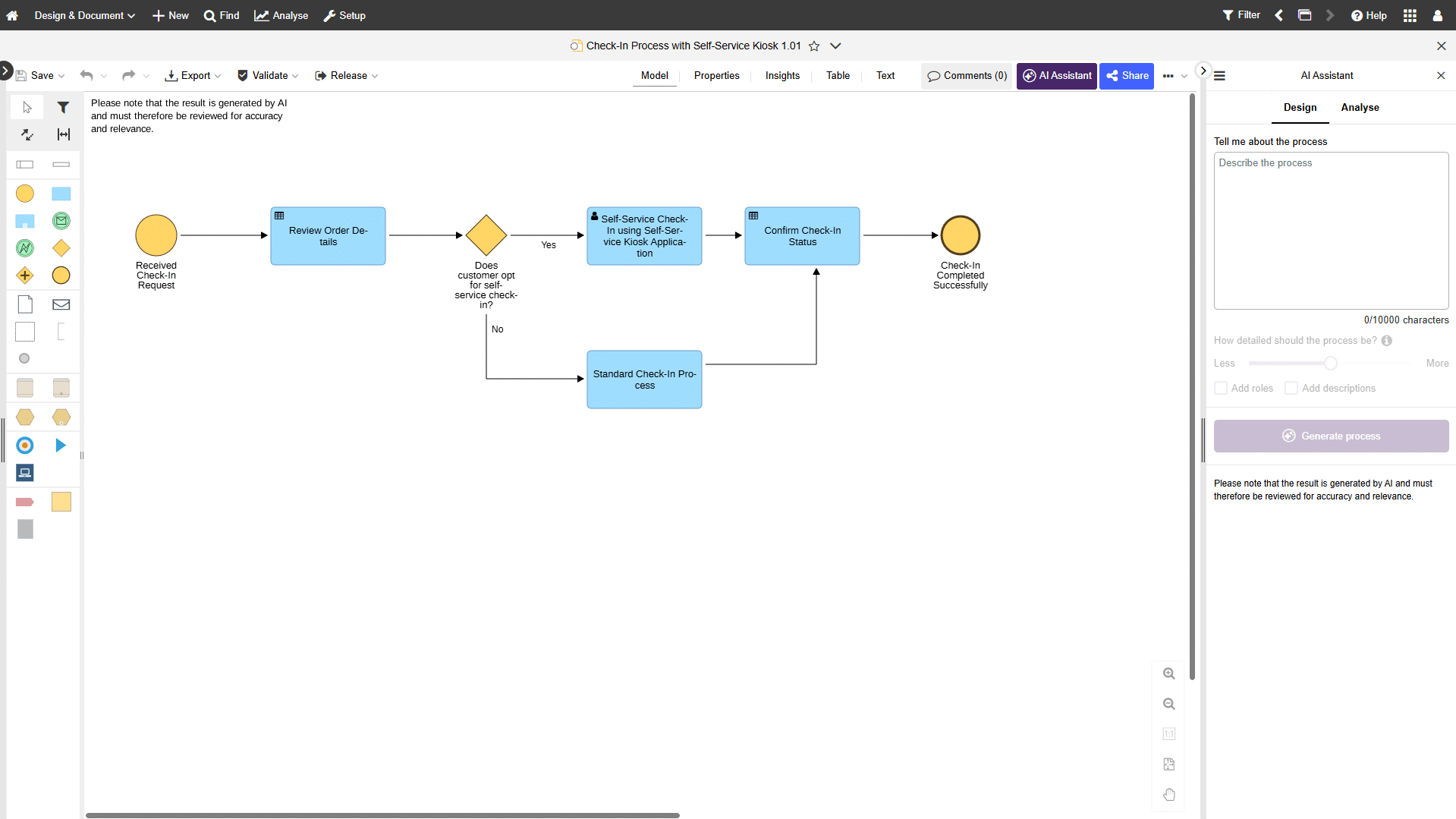
An example of an airport process with self-service check-in kiosks
The results of such approach would lead to:
- Lower operational costs
- A smoother passenger experience
- A scalable base for future digital services
- More targeted investment in IT and process change
One Story, Two Perspectives
Together, these two blog posts form one continuous story:
- Part 1: From operational insight to architectural root cause
- Part 2: From strategic vision to executable processes
The takeaway is simple: when ADONIS and ADOIT work hand in hand, organizations gain the visibility, structure, and confidence to drive sustainable transformation.





Already got our weekly updates?