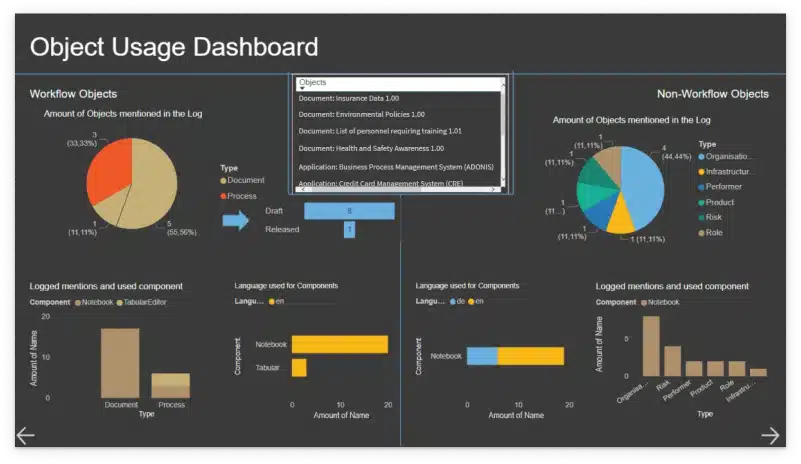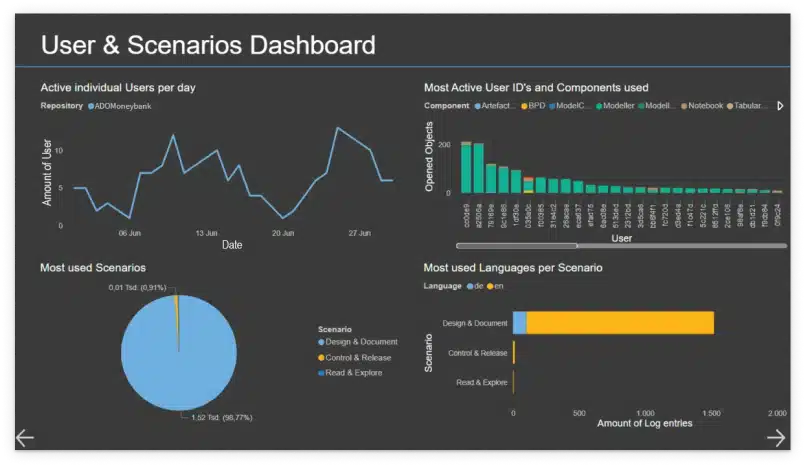
ADONIS Usage Analysis provides structured insights into user activity and modeling dynamics. Monitor adoption, identify inactive areas, and gain transparency into how your BPM environment is used.

Business need

Process Performance Management

Activity Reporting

Governance Monitoring

Categories

ADONIS

Product extension

Requirements

ADONIS 16.0 and above

    Gain detailed insights into user activity and repository utilization

    Features that make all the difference.
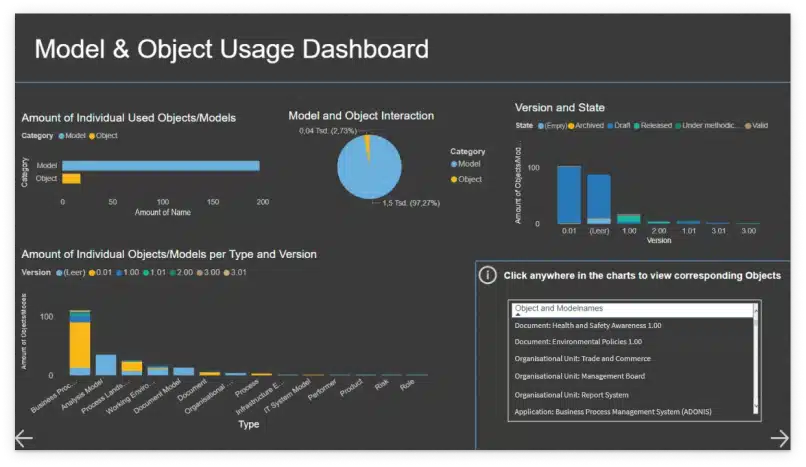
    User Activity Tracking

    Track logins, modeling activities, object changes, and portal usage. 
Gain visibility into how different roles interact with ADONIS across projects and initiatives.

    Repository & Model Analytics

    Analyze repository growth, model updates, object creation, and structural changes to monitor modeling dynamics and content evolution over time.

    Customizable Reports & Dashboards

    Generate structured reports and visual dashboards for administrators and governance teams to evaluate usage patterns, modeling discipline, and adoption trends.

    And beyond that

    Stronger platform governance

    Identify inactive users, outdated models, and deviations from modeling policies.

    Transparent usage visibility

    Provide objective insight into how ADONIS is used across teams and initiatives.

    Data-driven adoption management

    Use activity insights to guide training, communication, and rollout strategies.

    Put it to work where it matters most.

    Process Performance Management

    Usage analytics reveal whether process documentation is actively applied across the organization – providing the foundation for effective performance measurement and improvement.

    And power other core BPM scenarios:

    Process Design

    Process Standardization

    Process Compliance

    Process Portal

    This module is an extension for our holistic BPM suite

    Details on the latest release.

    • Corrective Support

    • Project delivery | Self Service Delivery | Standard Delivery

    Helpful links
    ADONIS Usage Analysis

    Monitor and analyze platform usage across your ADONIS environment.

    Version

    2.1.0

    Last Update

    25. June 2025

    Supported Languages

    All Languages

    Compatibility
    • ADONIS 14.0.0 and above

    Frequently Asked Questions (FAQ)

    The add-on logs anonymized usage data, including accessed models and objects, timestamps, repositories, scenarios, language context, and user roles. Logged parameters include:

    • Category
    • Component
    • ID
    • Name
    • Type
    • State
    • Repository
    • Scenario
    • Language
    • Version
    • Anonymized user reference

    No personally identifiable information is stored.

    Each model or object version is logged separately, as different versions are technically distinct entities.
    Cumulative analyses are possible when evaluations are based on stable attributes such as the model name. If the name remains unchanged, usage can be assessed across versions as well as individually.

    No additional software is required to collect usage data within ADONIS.
    For advanced visualization, exported log files can be analyzed using external BI tools such as Power BI.

    Logging works independently of the user interface language. Entries are stored in the system’s primary language, while the user’s language context is recorded for analysis.

    Governing BPM with measurable insight

    Visibility into user activity and repository dynamics allows organizations to manage their BPM environment based on measurable evidence rather than assumptions.

    Visibility into user activity and repository dynamics allows organizations to manage their BPM environment based on measurable evidence rather than assumptions.

    Matthias Putzler

    BOC Group

    Add ADONIS Usage Analysis to your BPM suite.

    Turn ADONIS usage data into actionable governance insights.

    Interested? Let’s talk!

    Book a quick 15-minute call and discover how this module can make a difference for you.

    Explore more BPM modules.