Governance, Risk & Compliance

Found this helpful? Share it with peers.
Introduction
Every organization has compliance obligations. Regulations set requirements, internal policies translate them into controls, and someone is supposed to check that those controls are actually working. In a small organization, that can be managed informally. As complexity grows, it can’t.
The moment that informal approach stops working looks different for every organization. A new regulation lands. An audit finds a gap nobody knew existed. A control that was working fine gets missed because the person responsible changed roles. Without a structured plan behind the monitoring, these things only become visible after the fact.
A compliance monitoring plan is designed to get ahead of that. It defines what needs to be monitored, how often, by whom, based on which risks, and what happens when something doesn’t pass. This guide walks through what a good plan includes, how to build one step by step and how it fits into your wider programme.
What is a Compliance Monitoring Plan?
Definition and purpose
A compliance monitoring plan is a structured planning document that translates applicable compliance requirements into concrete monitorable activities, assigned responsibilities, evidence requirements, reporting routines and escalation paths.
In practice, it answers six questions:
- What needs to be monitored?
- Why does it matter?
- How will it be monitored?
- How often will monitoring take place?
- Who is responsible?
- What happens when an issue is found?
The main goal is to make the real compliance status visible early enough to act. A useful plan helps teams identify gaps, document findings, trigger remediation, and show management where compliance is working and where obligations are being actively managed.
A strong compliance monitoring plan connects requirements to controls, controls to owners, owners to evidence, and evidence to reporting. Without those links, monitoring remains a collection of isolated checks. With them, it becomes part of a working compliance management system that can be evidenced when scrutiny arrives.
Compliance monitoring plan vs compliance monitoring programme
A compliance monitoring plan and a compliance monitoring programme are closely related, but they are not the same thing.
The compliance monitoring programme is the broader operating model. It includes governance, policies, methodology, roles, reporting, escalation, issue management and continuous improvement.
The compliance monitoring plan is the operational layer of that programme. It turns the monitoring approach into a concrete set of activities, owners, frequencies, evidence requirements and reporting routines for a defined period, usually a quarter, half-year or year.
Hint: For a broader overview of the monitoring process itself, see our guide on what compliance monitoring is.
| Compliance Monitoring Plan | Compliance Monitoring Programme |
|---|---|
| Defines specific monitoring activities | Defines the overall monitoring approach |
| Usually time-bound | Ongoing operating model |
| Focuses on scope, frequency, owners and evidence | Includes governance, methodology, roles and reporting |
| Used to plan and execute checks | Used to manage monitoring as a continuous capability |
| Updated based on risk, findings and change | Improved over time as the compliance function matures |
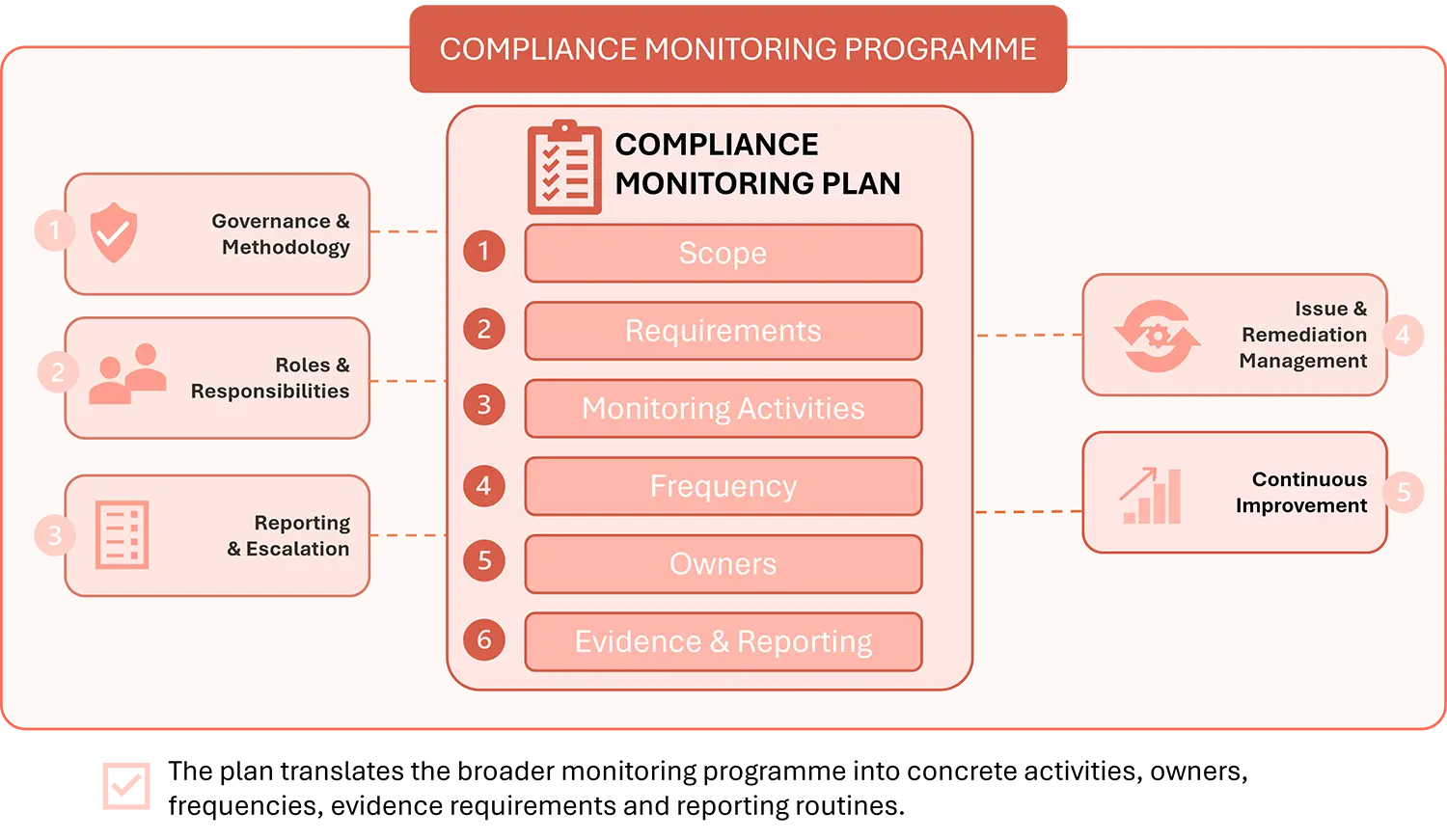
How a Compliance Monitoring Plan fits into the Compliance Monitoring Programme
Why You Need a Compliance Monitoring Plan
Regulatory pressure and audit readiness
Regulators and auditors expect organizations to demonstrate that compliance works in practice. Policies alone are rarely enough. What matters is whether requirements are understood, controls are operating, evidence is available, and weaknesses are followed up on.
A compliance monitoring plan helps create that evidence trail. It shows that monitoring is not random or reactive, but planned, risk-based, documented and linked to the requirements it is supposed to verify. When an audit or regulatory review starts, the organization can explain which areas were monitored, why they were prioritized, what was found, and which actions were taken.
Early detection of compliance gaps
Compliance gaps rarely appear all at once. More often, they develop quietly. A regulation changes, but the related policy is not updated. A control still exists on paper, but no longer matches the process. A system migration changes the evidence source. A remediation action remains open for too long.
A monitoring plan makes those issues easier to detect before they become audit findings, incidents or regulatory breaches. It creates regular checkpoints where teams compare intended controls are supposed to do with what is actually happening in the business. The goal is to monitor the right things with the right frequency, based on risk.
Accountability and documentation
One of the most common weaknesses in compliance monitoring is unclear ownership. A requirement may be owned by legal, a control operated by the business, evidence stored by IT, and remediation expected from a process owner who was never formally assigned.
A compliance monitoring plan makes these responsibilities visible. It defines who performs the monitoring, who provides evidence, who reviews the result, who approves remediation, and who needs to be informed when something is overdue or critical.
This is crucial, as it turns accountability from an assumption into a documented part of the process.
What To Include in a Compliance Monitoring Plan
Scope and regulatory requirements
Scope defines the boundaries of the plan. It may cover specific entities, business units, processes, systems, regulations, standards or third-party relationships. The important part is being explicit about what is included, because what isn’t named tends not to get monitored.
Each requirement in scope should be connected to the relevant policies, risks, controls, owners and evidence. A requirement that isn’t mapped to operational activity is difficult to monitor and even harder to evidence.
Monitoring objectives
Monitoring objectives explain what the plan is trying to achieve.
Typical objectives include:
- Verifying that controls are implemented
- Testing whether controls operate effectively
- Checking whether policies are followed in practice
- Detecting compliance gaps early
- Monitoring remediation progress
- Preparing evidence for audits and regulatory reviews
- Giving management visibility into compliance status
Good objectives are specific enough to guide the monitoring activity. “Ensure compliance” is too broad. “Verify that all high-risk third-party reviews were completed, approved and evidenced within the defined review cycle” is much more useful because it defines the activity, scope, evidence and expected outcome.
Roles and responsibilities
The plan should define the roles involved in monitoring and what each role is expected to do.
Common roles include compliance owner, control owner, process owner, risk owner, evidence provider, reviewer, approver, internal audit and management sponsor.
The important point is not the title, but the responsibility. Each monitoring activity should have a named owner and a clear reviewer. If the plan only says “Compliance team” or “Business unit,” accountability remains too vague to support reliable follow-up.
Monitoring activities and frequency
Monitoring activities translate requirements and controls into concrete checks. In many organizations, these activities are closely connected to the internal control system (ICS), where controls, responsibilities, evidence and testing activities are documented and reviewed.
Examples include control testing, sample-based transaction reviews, policy compliance checks, evidence completeness reviews, training completion checks, third-party compliance reviews, incident trend reviews, remediation follow-up, KPI and KRI monitoring, and regulatory change impact checks.
Frequency should be risk-based. High-risk controls or regulator-sensitive areas may require monthly or quarterly monitoring. Lower-risk areas may be reviewed semi-annually or annually.
A practical plan usually combines recurring monitoring activities with event-based triggers, such as new regulations, major process changes, incidents, audit findings or organizational restructuring.
Reporting structure and escalation paths
Monitoring only creates value if the results reach the right people.
The plan should define who receives monitoring results, how often reports are issued, which KPIs and KRIs are included, which findings must be escalated, and who approves remediation actions. Without escalation rules, findings can remain visible without becoming actionable. A dashboard may show an issue, but the organization still needs a defined path for decision, ownership and remediation.
Review and update schedule
A compliance monitoring plan should not be static and needs to reflect changes in requirements, risks, processes, systems and findings.
At a minimum, the plan should be reviewed annually. More mature organizations also update it when a new regulation applies, a major audit finding occurs, a critical control fails, a business process changes, or incident trends indicate recurring weaknesses.
The plan should evolve together with the organization. Otherwise, it creates the appearance of monitoring while still focusing on yesterday’s risks.
How to Create a Compliance Monitoring Plan Step by Step
Step 1: Define the scope
Start by deciding what the monitoring plan should cover — and just as importantly, what it should not cover.
For a first version, avoid making the scope too broad. It is better to create a reliable plan for high-risk areas than a comprehensive plan that cannot be executed.
Useful starting points include regulations with high enforcement relevance, processes with previous audit findings, controls linked to critical risks, obligations affecting customers or data, and third parties supporting critical operations. The scope should be clear enough that everyone understands what is included and what is not.
Step 2: Identify applicable regulations and standards
Next, identify the obligations that apply within the defined scope.
These may come from laws, regulations, industry standards, supervisory guidance, contracts, internal policies, codes of conduct, group standards or certification requirements. Do not stop at listing the regulation. Break the obligation down into monitorable requirements.
For example, “comply with data protection rules” is too broad. A monitorable requirement could be: “access rights to systems containing personal data must be reviewed at least quarterly.”
Each requirement should then be mapped to the relevant policy, control, process, system and owner. Depending on the requirement, controls may be preventive, detective or corrective and define how compliance is ensured in practice.
Step 3: Assess compliance risks
A monitoring plan should follow the risk. That means assessing where non-compliance is most likely to occur and where the consequences would be most serious. Consider factors such as regulatory impact, financial exposure, customer or employee impact, control maturity, past incidents, process complexity, third-party dependency and frequency of change.
The result should be a prioritized view of what needs more frequent or more detailed monitoring.
Step 4: Design monitoring activities and controls
Once risks and requirements are clear, define how each area will be monitored.
For each activity, document:
| Field | Example |
|---|---|
| Requirement / control | Access rights to systems processing personal data are reviewed quarterly |
| Monitoring method | Sample-based access review against HR leaver/mover list |
| Frequency | Quarterly |
| Data source | IAM system export and HR records |
| Evidence required | Signed review log, exception list, remediation tickets |
| Success criteria | 100% of sampled accounts reviewed; exceptions closed within 30 days |
| Owner / reviewer | IT Security / Compliance |
| Escalation trigger | Any exception open for more than 30 days is escalated to the Compliance Committee |
This is where the plan becomes operational. It should be specific enough that the activity can be repeated consistently, even if the person performing it changes.
For example, if customer complaints must be handled within a defined response time, the monitoring activity could be a monthly sample review of closed complaints. Evidence may include complaint records, timestamps and response documentation. Escalation may be triggered if delays repeat or affect critical complaint categories.
Step 5: Assign responsibilities
A monitoring plan without named owners is only a schedule, so each activity should have at least one responsible owner and one reviewer. In many cases, the control owner performs or supports the activity, while compliance reviews the outcome and challenges inconsistencies.
Responsibility should also cover remediation. If a finding is identified, the plan should define who creates the action, who owns it, who approves it, and who confirms closure. This prevents a common problem: monitoring identifies issues, but issue management happens somewhere else.
Step 6: Set reporting cadence and escalation rules
Define how monitoring results will be reported. A basic reporting structure may include monthly operational reports for control owners, quarterly compliance reports for management, immediate escalation for critical findings, and an annual summary for audit or board-level review.
Reports should focus on decision-relevant information, such as monitoring completion status, failed controls, missing evidence, open findings, overdue remediation actions, recurring issues and areas requiring management decision.
Escalation rules should be written clearly. For example: “High-risk findings overdue by more than 30 days are escalated to the compliance committee”. This removes ambiguity and makes follow-up part of the governance process rather than a matter of individual persistence.
Step 7: Review and update regularly
The final step is to build a review into the plan itself.
A compliance monitoring plan should be reviewed at least once per year, but updates should also happen when risk changes. If a high-risk area produces repeated findings, monitoring frequency may need to increase. If a control becomes automated and stable, the frequency or method may change.
The review should ask:
- Were all planned activities completed?
- Which findings occurred?
- Were remediation actions closed on time?
- Did the monitoring frequency match the risk?
- Did any new obligations appear?
- Are any controls obsolete?
- Did reporting support management decisions?
This review is the feedback loop that keeps the plan aligned with current risks, requirements and operational reality.
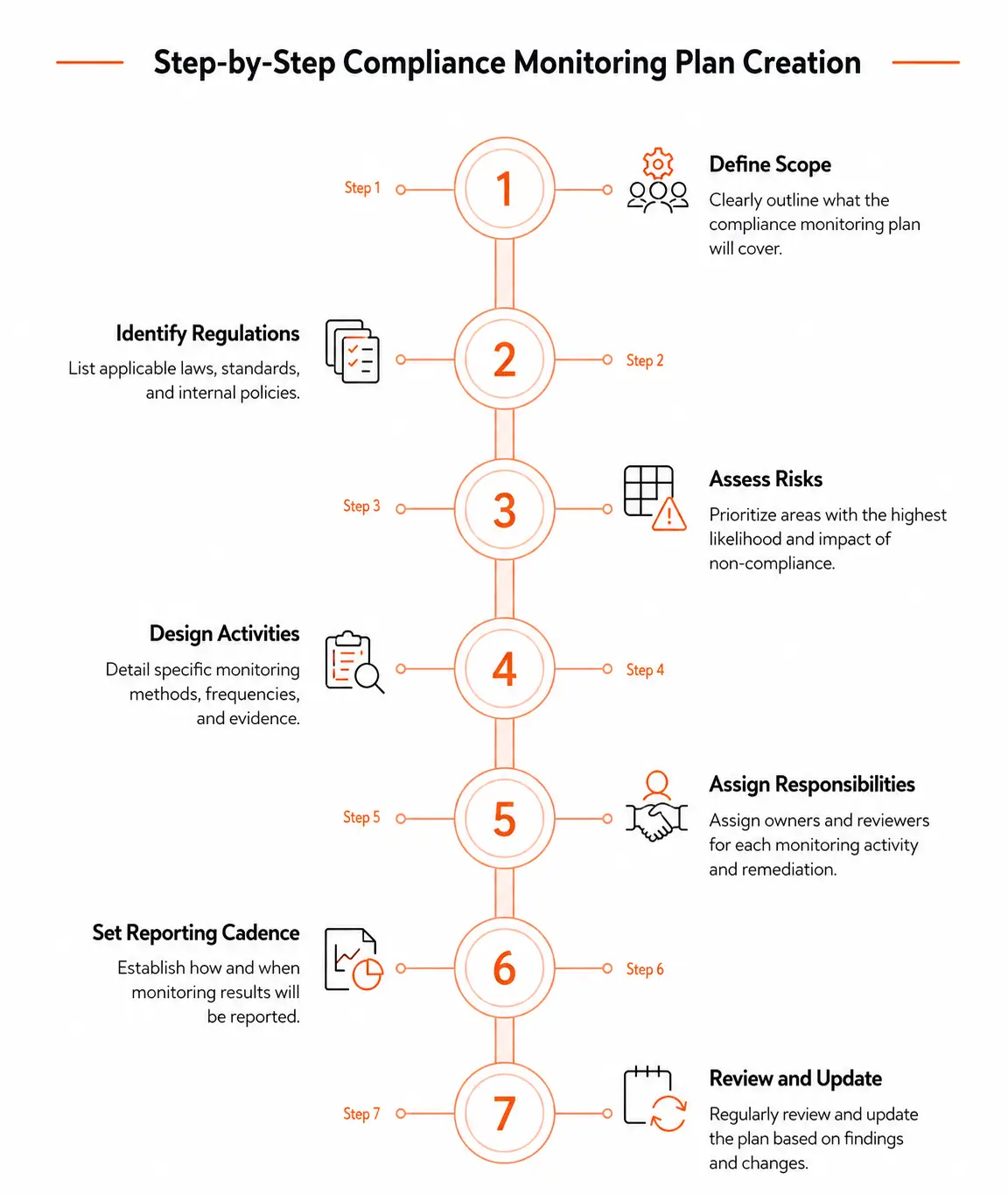
7 Steps for Building a Compliance Monitoring Plan
How to Adapt Your Compliance Monitoring Plan to Your Organization
The right level of detail depends on the size and complexity of the organization. A smaller organization can usually work with a compact plan that covers core obligations, owners, frequency and evidence. A more complex or heavily regulated organization will need more, including entity-level scope, control IDs, evidence repositories, issue tracking and management reporting.
The principle is proportionality. A plan that is too detailed becomes impossible to maintain. One that is too light stops being useful when it matters.
A practical way to test it: could someone outside the compliance team read the plan and understand what is being monitored, why it matters, who owns it, and what evidence proves the activity was completed? If yes, the plan is in good shape.
Common Mistakes in Compliance Monitoring Plans
No clear ownership
The most common mistake is assigning monitoring activities to teams instead of named individuals. When a finding appears and nobody is sure who should respond, the issue stays open. A plan that doesn’t separate responsibilities clearly creates visibility without action.
Monitoring too infrequently
Annual monitoring works for stable, low-risk areas. The problem is when it becomes the default regardless of risk. High-risk obligations and controls under regulatory scrutiny need more attention, and the plan should reflect that.
No escalation path defined
Findings are only useful if they lead to decisions. Many plans define the checks but stop there, so issues get recorded and remediation actions go overdue without anyone being formally accountable for moving them forward. Escalation thresholds should be defined before they’re needed.
How ADOGRC Helps You Manage Your Compliance Monitoring Plan
A compliance monitoring plan becomes much more effective when it is connected to the wider compliance system.
ADOGRC supports this by connecting requirements, controls, risks, responsibilities, evidence, workflows and reporting in one unified GRC environment.
Instead of maintaining the plan as a separate spreadsheet, teams can define monitoring activities directly in relation to the requirements and controls they address. Owners can be assigned, tasks can be triggered, evidence can be collected, and findings can be tracked through remediation workflows.
This creates a continuous connection between regulatory requirements, internal policies, compliance risks, controls, process and system context, responsible owners, monitoring activities, evidence and dashboards.
The ADOGRC Compliance Library gives teams a structured starting point for selecting relevant requirements and mapping them to controls and responsibilities. Monitoring activities can then be prioritized based on risk, findings and control criticality.
The result is a monitoring plan that no longer sits next to the compliance system, but becomes part of it. It is a live compliance monitoring system where the organization can see what is planned, what has been completed, where evidence is missing, and which issues require attention.
This is the difference between preparing for audits and staying audit-ready.
Summary
A compliance monitoring plan gives structure to one of the most important parts of compliance management: proving that requirements are not only understood, but actively monitored.
It defines what needs to be checked, how often, by whom, with which evidence, and what happens when a gap appears. That makes it easier to detect issues early, assign responsibility, report clearly and improve continuously. For organizations working with growing regulatory complexity, the plan should not exist as a static spreadsheet. It should be connected to requirements, controls, risks, evidence, owners and workflows.
That connection is what turns compliance monitoring from a periodic evidence-gathering exercise into a continuous part of the organization’s GRC system.




Already got our weekly updates?