Enterprise ArchitEcture

Found this helpful? Share it with peers.
Introduction
Customer journey mapping in enterprise architecture helps organizations connect customer interactions with business capabilities, processes, and IT systems. While customer journeys are often viewed as marketing tools, they are not the primary focus of enterprise architecture, but they provide valuable insights for connecting business and IT.
From an EA perspective, a customer journey represents how value is created and supported across organizational structures and applications. When modeled in ADOIT, customer journeys can be linked to capabilities, value streams, and systems — enabling impact analysis and more informed transformation decisions.
This article explains how to approach customer journey mapping within enterprise architecture and how ADOIT supports structured modeling and analysis.
What is a Customer Journey?
Embarking on a journey as a customer in today’s dynamic business landscape involves a series of interconnected experiences that shape our interactions with products, services, and brands. From the initial discovery to the post-purchase engagement, every touchpoint plays a crucial role in defining our overall experience. A customer journey, in essence, is the end-to-end exploration of these interactions, providing a comprehensive view of our experience from awareness to engagement.

What are the stages of a Customer Journey?
A customer journey consists of a sequence of interactions that can be structured into distinct stages. While commonly used in marketing contexts, these stages are equally relevant in enterprise architecture, where they help architects understand how value is delivered across capabilities, processes, and systems.
In most cases, a customer journey can be structured into five core stages:
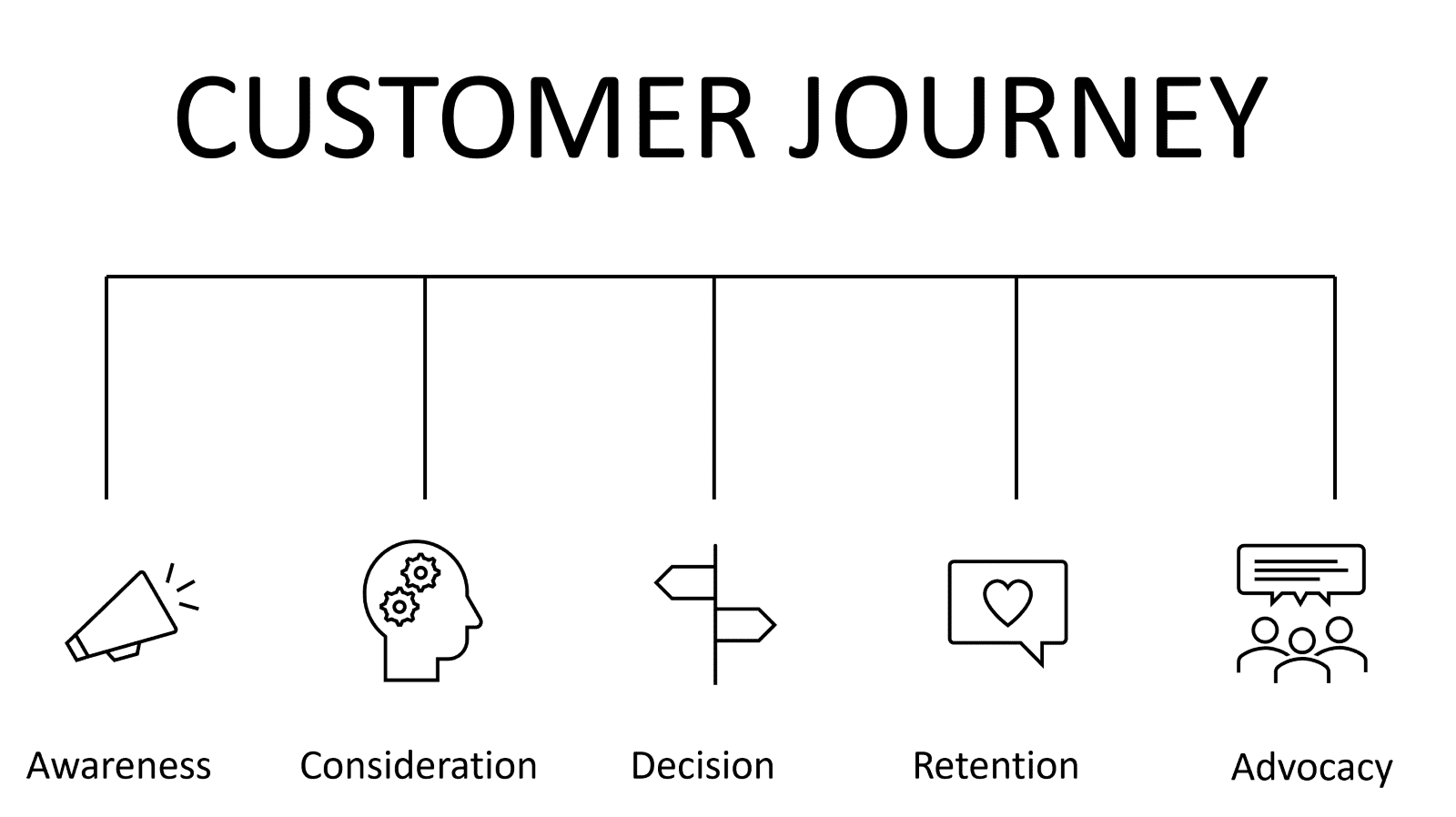
Customer Journey stages
1. Awareness
At this stage, a potential customer recognizes a need and starts exploring possible solutions.
From an enterprise architecture perspective, this phase is typically supported by marketing capabilities, digital channels, CRM systems, and data analytics platforms.
2. Consideration
Here, different options are evaluated. Customers compare offerings, assess features, and gather information before making a decision.
In EA terms, this stage often involves sales processes, product information management, integration layers, and customer data platforms.
3. Purchase
After evaluation, the customer proceeds with the transaction.
This stage connects directly to core business processes such as order management, payment systems, ERP integration, and fulfillment operations.
4. Retention
The journey continues beyond the transaction. Customers assess satisfaction and decide whether to remain loyal.
Enterprise architecture plays a key role here by linking service management, support systems, customer feedback loops, and performance monitoring.
5. Advocacy
Satisfied customers may recommend the product or service, amplifying its value.
From an architectural viewpoint, this stage often depends on digital ecosystems, customer communities, and integrated experience platforms that enable engagement and brand advocacy.
Why engage in Customer Journey Mapping?
n an enterprise architecture context, a Customer Journey Map is more than a visualization of customer experience. It is a structured representation of how value is delivered across business capabilities, processes, and applications throughout the organization.
By mapping customer journeys within Enterprise Architecture, organizations gain a transparent and end-to-end view of how customer interactions are supported by the underlying operating model and IT landscape. This makes dependencies, redundancies, and gaps visible — not only at the experience level, but across architectural layers.
Customer journey mapping therefore supports more than empathy and experience optimization. When combined with tools like the Business Model Canvas, it enables:
-
alignment between customer expectations and business capabilities,
-
identification of process inefficiencies and system bottlenecks,
-
impact analysis of transformation initiatives,
-
and better prioritization of investments across the architecture.
When modeled in ADOIT, customer journeys can be linked to value streams, capabilities, and applications, creating traceability between customer-facing interactions and enterprise-wide decision-making.
In this way, customer journey mapping becomes a strategic instrument within Enterprise Architecture — not just a design artifact, but a foundation for structured analysis and transformation governance.
Example of a Customer Journey Map
To illustrate the concept, consider a simple scenario: you are planning a birthday dinner and searching online for a suitable restaurant.
At first glance, this may seem like a purely customer experience story. However, from an enterprise architecture perspective, each stage of this journey is supported by distinct business capabilities, processes, and systems.
During the awareness stage, search engines, digital marketing platforms, and online presence capabilities enable discovery.
In the consideration stage, websites, booking platforms, menu management systems, and review integrations support evaluation and comparison.
The decision stage (table reservation) relies on reservation systems, CRM integration, and backend availability management.
In the retention stage, service quality, feedback systems, and customer data analysis influence future decisions.
Finally, the advocacy stage is enabled by social media integrations, digital ecosystems, and customer engagement platforms.
What appears to be a simple dinner decision is, in reality, the result of coordinated interactions across multiple architectural layers.
From an Enterprise Architecture standpoint, mapping such a journey makes visible:
-
which capabilities are required at each stage,
-
which applications support them,
-
where integration dependencies exist,
-
and where potential bottlenecks or risks may arise.
Even a single dinner experience demonstrates how customer-facing interactions are tightly connected to the underlying IT landscape and operating model. When modeled in ADOIT, these relationships can be visualized and analyzed systematically, enabling structured decision-making beyond anecdotal experience.
Tipp: Check out another great case study showcasing the role of EA in customer experiences.
The Importance of Customer Journey Mapping in Enterprise Architecture
Within Enterprise Architecture, customer journey mapping provides more than stage-by-stage experience optimization. It creates structural transparency across how value is delivered, supported, and governed within the organization.
Rather than focusing solely on marketing actions at each stage, Enterprise Architecture examines:
-
how customer interactions are supported by business capabilities,
-
how processes are orchestrated across departments,
-
which applications enable or constrain performance,
-
and where architectural misalignment impacts customer outcomes.
Awareness:
From an EA perspective, awareness depends on clearly defined digital capabilities, integration of marketing systems, and data consistency across channels. Architectural fragmentation at this stage often results in inconsistent messaging and limited visibility into customer behavior.
Consideration:
This phase requires alignment between product management, sales processes, and information systems. Enterprise Architecture ensures that data flows, integration points, and capability ownership are clearly defined.
Decision:
At the decision stage, architectural efficiency directly affects conversion and operational performance. Seamless integration between front-end channels and backend systems (e.g., ERP, CRM, booking engines) reduces friction and improves reliability.
Retention:
Retention is strongly influenced by service architecture, feedback mechanisms, and lifecycle management processes. Enterprise Architecture enables transparency across these supporting structures.
Advocacy:
Advocacy emerges when experience consistency is supported across digital ecosystems. Architectural coherence ensures that engagement platforms, community tools, and analytics systems operate in alignment.
By mapping customer journeys within Enterprise Architecture, organizations can move from reactive experience optimization to proactive architectural governance. Instead of optimizing isolated touchpoints, they create traceability between customer-facing stages and enterprise-wide transformation initiatives.
Benefits of Modelling a Customer Journey Map with ArchiMate
Modeling customer journeys using ArchiMate — alongside frameworks like the Value Proposition Canvas — allows organizations to move from informal journey visualization to structured architectural representation.
By leveraging ArchiMate, customer journey stages can be formally connected to:
-
Business capabilities
-
Value streams
-
Business processes
-
Application components
-
Technology layers
This structured modeling approach enables traceability across architectural domains and ensures that customer-facing interactions are not disconnected from internal operational realities.
| CUSTOMER JOURNEY | EXAMPLE | ARCHIMATE |
|---|---|---|
| Persona | Birthday person | Business Role |
| Customer Activity | Analyse the menus, Book a table, etc. | Business Process (Specialisation: Customer Task) |
| Touchpoint | Booking service | Business Service |
| Channel | Website A | Business Interface |
| Feeling | Happy | Assessment |
ArchiMate Artifacts in Customer Journey Mapping
Cross-layer transparency
Customer journey stages can be mapped to business, application, and technology layers, revealing how front-end experiences depend on backend structures.
Traceability and impact analysis
Changes in applications, capabilities, or technologies can be assessed for their impact on specific journey stages.
Alignment with value streams
Customer journeys can be linked to value streams, enabling strategic alignment between customer outcomes and organizational value creation.
Governance and standardization
Using ArchiMate ensures consistent notation and modeling standards across the enterprise architecture landscape.
Integration into ADOIT’s analysis capabilities
When implemented in ADOIT, customer journey models become analyzable objects within the EA repository, supporting reporting, dependency analysis, and transformation planning.
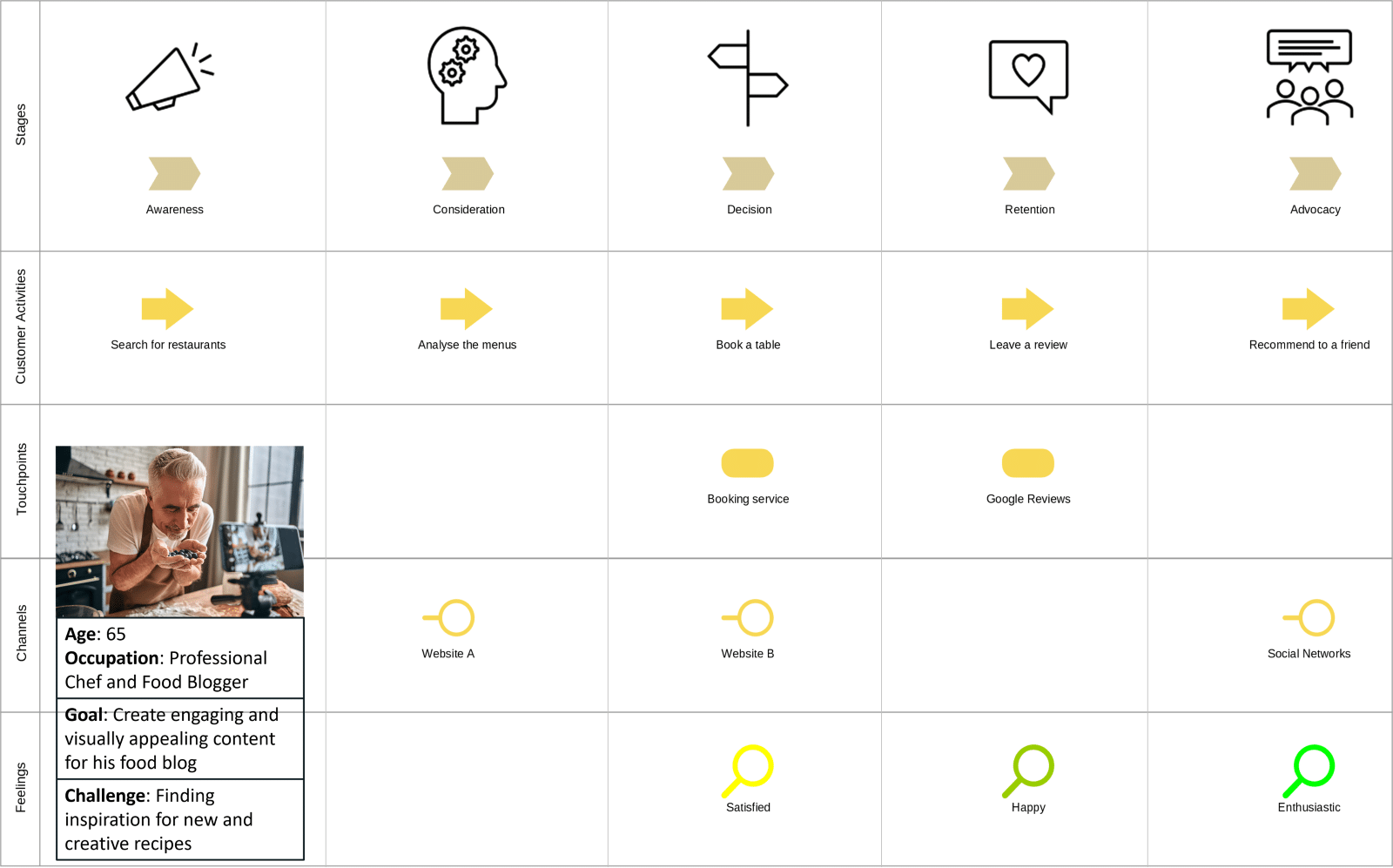
Example of a Customer Journey Map in the EA tool ADOIT
How to Model Customer Journeys in ADOIT
While ArchiMate provides the modelling language, ADOIT enables structured implementation and analysis within an enterprise architecture repository.
In ADOIT, customer journeys can be modelled as structured objects and linked to:
-
Business capabilities
-
Value streams
-
Business processes
-
Application components
-
Technology services
This allows architects to move beyond static diagrams and create traceable relationships across architectural layers.
Step 1: Define the Journey Structure
Customer journey stages can be modeled as structured elements, reflecting awareness, consideration, purchase, retention, and advocacy.
Step 2: Link to Capabilities and Value Streams
Each stage can be mapped to supporting business capabilities and value streams, ensuring strategic alignment.
Step 3: Connect to Applications and Systems
Applications, platforms, and integrations can be assigned to journey stages, enabling dependency visualization.
Step 4: Enable Analysis and Reporting
Because journeys are embedded in the EA repository, ADOIT allows impact analysis, reporting, and transformation scenario planning.
By integrating customer journey models directly into the architectural landscape, organizations gain decision-ready transparency instead of isolated experience diagrams.
Summary
Customer journey mapping in enterprise architecture goes far beyond visualizing touchpoints. It provides a structured way to connect customer-facing interactions with business capabilities, processes, and applications across the organization.
By modeling customer journeys using ArchiMate and implementing them in the ADOIT EA tool, organizations can move from isolated experience diagrams to traceable architectural representations. When embedded within the enterprise architecture repository, customer journeys become decision-support artifacts rather than static visualizations. They help ensure that customer-centric thinking is consistently aligned with strategy, governance, and the evolving IT landscape.
In this way, customer journey mapping becomes not just a design exercise, but a strategic instrument within Enterprise Architecture.





Already got our weekly updates?