BUSINESS PROCESS MANAGEMENT
Found this helpful? Share it with peers.
Starting Point: Robots Quickly Patched Gaps, but a System Was Missing
For people with lung disease in north-eastern Poland, the Warmian-Masurian Pulmonary Diseases Center in Olsztyn (WMCCP) is the largest center for respiratory medicine, covering prevention, treatment and rehabilitation. A single patient’s journey can lead through several wards, laboratories and specialists, and every handover along the way has to work. Good care depends on medical expertise, but just as much on how well the many people and departments behind it are coordinated.
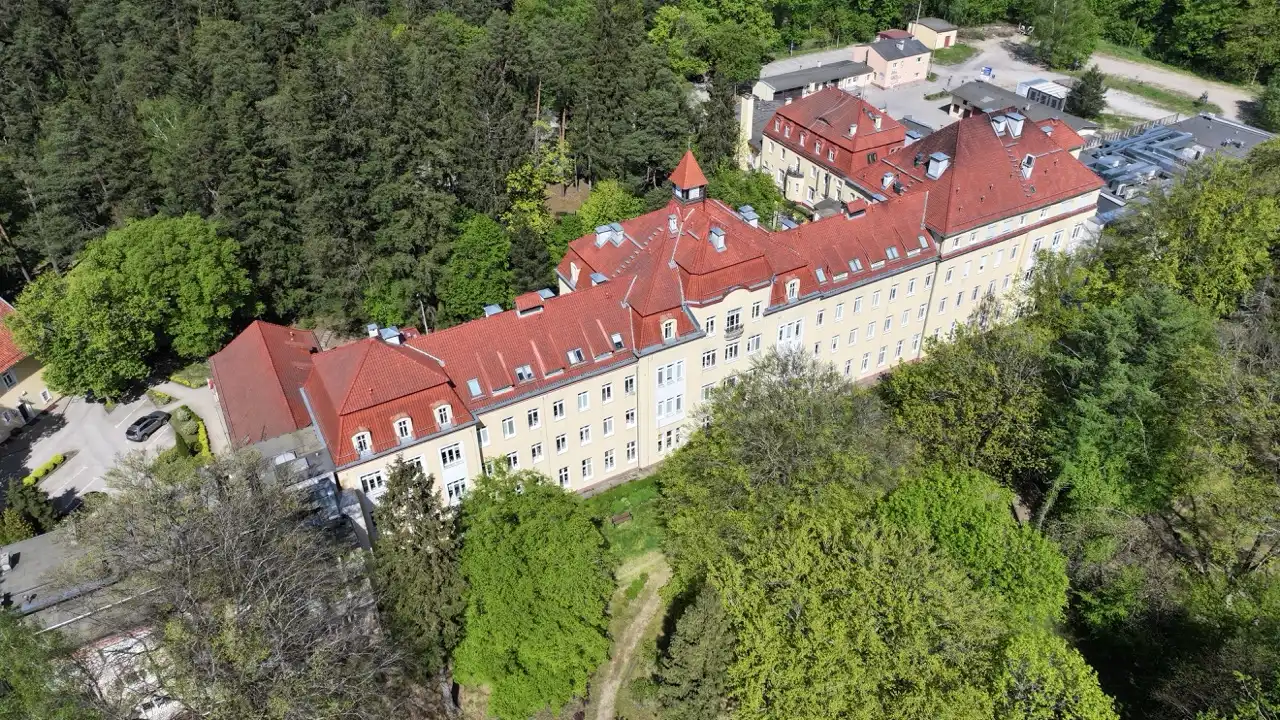
Photo: Property of the hospital.
Digitalisation at WMCCP began around three years ago – with software robots. The first RPA deployments were ad hoc: they quickly solved specific problems and delivered immediate, visible results. Over time, however, it became clear that more point automations without a common plan would not be enough.

Dr Janusz Sasak
Hospital Representative; Assistant Professor, Institute of Public Affairs, Jagiellonian University WMCCP
As in the entire healthcare sector, the volume of data at the hospital keeps growing, and supervisory bodies expect more and more reporting. WMCCP therefore set out to implement a modular solution based on a process architecture, which would automatically retrieve the information management needs and present it in clear dashboards.
Following a public tender, three companies delivered the project together: BOC Group provided ADONIS, in which the processes were modelled, analysed and optimised, First Byte automated them with its Wizlink® RPA tool, and LBPro built the management dashboards. The project took a few months.
The Solution: From Scattered Emails to One Standardised Process
1. Process Architecture First: Four Process Groups for the Whole Hospital
Work began with a top-down view of the hospital, i.e. by building a top-level process architecture. Instead of the classic split into three groups, four were defined:
-
Management processes – setting the direction and the rules that apply in the organisation
-
Core clinical and patient processes – arranged in a value chain: from patient identification and registration, through diagnostics and treatment, to discharge with handover of continuity of care, as well as rehabilitation and supportive care; complemented by a medical diagnostics megaprocess.
-
Clinical support processes – including management of medicines and medical devices, infection control and epidemiological safety, medical records management, and clinical and therapeutic nutrition
-
Support processes – including finance, HR, IT and maintenance of the hospital’s infrastructure.
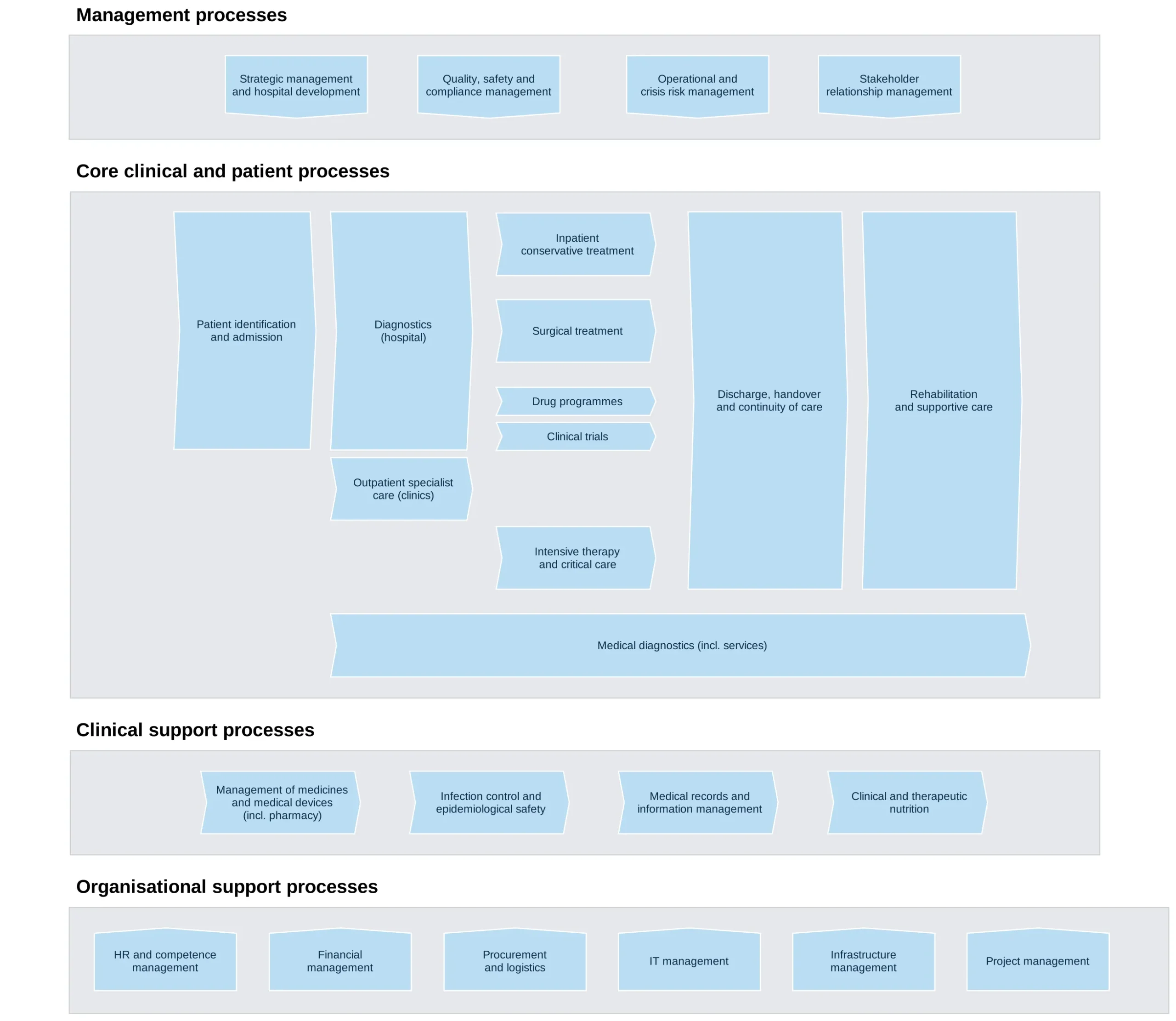
Top-level process architecture of the hospital in ADONIS:
management, core clinical and patient, clinical support and organisational support processes
This map is the first version of the architecture and will evolve as more processes are uncovered. Even at this stage, however, it made it possible to choose areas for optimisation and automation deliberately.
“A top-down view makes it much easier to plan projects aimed at optimising how the organisation works and to see where processes have little automation but should have more.”
– Michał Kossowski, Managing Director, BOC Group
Given the short timeline, the team focused on quick wins – processes that could be analysed and automated relatively fast. The choice fell on clinical nutrition, and specifically on meal ordering. The hospital knew the process existed, but it had never been standardised, documented or analysed. It runs around 600 times a month, as each ward orders meals at a different time and corrections come on top of that.
Before the change, wards sent their requirements through any channel – email or phone – directly to the catering company. Corrections were possible until a set time, but nobody had a full picture of what was ultimately ordered. There were no delivery confirmations, no consolidated view and no statistics beyond invoices and payments.
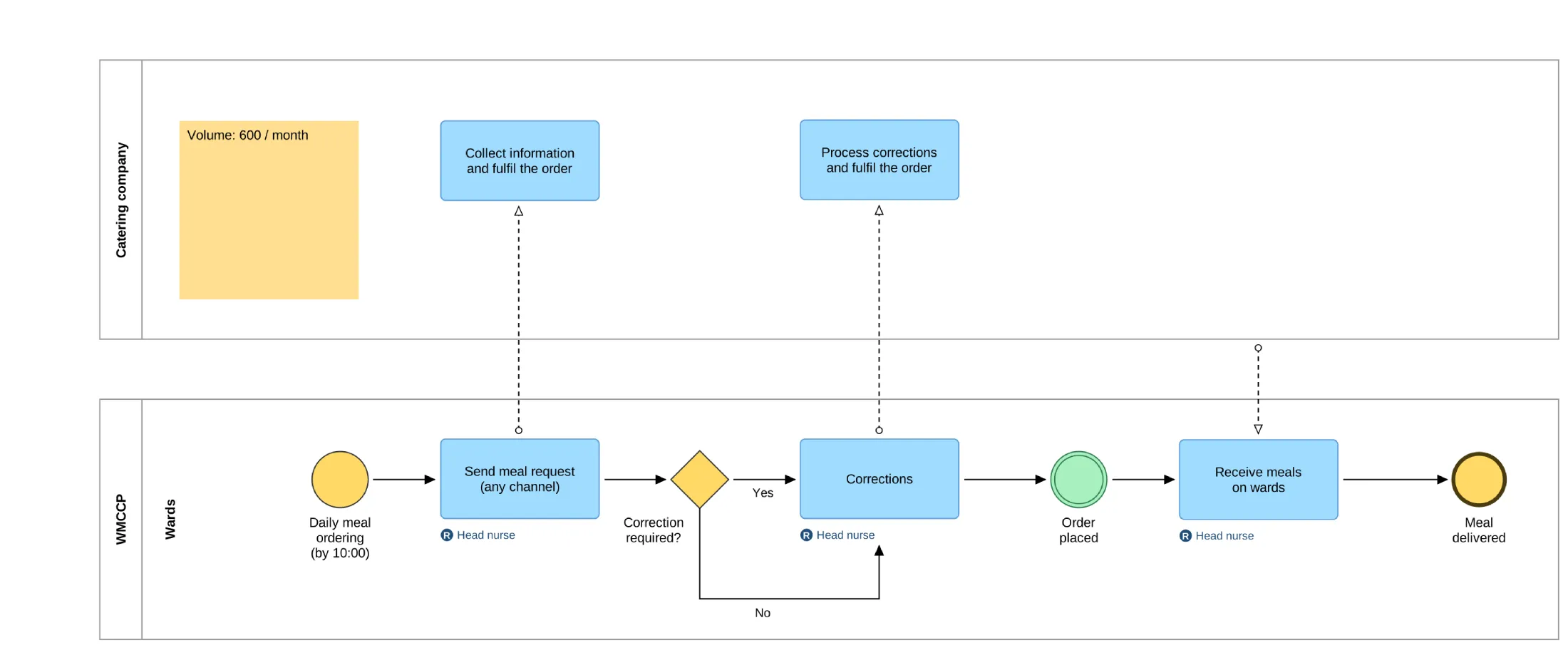
Meal ordering before the change (AS-IS): requests sent by any channel directly to the catering company
Following the analysis, a target (TO-BE) process was designed. Wards now place orders using a standardised electronic form.
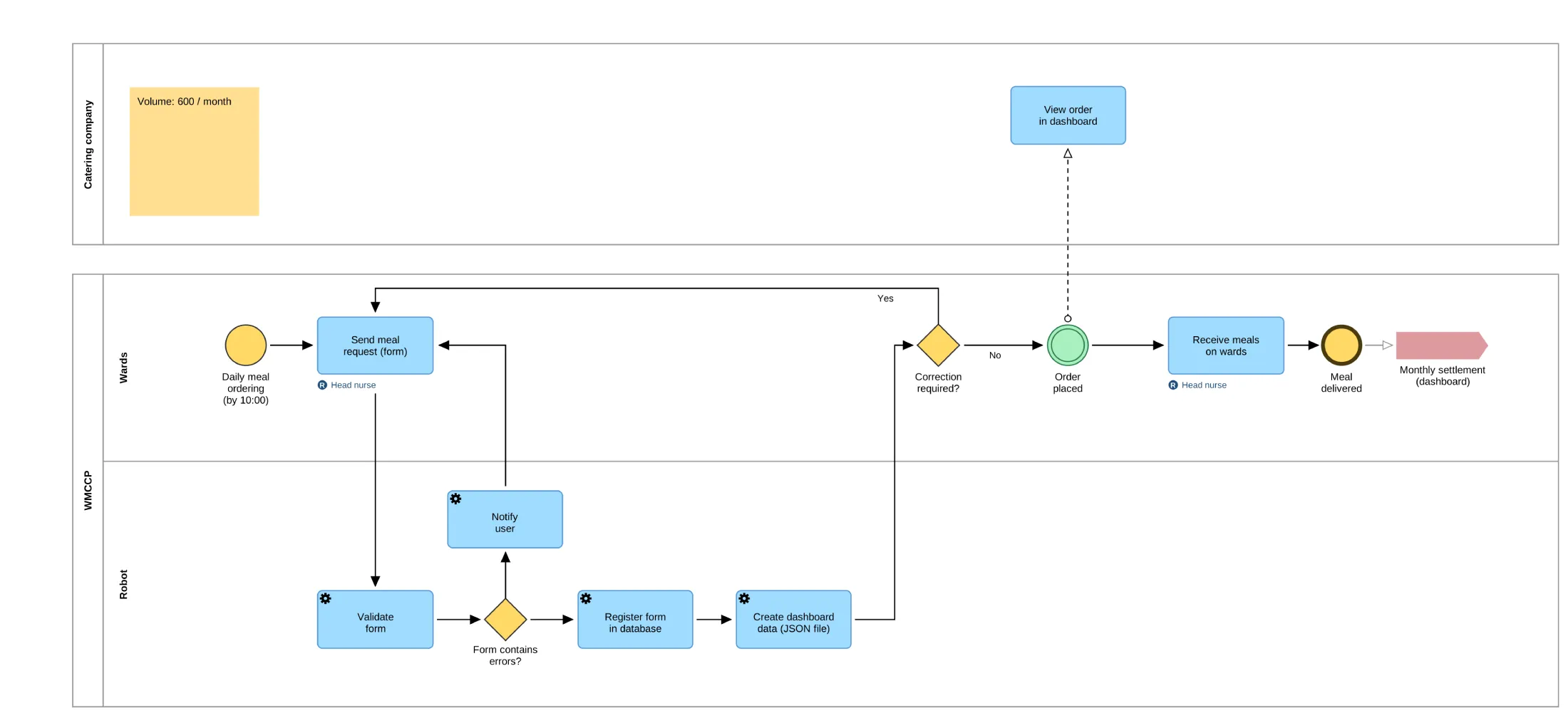
Meal ordering after the change (TO-BE): the new Robot lane validates and registers every order and prepares the data for the dashboards
Why does the optimised process look more complex? The TO-BE model has more steps than the AS-IS model, but most of them are performed by a robot. Tasks a person sums up in a single phrase have to be broken down into simple, unambiguous steps for a robot. For ward staff, the process has become simpler.
ADONIS now serves as the hospital’s central process repository: it holds the complete process architecture and process versions and keeps changes under control – a foundation for every next step.
2. Bridging Systems That Don’t Talk to Each Other
Automation was handled by software robots built in Wizlink® – a Polish low-code/no-code RPA tool. The robot works at the user interface level: it performs the same repetitive on-screen tasks as a person and moves data between applications that are not integrated with each other. This matters especially in a hospital, which uses internal systems, central systems (e.g. the National Health Fund, NFZ), files and email all at once.
“Integrations, especially in healthcare systems, usually mean very high costs and long lead times. With a robot, it can sometimes be done within a few hours.”
– Michał Wawiórko, robotisation expert, First Byte (Wizlink®)
In the meal ordering process, the robot receives each order form, checks it, returns incorrect forms to the ward with a request for correction and passes valid data on to the dashboards – several times a day. Following the same pattern, robots also feed the hospital’s other dashboards with data from systems such as HIS and ERP.
3. Three Roles, Three Dashboards: The Right Data for Everyone
The final element is LBPro’s Management Dashboard Generator, which connects to any data source and automatically includes new data prepared by the robots in its visualisations.
Three dashboards were created for the meal ordering process – one for each role involved:
-
The hospital ward sees orders broken down by day, diet, comments, meal and meal category.
-
The kitchen (catering company) knows exactly what to prepare, for whom, when and in what quantity, including special diets.
-
Administration receives aggregated monthly summaries – meal structure and value – needed for settlements and statistics.
On some wards and in the kitchen, the dashboard stays open all day and works like a screen on a production line: it shows the current status of orders and allows staff to respond to corrections in real time.

Results: An Error-Free Process and Data Everyone Trusts
1. Virtually error-free meal ordering
Thanks to the standardised form and validation by the robot, errors in the ordering process have practically disappeared. The hospital no longer orders surplus meals, and there is neither too little nor too much food.
“We have essentially achieved a 100% reduction in errors in the ordering process. The process itself is free of errors and of changes we would not be able to notice.”
– Dr Janusz Sasak
2. Several days of dietitians’ work regained every month
Previously, dietitians had to collect unstructured information from emails and check whether the caterer’s deliveries matched the orders. Today, a complete summary is generated automatically, and the hospital and the catering company work with the same data – with no month-end disputes.
“Collecting this data and sorting out the information sent by email took our dietitians several days, and it never balanced 100%. Now we have a table that shows how much was ordered, at what price and what was delivered.”
– Dr Janusz Sasak
3. Dashboards that became everyday working tools
The meal ordering dashboard has turned out to be one of the most intensively used in the hospital. In total, 12 dashboards are now live – in addition to management processes, they cover patient demographics, treatment costs and diagnostics, among others. New ones are being built in the same tool, and the same data can be presented in different ways depending on who needs it.
4. Data independent of system vendors
The hospital wanted a solution that would remain largely free of licence fees in the future and offer extensive configuration options. Combining robots, which can also use APIs, with an open dashboard platform makes data presentation independent of the HIS vendor and other system providers in the hospital.
“We have probably chosen one of the best paths. Software robots loading data into such a platform will let us shape whatever we want to see in the hospital.”
– Dr Janusz Sasak
Looking Ahead: A Hospital Modelled Down to the Data Level
The solution will be developed further towards a complete information architecture for the hospital. Plans include:
-
Modelling all hospital processes – not only down to the business process level but also to the data level, to know where and how to source data for automation and to make it easier to plan integrations and new systems.
-
Implementing a document management system (SZD) in the hospital’s administrative area from the new year – process models will be used to describe document workflows, and robots to classify documents and feed dashboards with data from the new system.
-
Extending the ADONIS repository – with documents, IT systems, data, risks and the organisational structure, so that it is clear who is responsible for what.
-
Monitoring technical parameters in dashboards – such as oxygen levels in tanks or fuel levels in generators – for the technical department.
“The process approach is changing the face of the hospital and its management standards. It becomes much easier to optimise and analyse what is really happening in the hospital.”
– Dr Janusz Sasak
The hospital also shares its approach with the wider healthcare community. In September 2026, it co-organised Hospital 360, an international conference in Olsztyn with nearly 50 speakers from Poland, Denmark and Italy. BOC Group took part as well: Michał Kossowski, Managing Director of BOC Group in Poland, presented processes as the foundation for understanding, analysing and automating hospital operations – the same approach that shaped this project.
The hospital is happy to share its experience and invites other healthcare facilities to Olsztyn to see the solution in action.
“If you would like to see this solution in practice, you are welcome to visit our hospital. We will show you how it works, talk it through, and perhaps get inspired by your ideas, too.”
– Dr Janusz Sasak
Summary
The project at the Warmian-Masurian Pulmonary Diseases Center in Olsztyn shows that hospital automation delivers lasting results when it is backed by a well-thought-out plan rather than the purchase of yet another system. The process architecture in ADONIS made it possible to pick the right area and describe the change precisely, robots built in Wizlink® took over repetitive work and connected non-integrated data sources, and LBPro dashboards gave each role exactly the information it needs.
The meal ordering process – carried out around 600 times a month – now runs with virtually no errors, and the dietitians have regained the time they used to spend on manual reconciliation. Importantly, the hospital is already using the same foundation for its next steps: data modelling, electronic document workflow and monitoring further areas of its operations.