Enterprise ArchitEcture

Found this helpful? Share it with peers.
Introduction: When More Applications Become a Problem
Digital transformation happened quickly. Before we knew it, applications have enhanced or completely changed the way things work. New tools are constantly introduced to improve efficiency, support innovation, and enable business growth.
This change has been so fast that we've hardly noticed the growing number of applications piling up. For many organizations, this speed means the number of applications has grown faster than their ability to manage them. Just like that, businesses find themselves dealing with rising costs and increasing complexity across their IT landscape. What begins as enablement can quickly turn into application sprawl.
In this article, we'll explore how to avoid this and how to make your application portfolio what it's supposed to be: a true enabler of digital transformation.
Why Application Sprawl Happens in the First Place
Lack of centralized application inventory
Without a single source of truth, it becomes difficult to answer simple questions, such as:
- How many applications do we have?
- What do they help us with?
- Who is responsible for each of them?
This lack of visibility is one of the biggest drivers of uncontrolled portfolio growth.
Missing ownership and accountability
When no one clearly owns an application, nothing happens. No one evaluates whether it is still needed, tracks its costs or associated risks, or takes the initiative to retire it. Outdated and redundant applications quietly remain in use, or continue generating costs without anyone noticing.
No continuous evaluation process
Applications are typically introduced with a well-defined purpose. What happens less often is a structured reassessment over time. Business needs evolve, more capable tools emerge, costs increase, and value declines. Without a regular evaluation process in place, applications outlive their usefulness and no one takes action.
The Hidden Impact of Having Too Many Applications
Paying for what you do not use
Most portfolios include applications that are no longer actively used, have been replaced by newer solutions that are still being paid for in parallel, or were only ever partially adopted. Licensing, infrastructure, and support costs accumulate regardless.
Increasing complexity and operational overload
A bloated application landscape makes it harder to train employees, maintain integrations, and ensure data consistency across systems. Rather than enabling productivity, an overcrowded portfolio overwhelms users and slows down day-to-day operations.
Untapped potential in existing applications
The problem is not always a surplus of applications. Sometimes it is underutilization. Certain tools remain in the portfolio without ever being used to their full potential, simply because their capabilities are not well understood, adoption has stalled, or no one is actively managing them.
The Key to Regaining Control: Transparency and Context
To truly understand your application landscape, you need more than a list. You need context: the kind that tells you not just what applications you have, but whether they still deserve a place in your portfolio.
That starts with linking every application to the business value it delivers. What processes does it support? What capabilities does it enable? What strategic goals does it contribute to? Without those connections, it is impossible to answer the question that sits at the heart of any portfolio decision: does this application still serve a meaningful purpose?
But business context alone is not enough. Good decisions also require the right operational data for each application:
- Business and IT fitness
- Lifecycle stage and end-of-support dates
- Annual costs
- Dependencies and integrations
Together, these two layers transform a passive inventory into actionable insight. That is the foundation everything else builds on.
Hint: Save time defining KPIs to optimize your application portfolio by using this ready framework to manage your applications effectively and drive smarter portfolio decisions.
Why a Simple Repository Isn’t Enough
Having the right data matters little if it lives in a spreadsheet. Static inventories and manual trackers might work at a small scale, but they break down quickly. They cannot model relationships between applications, they do not support structured evaluation, and they offer no way to visualize your portfolio or plan ahead.
Effective Application Portfolio Management requires a purpose-built foundation:
- A central, structured repository that serves as a single source of truth
- The ability to model relationships and dependencies across your architecture
- Built-in evaluation mechanisms to assess applications consistently
- Visualizations and roadmaps that support executive decision-making
The goal is not just to store information, but to make it usable. That means moving from a passive database to an active management tool that drives real decisions.
Making It Work: Engaging Application Owners
Good tooling only gets you so far. Without accurate, up-to-date input from the people who actually work with your applications, even the best platform will give you a distorted picture of your portfolio. What to do about it?
Make documentation easy
If contributing information feels like extra work, it will not happen. Lightweight, guided input methods such as structured ADOIT Forms lower the barrier to participation, improve data quality, and keep documentation consistent across the portfolio.
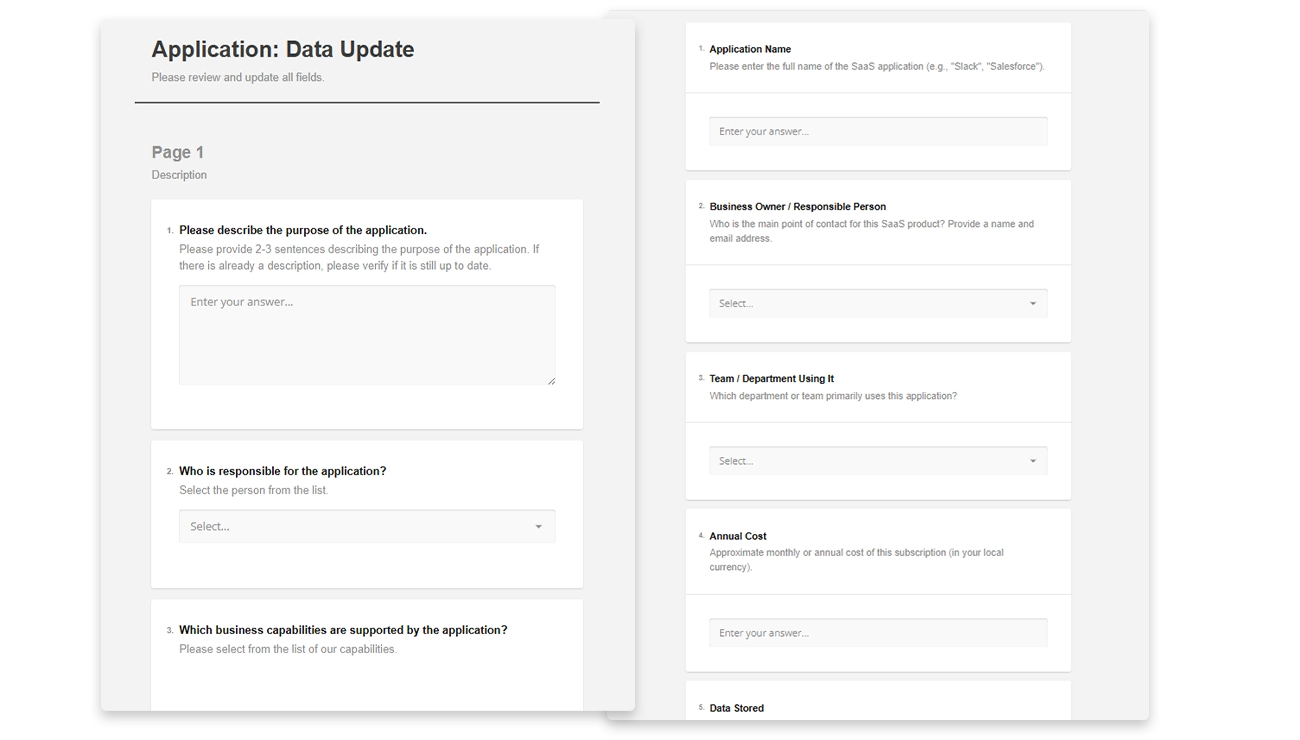
Structured ADOIT Forms for fast, consistent input from stakeholders
Standardize evaluation
Without a shared framework, every application owner will assess their tools differently. One person’s “business-critical” is another’s “nice to have.” Defined evaluation criteria, consistent scoring models, and automated calculations. Where possible, take the subjectivity out of the process and make comparisons across the portfolio meaningful.
Hint: Need inspiration to standardize evaluation? Explore key questions for application portfolio assessment that help you streamline your portfolio and make your applications fit for the future.
Turn data into decisions
Collecting data is not the finish line. Portfolio insights need to reach the right people in a format they can act on. For instance, clear visualizations for those working in the portfolio day to day, and well-structured findings for leadership conversations where budget and strategic direction get decided. That is where APM starts paying off.
What to Do About It: Applying the TIME Model
Once you have a clear, contextualized view of your portfolio, the next challenge is deciding what to do with each application. The TIME model provides a structured way to do exactly that. It assigns every application one of four strategic directions:
- Tolerate: Keep the application as-is when it delivers sufficient value at acceptable cost and risk.
- Invest: Prioritize and enhance applications that are business-critical and have strong future potential.
- Migrate: Replace or modernize applications that still deliver value but run on outdated or unsustainable technology.
- Eliminate: Retire applications that are redundant, unused, or no longer aligned with business needs.
The strength of the TIME model is its simplicity. Every application gets a clear verdict and that verdict creates a concrete basis for the next steps.
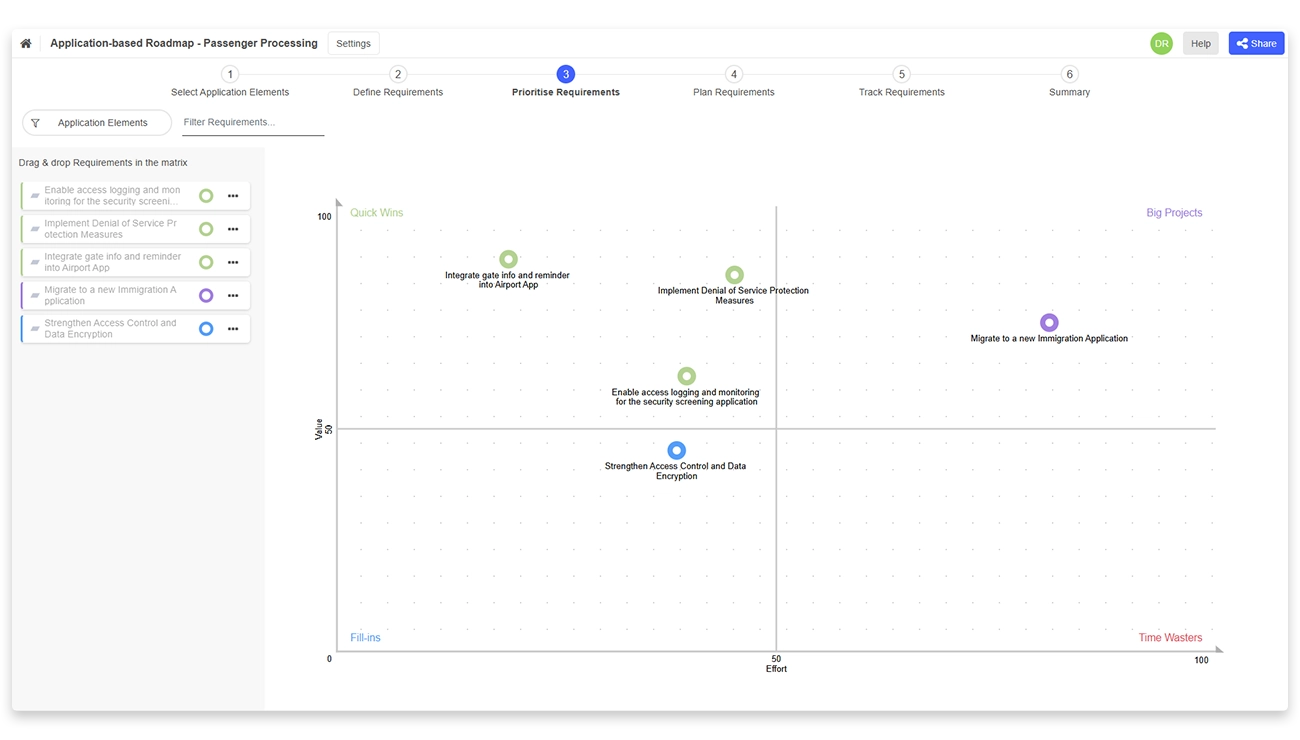
TIME application assessment based on business and IT fitness scores
Summary
Too many applications is not just an IT problem. Left unaddressed, it becomes a business risk. But the same portfolio, actively managed, is also an opportunity. By introducing transparency, accountability, and continuous evaluation, you can:
- Reduce unnecessary costs
- Simplify your IT landscape
- Improve alignment with business goals
- Unlock the full value of your application portfolio
The shift that makes all of this possible is a simple one in principle, even if it takes discipline in practice: moving from passive inventory to active management. That is what Application Portfolio Management, done well, actually delivers.




Already got our weekly updates?