Governance, Risk & Compliance

Found this helpful? Share it with peers.
Introduction
When a regulator asks for proof that your organization is meeting its obligations, the honest answer is rarely “here it is.” More often, it triggers a scramble: who owns this, is that policy still current, does this process diagram reflect what actually happens today?
That scramble is diagnostic as it tells you something about how compliance has been built inside your organization. Specifically, that it has been built around effort rather than around infrastructure. People are doing the right things, but none of it is connected in a way that makes the whole thing easily retrievable on demand.
This distinction between compliance as effort versus compliance as a system is what this guide is about. Discover what compliance management is, why it matters in 2026, how it differs from risk management and GRC, and how you can build a connected system that turns obligations into ownership and evidence.
What is Compliance Management?
Compliance management is the structured, ongoing process of identifying, managing, monitoring, and improving how an organization meets its legal, regulatory, contractual, ethical, and internal obligations.
In practice, it connects a requirement to the policy, process, control, owner, evidence, and reporting needed to prove that the requirement is being fulfilled. That means being able to show what is happening, where gaps exist, who is responsible, and how the organization improves over time.
Compliance Management Definition
Compliance management is the system an organization uses to understand which obligations apply, assess where non-compliance could occur, define controls and responsibilities, monitor performance, collect evidence, and improve continuously.
A useful way to test whether that system exists is to ask five questions:
- Which obligations apply, and where do they come from?
- Which entities, locations, processes, products, or systems are in scope?
- Which controls address each requirement?
- Who owns each control, assessment, policy, and remediation action?
- Can we produce current evidence that the system is working?
If the answers are consistent and evidence-backed, the organization has a compliance management system. If they depend on who is asked, it has compliance activities but not yet a reliable system.
Compliance Management vs Risk Management: What’s the Difference?
Risk management covers the full range of uncertainty an organization faces: strategic, operational, financial, regulatory. Compliance management is narrower. It focuses specifically on whether the organization is meeting its obligations and can demonstrate that it is.
The two are connected because compliance obligations are not all equal. A risk-based approach helps teams focus where the consequences of failure are most serious, rather than treating every requirement the same way.
How Compliance Management Fits into GRC
GRC connects governance, risk and compliance into one operating model. Compliance management is one part of that: it ensures obligations are identified, owned, monitored and evidenced. Governance provides the accountability structure around it, risk management the prioritization logic.
Without that connection, compliance tends to get managed in fragments. GRC makes the full picture visible.
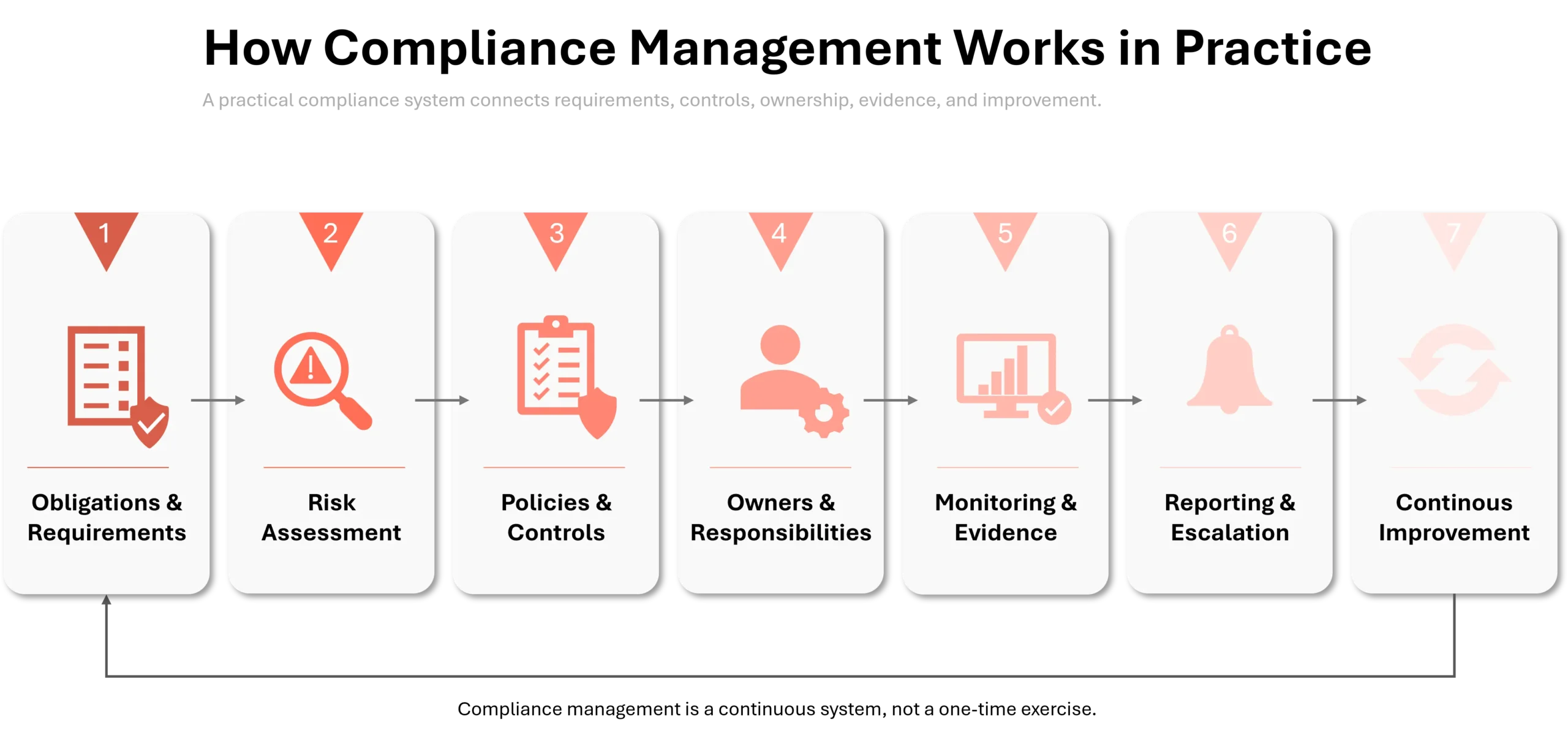
Compliance management connects obligations, risks, controls, ownership, evidence,
and reporting in one continuous system
Why Compliance Management Matters
Most organizations understand that non-compliance can result in fines. What is less often appreciated is how much the nature of regulatory scrutiny has changed, and what that means for how compliance needs to work internally.
Legal and Regulatory Consequences
Regulators are no longer satisfied with evidence that policies exist. They want to see documented ownership, working controls, audit trails, and proof that the compliance program functions in practice, not just on paper. Recent enforcement data reflects how seriously that expectation is being applied:
- The UK Financial Conduct Authority reported 37 Final Notices, five criminal convictions, more than 186 million in fines, and 1,456 cancelled authorisations in its 2024/25 enforcement data.
- DLA Piper’s 2026 GDPR and Data Breach Survey reported approximately 1.2 billion in GDPR fines in 2025 and a 22% year-on-year increase in average daily breach notifications, reaching 443 per day between January 2025 and January 2026.
- The SEC reported in April 2026 that since fiscal year 2022, the prior Commission had brought 95 actions and 2.3 billion in penalties related to off-channel communications recordkeeping violations.
The sectors and circumstances differ, but the underlying message is the same: demonstrating compliance has become as important as achieving it.
Business and Reputational Risk
The consequences of non-compliance extend well beyond regulatory action. PwC’s Global Compliance Survey 2025 found that compliance responsibilities have expanded significantly, with increased complexity affecting technology, data, business transformation and growth initiatives. For many organizations, compliance has become a prerequisite for moving forward on strategic priorities, as opposed to a separate obligation running alongside them.
When compliance is managed as a connected system rather than a collection of activities, issues surface earlier and responses are more credible. That matters not just in audits, but in how the organization is perceived by customers, partners and boards over time.
Key Components of a Compliance Management Program
An effective compliance management program is measured by whether the organization can identify obligations, act on them, monitor performance, detect failures, and improve over time.
Compliance Policies and Standards
A policy that nobody reads, references or enforces is not really a policy. It is documentation. The difference matters because organizations often have more policies than they have compliance, and the gap between the two is usually where auditors look first.
Useful policies are connected to the work they govern. They name an owner and reference the obligation they address. They also specify how often they are reviewed and point to the controls that make them operational. Without that, a policy is just a statement of intent.
Risk Assessment and Identification
Compliance risk assessment exists to find where non-compliance could happen before it does. That sounds straightforward, but most assessments are built on documentation rather than observation, which means they tend to confirm what the organization believes about itself rather than what is actually happening.
What makes an assessment genuinely useful is whether it reflects operational reality. It usually involves people who know where the friction is: process owners, IT, internal audit, legal, etc. The goal here is not to build a comprehensive picture, but to find where the gap between policy and practice is widest and where the consequences of that gap are most serious.
Training and Communication
Training is how policies and standards become behavior. Generic annual training may produce completion records, but completion is not the same as understanding, and understanding is not the same as changed behavior. A stronger program is role-based and risk-based. It tracks whether high-risk roles are covered, whether understanding is tested, and whether incidents or findings suggest the content needs to change.
Communication matters alongside training. People need to know where to find policies, how to raise concerns, and what happens when they do.
Monitoring and Reporting
Knowing that compliance activities are scheduled is not the same as knowing they are working. Monitoring exists to close that gap, and reporting exists to make what it finds useful to the people who need to act on it.
That means giving leadership, compliance committees and process owners a clear view of:
- Current compliance status
- Open findings and remediation actions
- Overdue controls or assessments
- Evidence completeness
- Recurring issues
- Escalations
- Areas where risk exposure is growing
The goal is not a dashboard where everything shows green. It is visibility that is accurate enough to drive decisions.
Continuous Improvement
Compliance programs age faster than most people expect. Regulations get updated, processes shift, systems get replaced, and the controls built around older versions quietly stop applying. Nobody removes them. They just sit there, creating the appearance of coverage where there isn’t any.
Incidents, audit findings, regulatory changes and control failures should all feed back into policies, controls, risk assessments and training. That feedback loop is what separates a living compliance system from an archive.
Compliance Management Frameworks
Frameworks give organizations a structured way to design, assess and improve how they manage compliance. They provide common language, clear expectations and operating principles that teams can actually work from.
ISO 37301
ISO 37301 is the international standard for compliance management systems. It covers the full lifecycle: establishing, developing, implementing, evaluating, maintaining and improving a compliance management system.
Its value is in the management system logic it brings. Rather than treating compliance as a set of individual activities, ISO 37301 helps organizations build something with defined scope, leadership commitment, obligation management, risk assessment, controls, monitoring and reporting. It is particularly useful when the goal is a formal system that works across multiple entities or locations, aligns with other ISO management systems, or needs to support auditability or certification.
COSO
COSO is most useful when compliance needs to connect to enterprise risk management, internal controls and board-level governance. For organizations already using COSO language in risk, audit or internal control reporting, it offers a natural way to position compliance risk within the broader enterprise risk picture, making it easier for leadership to understand compliance as a risk domain that affects objectives and performance rather than a separate checklist.
How to Choose the Right Framework
The right choice depends on the organization’s maturity, regulatory environment and governance model.
ISO 37301 tends to be the best fit when the goal is a dedicated compliance management system. COSO adds most value when the challenge is integrating compliance risk into enterprise risk management and board reporting. GRC frameworks and capability models are more relevant when the broader goal is connecting governance, risk, compliance, audit, process and enterprise architecture into one operating model.
In practice, mature organizations often use more than one. ISO 37301 provides the compliance management structure, COSO supports risk and control language, and GRC ties everything together into an integrated operating model.
How to Build a Compliance Management System
Building a compliance management system should follow a clear sequence. The goal is not a procedural manual that sits unused, but a reliable system that connects obligations to action, accountability, evidence, and improvement.
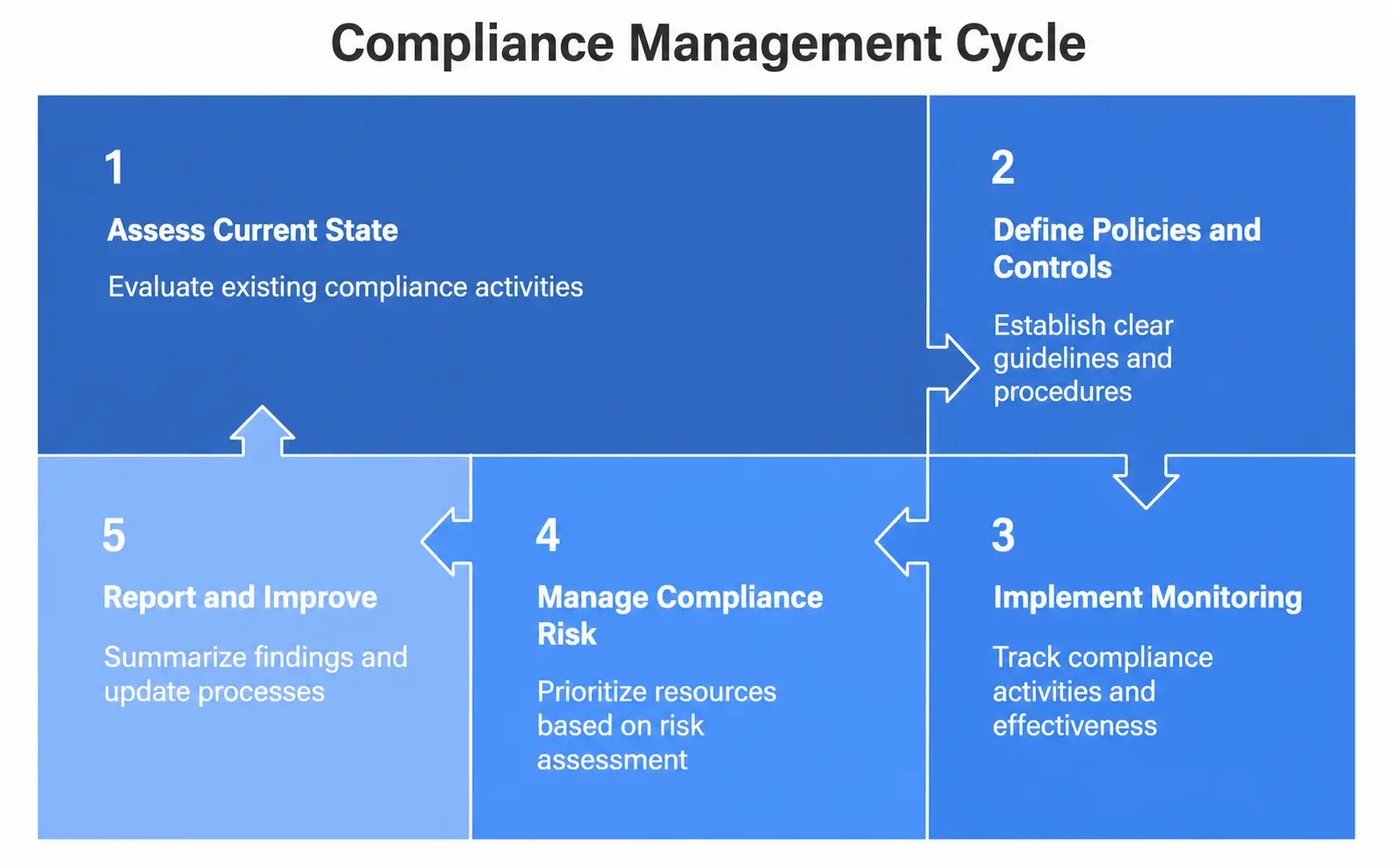
A practical compliance management system is built step by step
Step 1: Assess Your Current State
Start by understanding what already exists. Most organizations have policies, controls, assessments and reporting in place. The problem is usually that these elements are fragmented and disconnected from each other.
A current-state assessment should cover:
- Which obligations are already documented
- Which entities, locations, processes, products and systems are in scope
- Which policies and controls exist and whether they are mapped to obligations
- Where evidence is stored and who owns controls and remediation actions
- Whether existing reporting reflects current reality
The output is a clear picture of whether the organization has a connected system or a collection of separate compliance activities.
Step 2: Define Policies and Controls
Once obligations are understood, define or refine the policies and controls that address them. Every significant obligation should connect to:
- A policy or standard
- A process or operational activity
- One or more controls
- A named owner
- A defined review frequency
- Evidence requirements
- Monitoring or testing activities
A requirement without an owner, a control, or an evidence trail is a gap that an auditor will eventually find.
Hint: Explore how ADOGRC supports Internal Controls Management by structuring controls, reducing process risks, and strengthening audit readiness.
Step 3: Implement Monitoring
Monitoring should follow risk, not a static calendar. High-risk obligations, critical controls, recurring findings and regulator-sensitive areas will need more frequent attention than lower-risk ones.
Monitoring should check both activity and effectiveness. For example, it is useful to know whether training was completed, but it is more useful to know whether high-risk roles completed it, whether understanding was tested, and whether incidents suggest that the training needs to change.
Step 4: Manage Compliance Risk
Not every obligation carries the same weight, and not every control failure creates the same exposure. A risk-based approach considers likelihood, impact, control effectiveness, regulatory attention, business criticality and the organization’s own history of findings.
The output should drive concrete decisions: where to strengthen controls, where to increase monitoring frequency, where to remediate first, and where leadership needs direct visibility.
Step 5: Report and Improve Continuously
Reporting should help leadership make decisions, which means showing where compliance status is strong, where exposure is growing, which remediation actions are overdue, and which issues keep recurring.
Continuous improvement closes the loop by integrating audit findings, incidents, regulatory changes and control failures into obligations, policies, controls, training and monitoring plans. Without that feedback loop, the system reflects the past rather than the present.
Compliance Management Software: What to Look For
Manual compliance management usually starts reasonably enough. Spreadsheets, shared folders, email threads for evidence collection. For small teams with a limited set of obligations, that can hold together. The difficulties tend to emerge gradually, as regulatory complexity grows and the number of obligations, controls, owners and evidence sources expands beyond what any collection of documents can reliably track.
The core problem is not effort. It is that the information ends up in too many places at once. Obligations in one system, controls in another, evidence scattered across inboxes and file servers, owners tracked in spreadsheets that may or may not be current. When an audit starts, the first task becomes reconstructing a picture that should already exist.
Software-based compliance management addresses this by bringing obligations, controls, ownership, evidence and reporting into one place, so the compliance picture is something the organization maintains continuously rather than assembles on demand.
| Manual Approach | Software-based Approach |
|---|---|
| Scatttered documents | Centralized requirements |
| Unclear ownership | Assigned responsibilities |
| Evidence collected manually | Audit-ready evidence |
| Slow reporting | Real-time dashboards |
| Reactive audit preparation | Continuous monitoring |
For larger organizations the value goes beyond centralization. What matters is traceability: being able to show how a requirement connects to a control, how that control is owned, when it was last assessed, what evidence exists, and which remediation actions remain open. That level of visibility is difficult to maintain manually and becomes more difficult as the organization grows.
When evaluating compliance management software, look for:
- A central obligations library
- Scoping by entity, geography, standard, regulation, process, or business unit
- Policy and control mapping
- Named ownership and accountability
- Risk-based assessments
- Workflow-based task and remediation management
- Evidence management
- Audit trails
- Dashboards and reporting
- Issue intake and investigation support
- Integration with risk, audit, process, and enterprise architecture data
- Support for continuous improvement and regulatory change management
How ADOGRC Supports Compliance Management
ADOGRC connects requirements, controls, responsibilities, evidence, workflows and reporting in one integrated GRC environment.
The ADOGRC Compliance Library gives teams a structured starting point. Rather than building a compliance inventory from scratch, organizations can select the standards and requirements relevant to their scope, assess current status, and identify where action is needed. From there, teams can assign ownership, run gap assessments, track remediation, monitor compliance status through dashboards, and maintain the audit trails needed for evidence-based reporting.
What makes this useful in practice is the connection to operational context. Requirements can be linked to processes, applications, controls, responsibilities, risks and evidence, which means compliance is not something that exists separately from how the organization actually works, but is rather grounded in it.

Tailored scope of compliance requirements in ADOGRC
Summary
Most organizations are doing more compliance work than they realize. The problem is rarely the effort, it is that the effort does not add up to anything coherent when it needs to. Obligations sit in one place, evidence in another, ownership somewhere else entirely, and when scrutiny arrives the first task is finding everything rather than presenting it.
Getting that under control is partly a question of process and partly a question of tooling. ADOGRC is built specifically for organizations that need to manage compliance across multiple obligations, standards and teams without losing the thread between requirements, controls, ownership and evidence.



Already got our weekly updates?