BUSINESS PROCESS MANAGEMENT
Found this helpful? Share it with peers.
For a global biopharma leader like Bristol Myers Squibb (BMS), the path to delivering life-saving medicines is built on thousands of interconnected steps. In an industry where speed-to-patient is the primary mission, any lack of coordination acts as a direct barrier to progress.
BMS found that as the organization grew, critical process knowledge had become decentralized. Vital workflows were often stored in personal files or shared via word-of-mouth, leading to a situation where different teams had different versions of the same process. To bridge these gaps, the company established its first enterprise-level Business Process Management (BPM) capability, powered by ADONIS.

Ashley Peal
Director of BPM and Operational Excellence
BMS
This vision of a unified organization required a fundamental shift in how BMS managed its daily operations. To get there, the team first had to dismantle the deeply rooted inefficiencies that were keeping their global processes fragmented.

The Challenge: Fragmented Processes Slowing Drug Development
BMS operates in a highly complex and regulated global environment with over 34,000 employees across 60+ countries. In such a setting, operational clarity is a prerequisite for safety and compliance, yet it remained difficult to attain at scale.
Before implementing a formal BPM capability, process knowledge across the drug development organization was decentralized and inconsistent. This led to a “tribal knowledge” culture where teams frequently encountered significant friction:
Version Fragmentation
Multiple, conflicting versions of the same process existed across different regions.
Documentation Silos
Critical guidance was buried in static PowerPoints, SharePoint folders, or personal files, making it nearly impossible to find a definitive “source of truth.”
Conflicting Instructions
Employees often received different guidance depending on who they asked, leading to rework and confusion.
As Ashley Peal described the reality on the ground:
“You ask one colleague how a process works and get one answer. Ask another colleague and get a completely different one.”
This lack of consistency was not simply a matter of convenience. It created tangible operational risks that directly impacted the business:
- Extended Cycle Times: Critical drug development workflows slowed down due to hand-off delays and procedural ambiguity.
- Redundant Initiatives: Without a central view, departments unknowingly launched duplicated improvement projects, wasting resources and effort.
- Lack of Accountability: A lack of clear process ownership made it difficult to identify who was responsible for specific outcomes or global changes.
- Scalability Barriers: Validated improvements in one function couldn’t be easily shared or scaled across others.
In an industry where speed directly affects patient access to medicine, these inefficiencies had a significant impact. BMS recognized that improving processes required a systematic BPM capability across the organization.
The Solution: Building a BPM Capability with ADONIS
BMS recognized that lasting change wouldn’t come from a simple documentation project. Instead, the company treated the rollout of ADONIS as the launch of a fundamental organizational capability.
The objective was to move beyond static maps and create a dynamic process foundation designed to:
- Break down functional silos by visualizing how tasks connect across departments.
- Establish clear governance so every process has a verified owner and a maintenance schedule.
- Enable data-driven improvement by using real process data to identify bottlenecks.
- Create a single source of truth where 5,000 employees can find the current, approved standard for any task.
To turn this vision into a reality, BMS structured its BPM foundation around four key components:
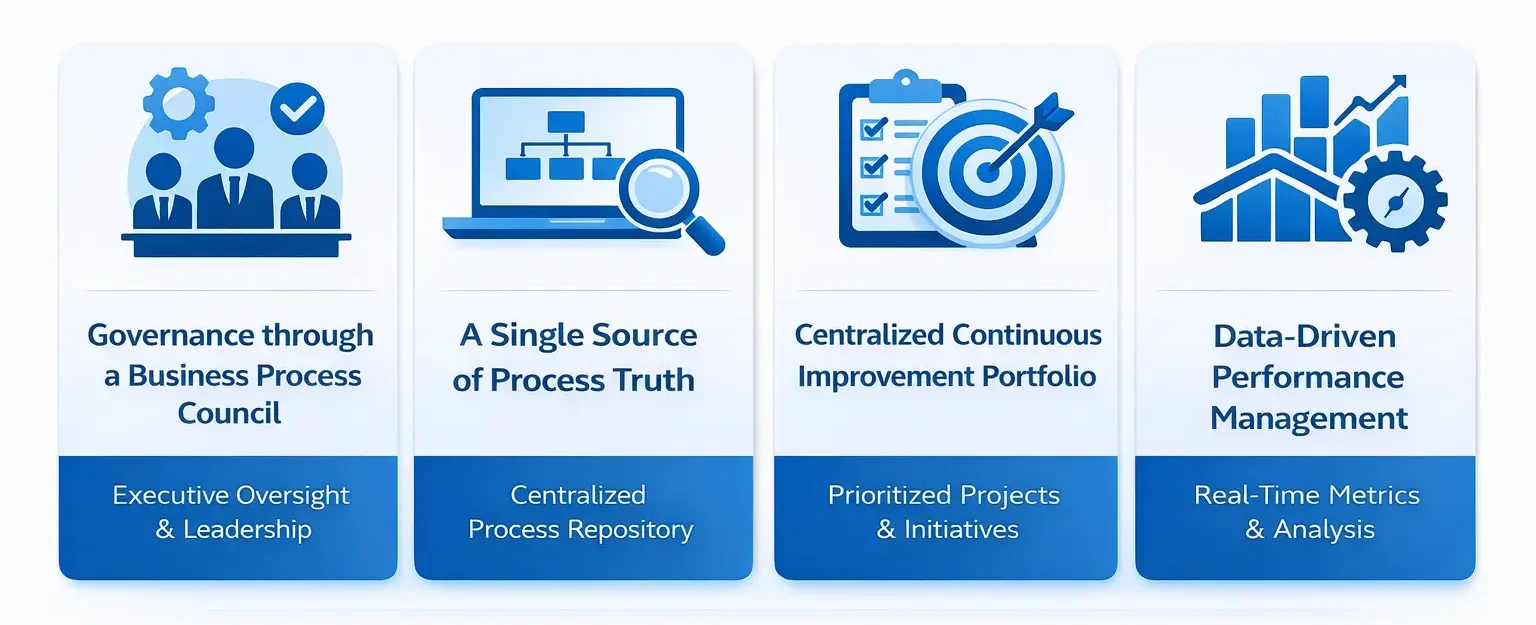
1. Governance through a Business Process Council
BMS created a cross‑functional Business Process Council with senior leaders providing oversight and strategic alignment, clear process ownership and performance monitoring across cycle time, cost, quality, and risk
Each executive became a Business Process Owner accountable for process performance targets including:
- Cycle time
- Cost
- Quality
- Risk
This governance structure forced cross-functional collaboration and enabled teams to identify root causes of issues that previously remained hidden inside functional silos.
For example, challenges with clinical trial enrollment were ultimately traced back to inefficiencies in upstream study design, enabling targeted improvements.
2. A Single Source of Process Truth
Using ADONIS, BMS created a centralized space where employees could finally view and understand the full scope of their operational workflows. By moving away from decentralized folders, the organization established a transparent ecosystem that provided:
- A shared process language that ensured consistent terminology across global teams.
- Granular visibility into roles, responsibilities, and RACI assignments.
- A unified repository for all verified process documentation and standards.
Instead of searching across disparate systems, employees gained a single, reliable destination for operational guidance. The impact was immediate: onboarding cycles were shortened as new hires had a clear roadmap of their roles, and cross-team workflows became significantly more fluid as hand-offs were clearly defined.
Rather than working in a vacuum, employees could now see exactly how their individual tasks fit into the broader drug development timeline, including improved visibility into handoffs, dependencies, and indicative timelines.
3. Centralized Continuous Improvement Portfolio
One of the most significant revelations came when BMS consolidated its operational data. Before the BPM implementation, the organization discovered over 300 independent improvement projects running simultaneously across various departments. Without a central view, many of these initiatives overlapped or directly competed for the same internal resources.
To address this fragmentation, BMS used ADONIS to centralize all activities into a single Continuous Improvement Portfolio. By gaining a high-level view of these 300+ projects, the leadership team was able to:
- Audit project impact, identifying and stopping low-value or redundant work.
- Prioritize strategic alignment, narrowing the focus to 15–20 high-impact initiatives specifically tied to the drug development roadmap.
- Centralize value tracking, ensuring that resource allocation was dictated by data rather than departmental siloes.
Today, this portfolio is managed through a formal PMO structure and monthly performance reviews. This rigorous oversight ensures that every process improvement remains aligned with the company’s long-term strategic goals, providing a clear line of sight from a single process change to its bottom-line impact.
4. Data-Driven Performance Management
BMS introduced process-level KPIs to track their most critical development paths. Instead of guessing where delays happened, Global Process Owners now monitor these metrics to see exactly where a workflow is lagging. When performance deviates from a target, they conduct a root cause analysis to fix the underlying issue.
This feedback loop ensures that improvement efforts are based on hard data. By putting these metrics in front of the Business Process Council, BMS moved away from “gut feel” and toward a system where every process change is an objective response to operational reality.
Hint: Explore how to measure, monitor, and improve what really matters with Process Performance Management.

Scaling the BPM Capability Across the Enterprise
The BPM initiative began as a focused effort within the drug development organization, involving approximately 5,000 employees. After demonstrating clear value, BMS began expanding the platform into other critical areas like manufacturing, specifically targeting the points where production dependencies and drug development workflows intersect.
As the scope grew, the BPM team transitioned from a single initiative into a permanent group of specialists. This dedicated team includes Business Process Managers, a BPM system architect, and a PMO lead to manage the continuous improvement portfolio. This internal structure allows BMS to maintain strict governance while scaling process excellence across the broader organization.
Looking Ahead: The Compound Value of Process Excellence
The transition to a centralized BPM capability moved BMS from uncoordinated activity to a disciplined, high-performance model. By the end of the second year, the initiative delivered $295 million in combined cost savings and cost avoidance. This was achieved by auditing the initial list of 300 disconnected projects and narrowing the focus to the top 20 strategic initiatives.
This transparency led to a 30% increase in operational efficiency by eliminating duplicated work and clarifying the “white space” between functions. The human impact was equally measurable: a 20-point increase in employee NPS reflected a significant drop in operational friction. With 5,000 users now following a single source of truth, teams reported that responsibilities were clearly defined and the time spent searching for answers was drastically reduced.
With this solid foundation in place, BMS is now moving from process governance into process simulation, process automation, and AI-enabled analysis. Because the organization has a reliable map of how work gets done, it can now pilot and scale AI initiatives with a level of control that was previously impossible. The objective is to lay the foundation for future process simulation and AI‑enabled analysis, allowing teams to better anticipate the impact of operational changes.
As Ashley Peal summarizes:
“Transformation doesn’t happen overnight. But once the foundation is in place, you start to see the value compound.”
By closing the gaps between functions, BMS has built a scalable engine that ensures the organization remains focused on its primary mission: delivering life-saving medicines to patients faster.
*Results reflect targeted Drug Development process areas and were realized over a multi‑year period through phased implementation and leadership sponsorship