Enterprise ArchitEcture

Found this helpful? Share it with peers.
Introduction – From Simulation to Understanding Reality
Organizations have always tried to simulate reality. But not every simulation is equal. Traditional digital models, including many Enterprise Architecture repositories, capture how things are designed to work, or how they looked at a specific point in time. In practice, however, organizations are constantly evolving. Systems change, processes adapt, usage shifts. What was accurate yesterday can quickly become outdated.
This is the gap that digital twins aim to close. Rather than describing assumptions alone, a digital twin reflects how the organization actually behaves – continuously evolving alongside it. The idea itself is not new. As early as the 1960s, NASA used detailed simulations during the Apollo missions to mirror complex systems and test scenarios before acting.
Today, that same principle is becoming increasingly relevant for Enterprise Architecture. EA already provides a structured digital representation of the organization and supports understanding dependencies, assessing impact, and planning transformation. But as organizations expect these decisions to become faster, more data-driven, and more closely connected to operational reality, the need for a more dynamic and continuously updated view becomes clear.
This is where the digital twin concept adds another layer of value. Instead of a static representation, the architecture becomes a living system that evolves alongside the organization.
What Is a Digital Twin in the Context of EA?
In Enterprise Architecture, a digital twin is a virtual representation of the organization – including its capabilities, processes, applications, and technologies – that reflects how these elements interact in practice.
It builds on existing architectural models, enriching them with additional data and context so they can be continuously validated against how the organization operates. This supports a more informed exploration of change:
- What happens if a core application is replaced?
- Which capabilities are affected if a process changes?
- How would a strategic initiative ripple through the architecture landscape?
Enterprise Architecture already helps answer questions like these. What the digital twin adds is a stronger connection between architectural structure and operational reality, making analysis more observable, data-informed, and reliable for decision-making.
The difference is not in the model itself, but in how closely it reflects and adapts to how the organization actually operates. A digital twin becomes powerful when it allows you to understand not only where dependencies exist, but how change propagates across the organization in practice.
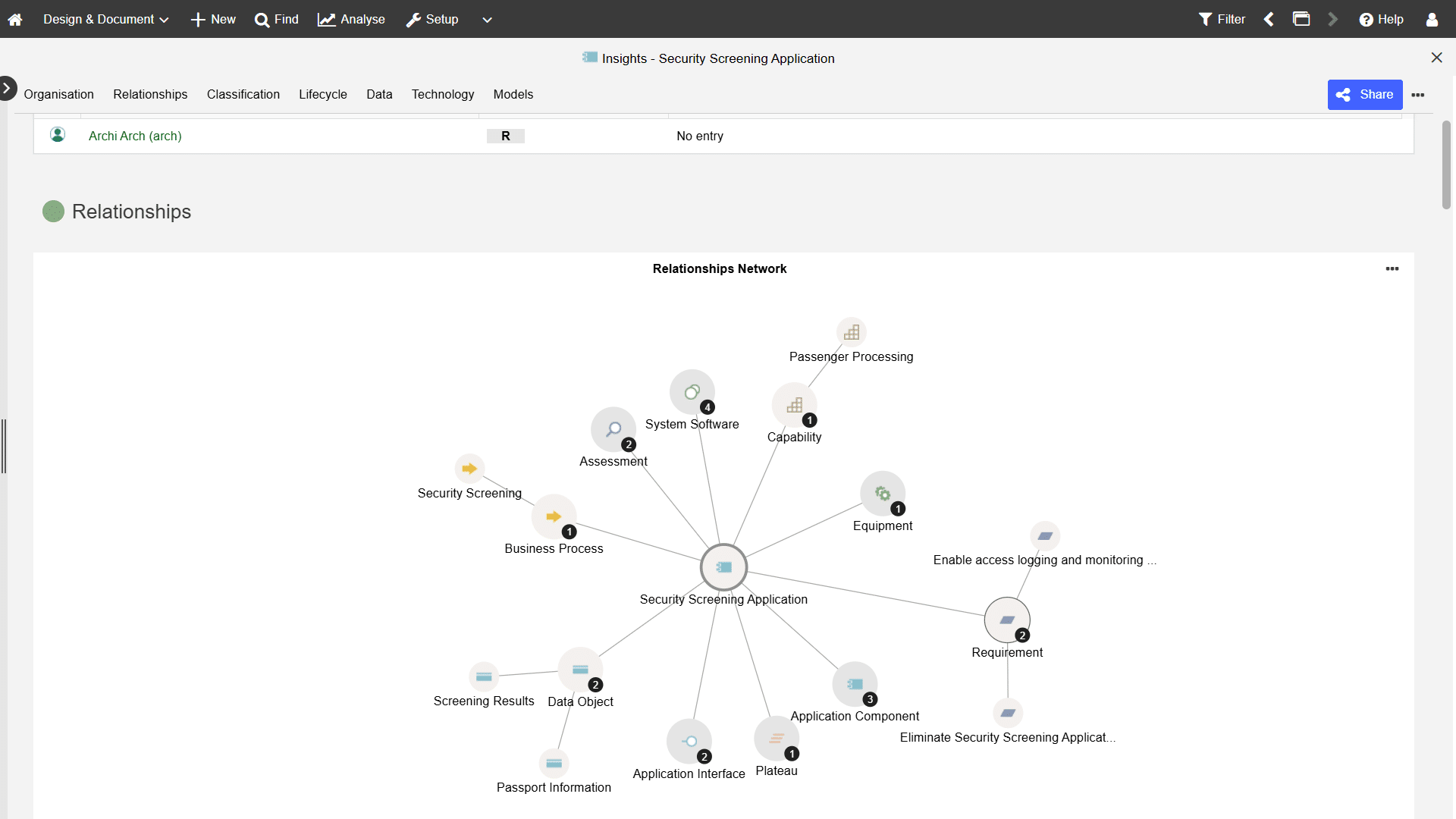
An ADOIT network graph showing how a single application functions as a digital twin
by mapping its live business and technical dependencies
Why Enterprise Architecture Is Foundational
At its core, a digital twin depends on how well the organization is structured and understood. Enterprise Architecture provides that structure.
It defines how different parts of the organization relate to each other, creating a coherent system rather than a collection of isolated elements. This is what already makes EA valuable: it provides a holistic view of the enterprise, supports impact analysis, and helps organizations plan transformation and guide investment decisions. Without this foundation, even the most advanced digital twin remains limited:
- Data may exist, but without context
- Dependencies remain unclear
- Simulations are difficult to trust
With Enterprise Architecture in place, the digital twin becomes something more than a representation. It becomes a system you can explore and reason about.
Enterprise Architecture provides the relationships that make a digital twin usable – without it, data remains disconnected, and decisions remain guesswork.
Key Components of an EA Digital Twin
A digital twin builds on familiar EA elements: capabilities, processes, applications, technologies, and the relationships between them. These remain the foundation, because without them there is nothing meaningful to mirror.
What changes is how this structure is extended. By integrating data – whether operational metrics, usage information, or performance indicators – architectural models become easier to validate against actual usage and performance. This does not replace traditional EA analysis, but strengthens it.
Relationships are no longer only conceptual. They can be assessed based on how systems and processes are used in practice. This allows organizations to see:
- which systems are most critical in practice
- where bottlenecks emerge across processes and applications
- how different parts of the architecture interact under real conditions
EA tools bring this together through visualizations, heatmaps, and dashboards, enabling different stakeholders to engage with the twin from their perspective, whether strategic or operational.
Practical Use Cases for Digital Twins in EA
The value of a digital twin becomes tangible when it is applied to real decisions. Enterprise Architecture already supports many of these decisions by making dependencies visible. A digital twin strengthens this by adding a closer connection to actual usage and performance.
One of the most common use cases is scenario planning. Organizations can explore how changes – such as replacing an application or introducing a new platform – affect the broader architecture before taking action.
Closely related is impact assessment. Changes rarely happen in isolation, and a digital twin helps make downstream effects visible across the architecture with greater confidence.
This is particularly valuable in transformation initiatives, where multiple moving parts interact. By combining architectural relationships with data, organizations can better understand where to invest, what to optimize, and how initiatives influence each other.
Across all these use cases, one thing remains constant: the value comes from understanding dependencies, not just individual elements. This reduces uncertainty, minimizes unintended consequences, and enables faster, more confident decisions.
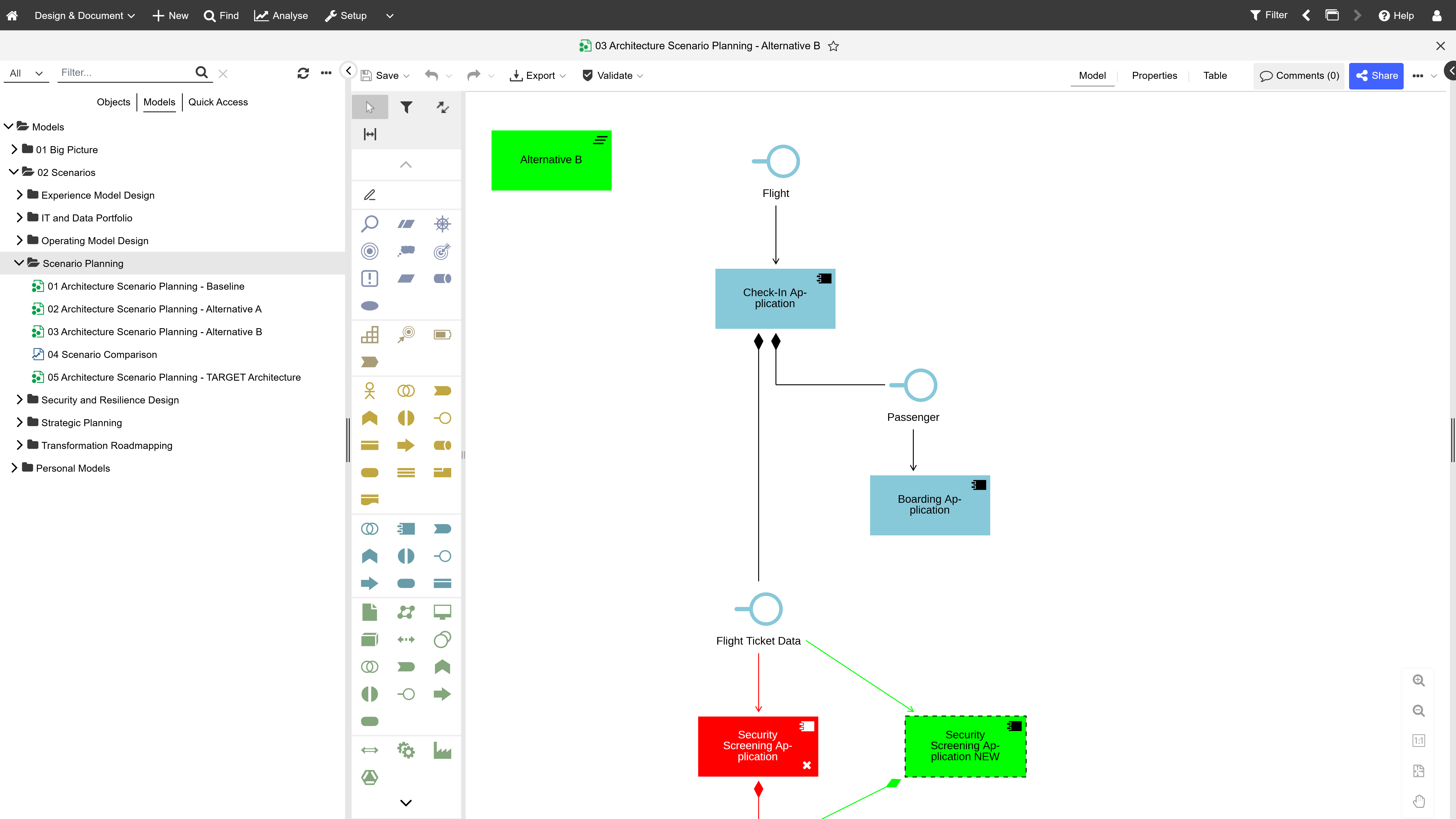
An architecture scenario in ADOIT simulating the impact of replacing a core security application within the digital twin
Steps to Implement a Digital Twin for EA
Implementing a digital twin does not require starting from scratch. A focused and incremental approach is usually more effective.
Step 1: Start with a high-value use case
Anchor the effort in a specific decision or initiative where better visibility would create immediate value.
Step 2: Strengthen the EA foundation
Ensure architectural models are accurate, consistent, and connected. Without trust in the structure, the twin will not be used.
Step 3: Integrate data gradually
Even limited data can significantly enhance the model. Expand over time as needed.
Step 4: Validate and refine with stakeholders
A digital twin only creates value if it is trusted and actively used. Continuous feedback is essential.
Common Challenges and How to Overcome Them
Data quality and integration
Inconsistent or incomplete data affects the reliability of the twin. Clear data ownership and gradual, incremental improvement address this over time.
Complexity and stakeholder adoption
Trying to model everything at once makes the twin difficult to use. Focusing on relevant domains and providing tailored views keeps it manageable.
Tooling and interoperability
Forcing everything into one platform is rarely practical. Ensuring existing tools can exchange data and support a coherent architecture practice together is usually the better path.
Future Outlook: EA and Digital Twins
As digital twins evolve, their value will increasingly depend on how well they support decisions. Enterprise Architecture is central to this shift.
By combining structured models with data and analysis, EA moves closer to becoming a decision layer – one that not only reflects the organization, but actively supports how it evolves.
With advances in AI and analytics, this layer can be further enhanced:
- identifying risks and dependencies automatically
- suggesting optimization opportunities
- enabling more advanced scenario evaluation
This turns the digital twin into more than a mirror of the organization, it becomes a tool for shaping its future.
Summary
Enterprise Architecture has long provided the structure needed to understand how an organization works and how it can evolve. It connects strategy, processes, applications, and technologies into a coherent whole – making impact visible and transformation possible.
What the digital twin adds is a closer connection between this structure and how the organization actually operates. By enriching architectural models with data, the architecture becomes a continuously evolving view of the organization, where analysis is more reliable, dependencies easier to assess, and decisions aligned with how the business changes in real time.
This does not change the role of Enterprise Architecture, it strengthens it. As organizations face increasing complexity and pressure to adapt, this combination becomes essential. It enables them not only to understand their current landscape, but to navigate change with greater clarity and confidence.
In this sense, the digital twin is not a new layer replacing Enterprise Architecture – it is the next step in making it truly actionable.




Already got our weekly updates?