Enterprise ArchitEcture

Found this helpful? Share it with peers.
The History of ArchiMate: How It Became the EA Modeling Standard
ArchiMate emerged in the early 2000s from a Dutch government-funded research initiative with the goal of giving Enterprise Architecture a shared visual language. When The Open Group adopted it as a standard in 2008, ArchiMate became the only open and widely-recognized standard notation for EA and arguably the closest thing the industry has to a common grammar for describing how strategy, organization, applications, and technology fit together.
Since then, it has evolved through several major releases: 2.0 in 2012, 3.0 in 2016, and 3.2 in 2022. Each iteration kept the overall structure practitioners know while extending the language with new concepts and stronger support for strategic and physical perspectives. That evolution came with a tradeoff. The more the language grew, the steeper the learning curve became, particularly for teams encountering ArchiMate for the first time.
Why ArchiMate 4.0 Was Introduced (formerly ArchiMate Next)
As ArchiMate continues to mature, the experts shaping the specification introduce refinements to address complex or less common scenarios. While this expanded the language’s capabilities, it also increased its complexity. ArchiMate 4.0 builds on the ideas outlined in the earlier “ArchiMate Manifesto” and introduces a refined approach focused on simplicity, consistency, and usability.
What’s New in ArchiMate Next
ArchiMate Next, now known as ArchiMate 4.0, introduces several structural and conceptual refinements across the framework. The new version follows an evolutionary approach that builds on the existing ArchiMate structure while simplifying key aspects of the language. Many existing models remain compatible, although some areas may require adjustments where concepts have been streamlined or redefined.
Streamlined language scope
The focus is on keeping the language small and practical. The direction is to reduce conceptual overhead and avoid maintaining rarely needed constructs as first class parts of the language, so diagrams stay simpler and the learning curve stays manageable.
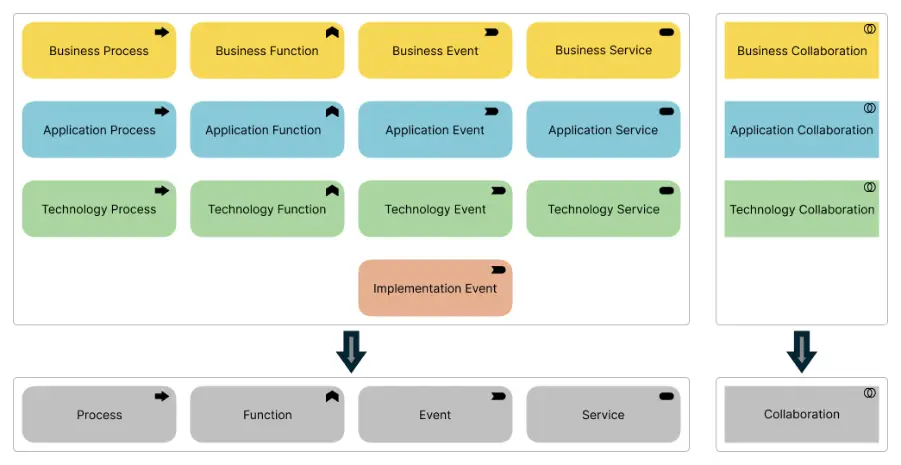
From layers to domains and more flexible organization
ArchiMate 4.0 replaces the traditional layer concept with domains. It consistently uses the term domain and presents the framework as a way to categorize concepts rather than define a fixed diagram layout. The new hexagon style visualization reflects this more flexible organization.
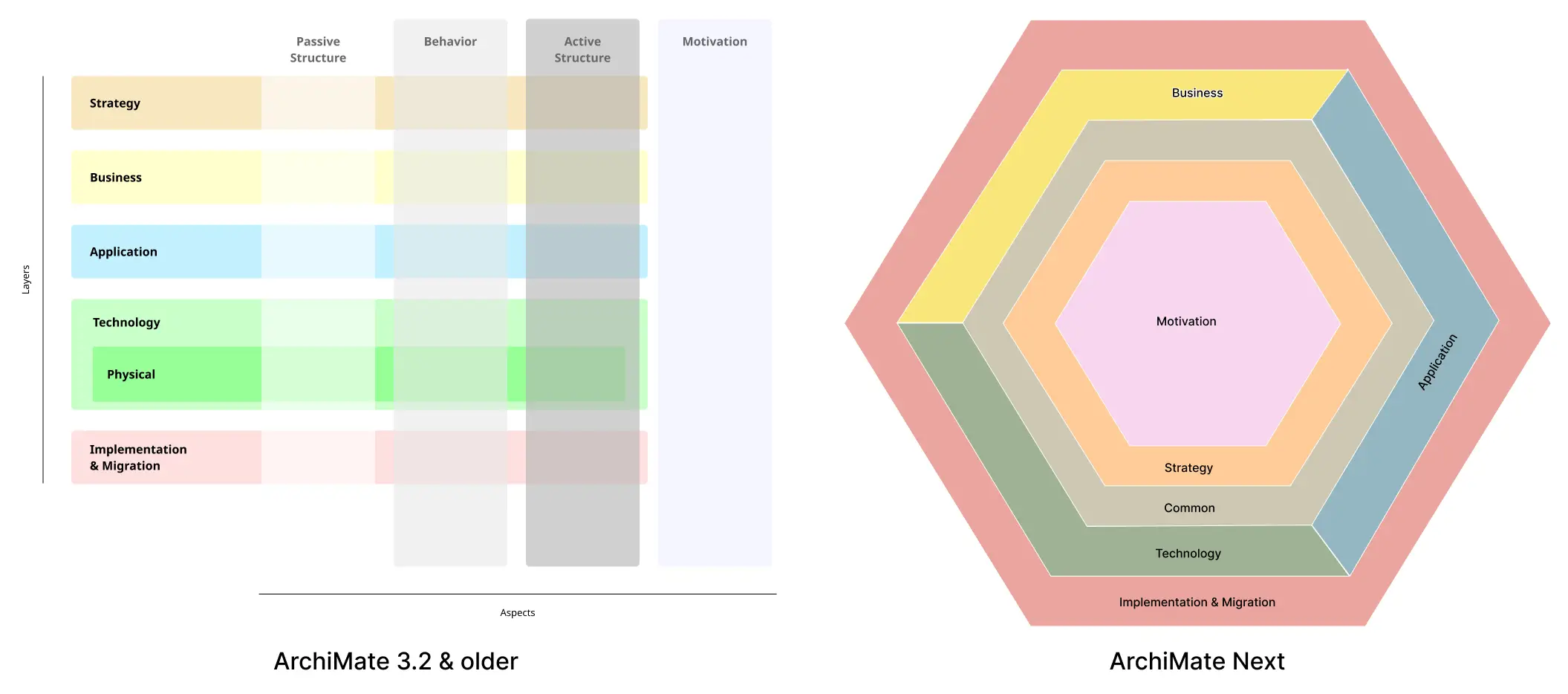
Stronger focus on common building blocks
ArchiMate Next puts more weight on a shared foundation that works across all domains. Concepts in the Common Domain are positioned as reusable building blocks, so the same core ideas apply consistently whether modeling business, applications or technology.
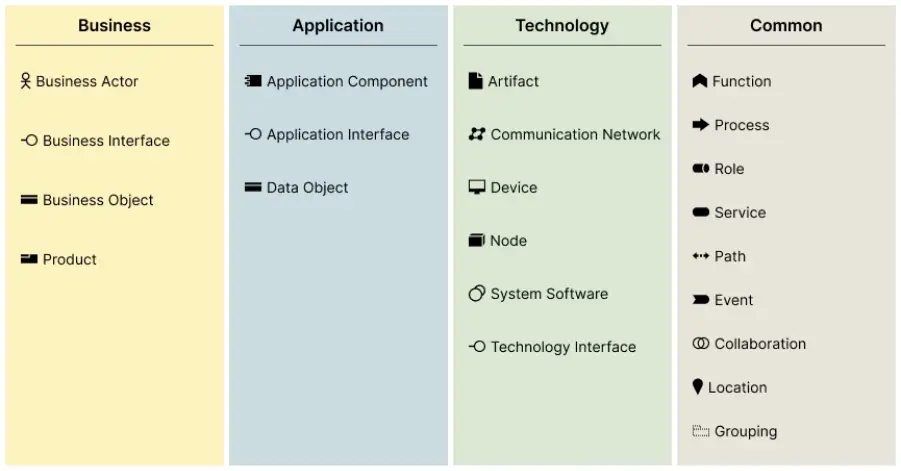
More explicit metamodel rules
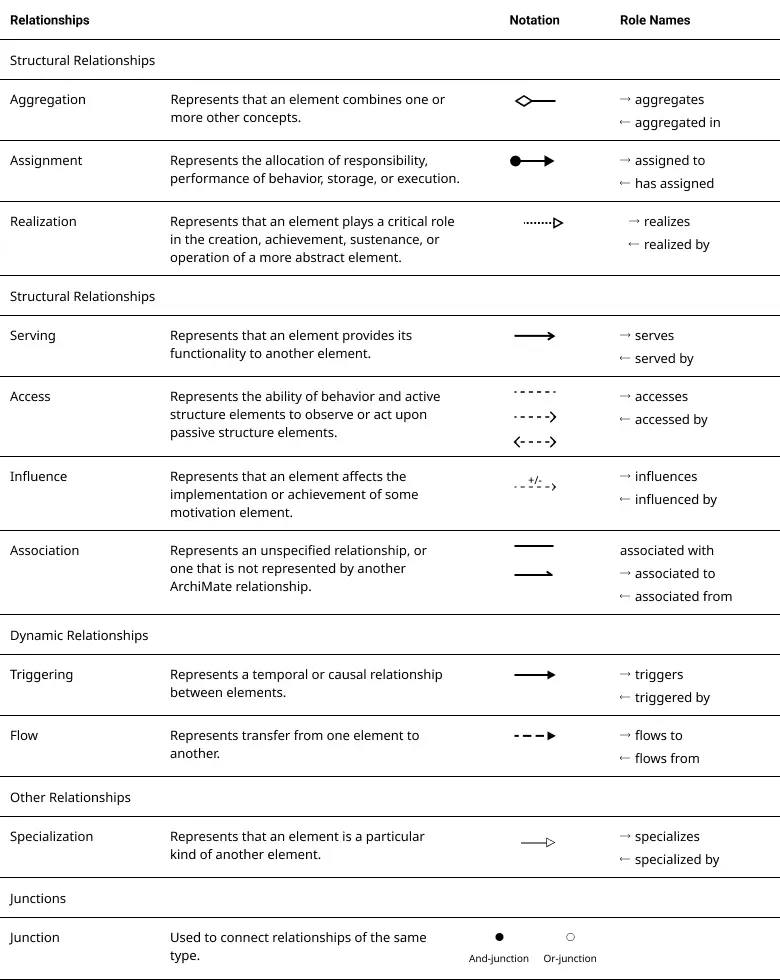
The new version introduces clearer relationship definitions, including cardinality on relationships, supporting more precise modeling rules and validation.
Detailed Changes from ArchiMate 3.2 to ArchiMate 4.0
The following table provides an overview of the relationship types in the ArchiMate Next Snapshot (ArchiMate 4), including their meaning, notation, and role names. It reflects the clearer and more explicit relationship definitions introduced in the updated metamodel.
What This Means for ADOIT Users
In ADOIT, the ArchiMate Next (ArchiMate® 4) changes are supported without forcing an immediate, repository-wide migration. New customers starting from scratch can begin with ArchiMate Next as the default modeling baseline, while existing users can adopt the new version at their own pace.
A key control point is the ADOIT Administrator. For each change category listed in the overview above, administrators can decide what is allowed for new modeling. The decision is granular: it is made per change category, not as a single all-or-nothing switch.
ArchiMate 3.2 elements that are not included by default in ArchiMate Next are treated in ADOIT as specializations. This means they remain available where needed, without introducing an additional generic element alongside them.
These settings affect user models in a predictable way. Existing diagrams and repository content remain usable, but what users can create going forward depends on the administrator’s configuration per change category. Where an administrator decides that a specific ArchiMate 3.2 concept should no longer be used for new modeling, ADOIT will offer a migration action that re-expresses existing occurrences in line with the new changes. This enables incremental migration concept by concept, at the organization’s own pace.
For interoperability, the ArchiMate XML export offers an ArchiMate 4.0 option and automatically translates former ArchiMate 3.2 concepts into their ArchiMate 4.0 equivalents during export.
Summary
ArchiMate Next, now ArchiMate 4.0, marks an important step in the evolution of Enterprise Architecture modelling. With a leaner language, more explicit rules, and a more flexible structure, it aims to improve usability without sacrificing the expressive power practitioners rely on.
For ADOIT users, the transition is fully supported. Organizations can adopt ArchiMate 4.0 at their own pace while continuing to leverage existing models and repository content.





Already got our weekly updates?