BUSINESS PROCESS MANAGEMENT

Found this helpful? Share it with peers.
Search for the Official Process Version
Ask any team how they find the “official” way of doing something, and the answer is usually a pause. Not because guidance doesn’t exist – but because it exists in too many places.
Three companies from very different industries (insurance, logistics, and consumer goods manufacturing) found themselves stuck in this same loop. Documentation lived in slide decks, wikis, legacy tools, and parallel modelling environments, all telling slightly different stories. A step described one way here, a handover framed differently there, a draft that looked indistinguishable from a release. People weren’t confused because content was missing; they were confused because everything seemed equally credible.
Their turning point was simple but transformative: one front door – a reader-first Process Portal in ADONIS that always shows the released, governing version.
Once that door existed, everything else finally snapped into place. This is the story of how three organisations cut through the noise and rebuilt trust with a Process Portal.
Why Process Guidance Breaks
Once these companies recognized that “too many versions” wasn’t just an inconvenience but a systemic issue, another insight emerged: the real problem wasn’t the documentation volume – it was a fragmentation problem.
Process information accumulated in whichever tools teams preferred. Customer journeys lived in one place; BPMN models in another; work instructions elsewhere. New initiatives created more locations, not fewer.
This made simple everyday questions far harder than they should be:
- Where do I start?
- Is this current?
- Why doesn’t this match what I saw the other day?
Across industries, the symptoms were similar:
- Insurance: customer journeys and executable steps evolved on separate tracks.
- Logistics: each site shaped its own version of the ‘same’ flow.
- Consumer goods: global standards were strong, but local adaptations became opaque.
All three had the same missing piece: one place that anchored the truth. A Process Portal built within the ADONIS BPM suite filled exactly that gap.
The Approach: How a Reader-First Portal Helps
These organisations didn’t simply publish process documentation. They designed an experience, one that mirrors how people actually look for guidance.
The first shift was structural. Each organisation echoed its real operating model rather than forcing a generic hierarchy. The top-level structure varied by industry (customer → end-to-end → BPMN in insurance; company → business unit → site → core/support in logistics; headquarters → subsidiary in consumer goods), but the principle stayed constant: employees land where they work and drill down only when needed.
The bigger shift came when teams began treating the Process Portal like a product – with users, ownership, and continuous improvement, rather than a documentation dump. Each organisation appointed a product owner and defined a simple vision: a trustworthy front door to how we work today.
They iterated in tight loops:
-
Discover: observe how people search and where they get stuck.
-
Design: keep the information architecture simple and familiar.
-
Deliver: release in small, coherent slices.
-
Improve: ask, “did I find what I needed without a detour?” and adjust quickly.
This mindset is what allowed adoption to grow organically – one solved search at a time.
What Changed for Three Organisations
Once the portal became the single source of truth, the impact unfolded quickly across all three organisations.
Insurance: customer journeys and controls aligned
Teams no longer cross-checked journey maps, models, and checklists. They began in one place, saw the released version, and drilled into steps, roles, and controls only when needed.
Logistics: variation became visible, and governable
Sites stopped redrawing ‘their own’ flows. Standard processes sat at the centre; governed variants handled layout or regulatory specifics. Alignment became transparent.
Consumer goods: enablement replaced policing
HQ stopped acting as a bottleneck. Subsidiaries gained capability through role-based coaching and template guidance. Variants kept lineage visible without losing global standards.
Across all three, the outcome was the same: people trusted the version in front of them, and stopped searching for alternatives.
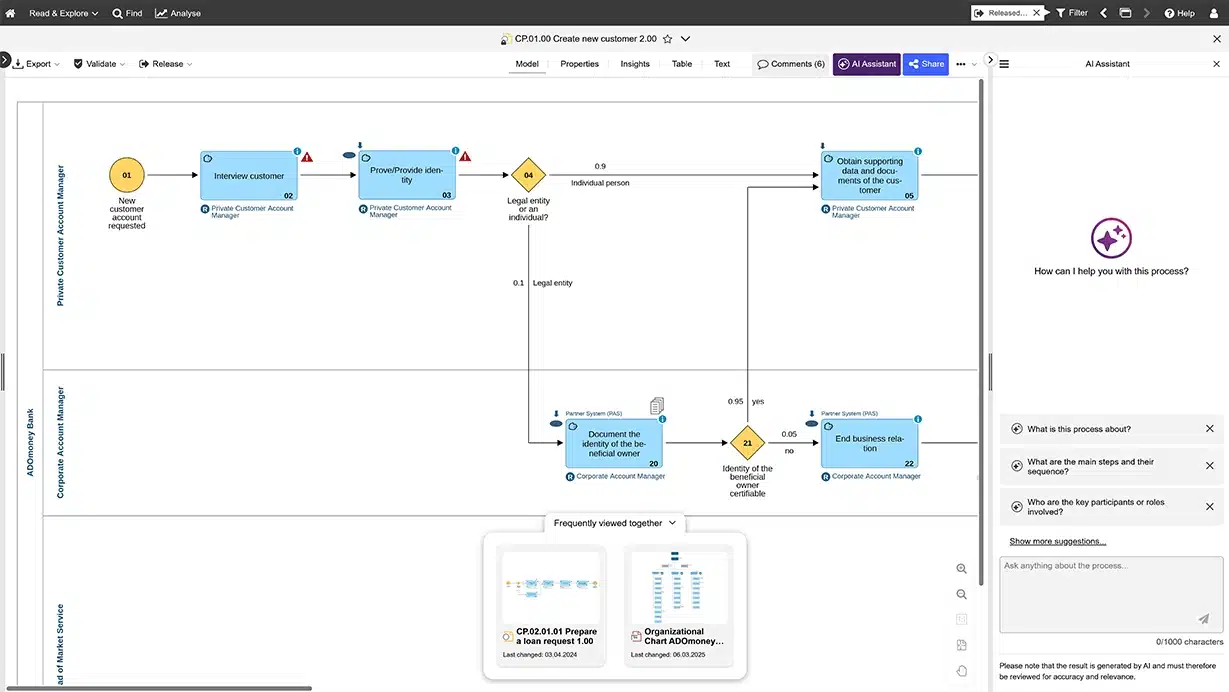
Process Portal in ADONIS as a single source of truth for process instructions
Structuring the Portal for Readers
People don’t want to learn your taxonomy, they want to find their next step. The portal reflects that by mirroring how the organisation works, not how a methodology labels things.
At the highest level, the layout stays consistent:
Company → Business Unit / Site → Core & Support Processes → Work Instructions and References.
Names stay simple and consistently reused across domains. Search, filters, and contextual links do most of the navigation work. Drafts and history never appear in the reader view.
Employees only see released content, the version that governs today, and every page displays:
- the content owner, and
- the next review or recertification date.
This simple transparency builds confidence without additional explanation.
Keeping Content Clean and Current
Governance that works is governance people barely notice. The reader experience stays simple because the contributor workflow is simple too. Each organisation followed a lightweight loop:
1. Draft
Designers work in draft mode, shaping the flow, links, and context. Drafts are invisible to readers and contained in contributor workspaces.
2. Method Check
A quick method check catches modelling issues early – missing roles, inconsistent labels, broken links, or BPMN mistakes. It prevents small errors from becoming reader-facing confusion later.
3. Business Review
The process owner confirms scope and usefulness: Is this the way we work today? Does it reflect the controls, handovers, and responsibilities we expect? This is where fitness for purpose is validated.
4. Release
Once approved, the content moves to the reader view. Drafts, branches, and history stay behind the scenes; only the released version becomes visible.
Variants without duplication
Where local differences were needed, contributors extended a governed variant of a global template, not a duplicate. Variant lineage stays visible, making alignment easy to inspect and deviations transparent.
Different industries applied small twists, but the principle remained the same:
- In consumer goods, the BPM lead performed a methodological review before the business review.
- In logistics, Quality Management acted as the final gatekeeper.
- Some teams used a project branch for upcoming sites or rollouts, allowing project-stage releases that never appear in the reader portal until they are ready.
Keeping Scale Under Control
A simple rule kept the model clean:
- Minor changes (labels, typos, non-semantic fixes) moved quickly.
- Major changes (logic, handovers, controls) went through the full loop.
- Periodic recertification ensured guidance stayed fresh without exposing drafts.
The result: a contributor experience that stays fast, controlled, and aligned, supporting a clean, release-only reader surface. The trick wasn’t adding more gates, but making the few gates they had unmistakably clear.
A Simple Model That Scales
Once structure, governance, and the portal were in place, organisations fell into a steady rhythm. A small central team stewarded the information architecture, naming conventions, lifecycle cadence, and variant approach. Business units created content within these guardrails and followed the same release workflow.
The portal became the golden source for process guidance. And the outcomes were clear:
-
Readers stopped hunting; retry rates dropped.
-
Trust increased as ownership and review dates provided clarity.
-
Local variation became controlled rather than improvised.
-
Screenshots disappeared as teams embedded live portal views.
-
Support conversations shifted from “Where’s the latest?” to improving handovers and clarity.
-
Audits became simpler with a clean, centralised release history.
-
Onboarding accelerated – one structure, one language, one starting point.
A Rollout Path That Works
Every organisation followed a similar rollout pattern:
1. Start with one journey or one site end-to-end.
Enough content to be useful on day one, not everything the organisation has ever modelled.
2. Finalise the information architecture.
Clear levels, consistent naming, no synonyms.
3. Migrate only what’s needed.
Don’t flood the portal with half-relevant legacy content.
4. Agree the release workflow and review cadence.
One loop, one definition of “released.”
5. Train by role.
A short intro for readers; focused sessions for owners and designers.
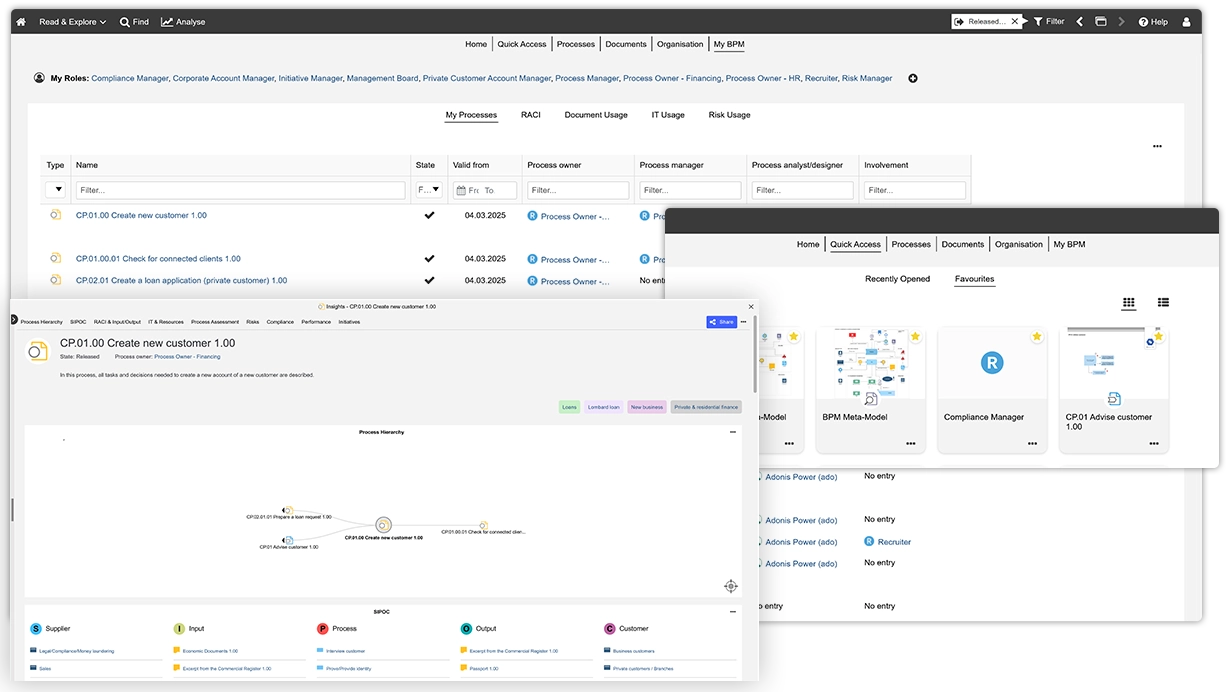
The personalized start page in ADONIS Process Portal
makes sure only role-specific information is shared
6. Publish a simple “how to find things” guide.
Two pages is enough.
7. Embed the portal where people already work.
Confluence, SharePoint, Teams – live links to released content.
8. Expand by domain, not by feature.
Grow by journeys, departments, or sites – not by adding every model at once.
This approach kept the portal coherent from day one, and scalable from day two.
The Power of One Front Door
Across three very different industries, the pattern was the same: too many credible versions created friction that no one could quite name, but everyone felt.
What broke the cycle wasn’t a new methodology. It was giving people one front door, the reader-first ADONIS Process Portal, and protecting that surface with clear, lightweight governance.
The moment there was one released version in one place:
- the noise disappeared
- trust returned
- alignment became visible
- guidance finally matched the way people work
Different industries. Different pressures. Same outcome: a single, reliable starting point for how work gets done today.
Explore the Full Stories
This case study showed the shared pattern behind three organisations. Together, these stories show one truth from three angles:
one front door to how you work today changes everything.
Hint: See how ADONIS Process Portal can reshape process adoption, compliance, and day-to-day decision-making.
To explore the nuances of each journey, and see what might mirror your own – dive into the full sessions:


Already got our weekly updates?