Governance, Risk & Compliance

Found this helpful? Share it with peers.
Introduction
AI Governance has become an expectation rather than an ambition, and the pressure is coming from several directions at once. Regulators are setting obligations that apply to specific AI systems, auditors are asking how those obligations have been met, and boards want confidence that AI is being used without creating exposure nobody has accounted for.
The common response is to build an inventory of AI systems and use cases, which covers the first part of what is being asked by showing where AI is in use. What it leaves open is everything that follows, because a list of systems carries no requirements, no assessment of what could go wrong and no evidence of who is accountable for keeping any of this under control. Those are the layers an organization has to build on top of the register, and they are what separate a documented AI landscape from a governed one.
Hint: Looking for the broader foundation? Explore how data governance, risk management, internal controls and compliance contribute to AI readiness in GRC.
Your AI Inventory Is Only the Starting Point
A structured inventory helps an organization identify where AI is being developed, purchased, embedded in existing applications or used by individual teams. It can record the provider, purpose, business owner and current status of each use case.
The NIST AI Risk Management Framework explicitly recognizes AI-system inventories as part of the governance function. However, it places them alongside defined roles, policies, documentation, monitoring, third-party oversight and lifecycle risk management. An inventory earns its value from what an organization builds around it, and treating the completed register as the end of the work leaves the rest of that function unaddressed.
What an AI Inventory Does Not Show
A row in a register may tell you that HR uses an AI-supported screening tool. It may even name the vendor and responsible department. Yet it does not automatically answer the questions that matter to GRC teams:
- Which recruitment decisions does the tool influence?
- What candidate data does it process?
- Which legal and internal requirements apply?
- What could go wrong? Which controls reduce those risks?
- Who can approve, restrict or stop its use?
- What evidence shows that the agreed measures are in place?
The same gap appears with third-party AI, embedded capabilities and public generative AI tools. Knowing that a technology is present does not reveal the full business context, dependencies or control environment around it.
An inventory creates visibility. Operational AI Governance connects each AI use case to the governance structures around it.
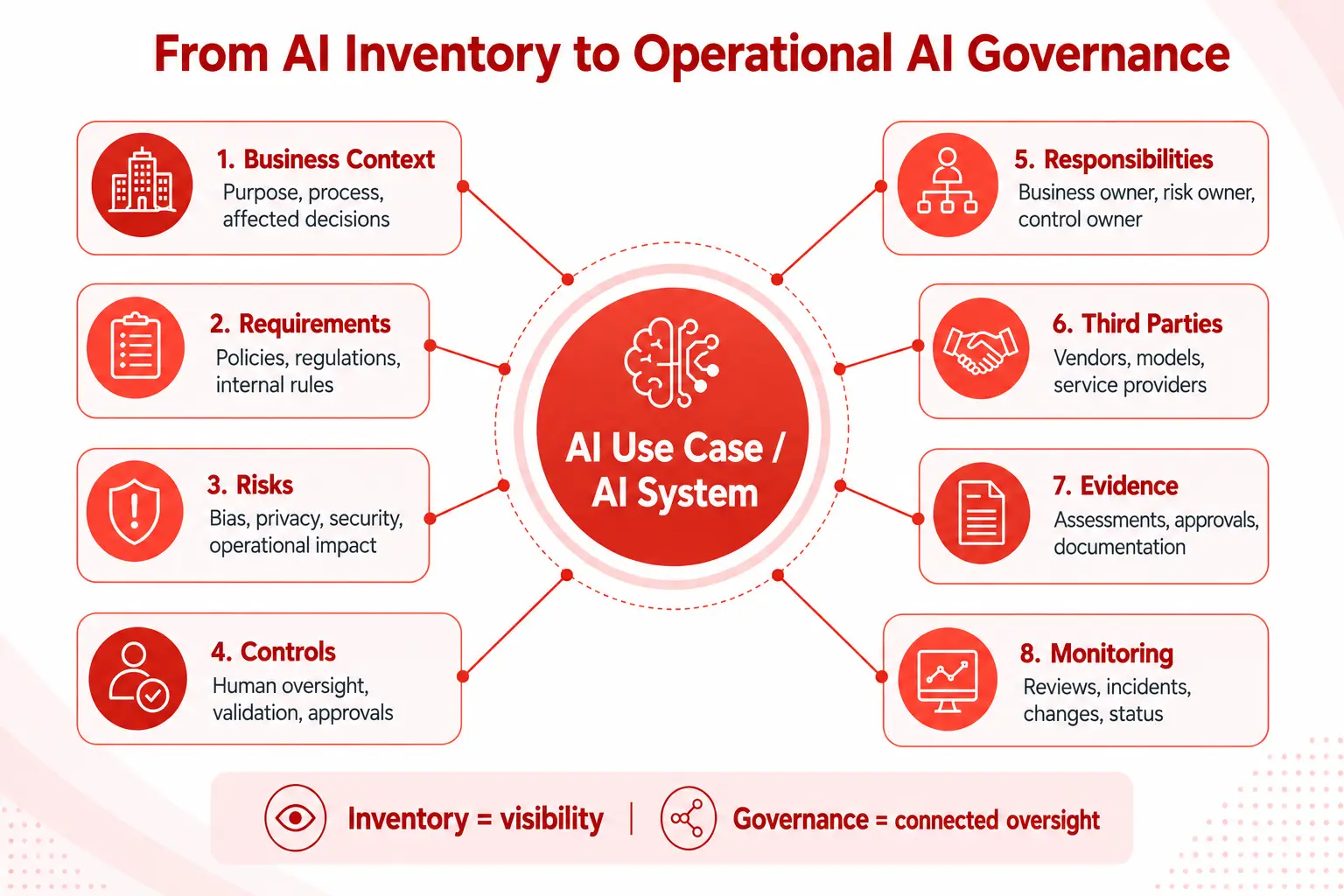
From AI Use Cases to GRC Objects
GRC objects are the governance elements — purpose, requirements, risks, controls, owners and third-party information — that turn a listed AI use case into a governed one.
Operational AI Governance starts when the use case is connected to the governance information around it:
- The intended purpose and the affected process give it context
- Requirements define what the organization is obliged to do and what it has committed to beyond that
- Risks describe what could prevent responsible use
- Controls, measures and human oversight turn those expectations into action
- Owners make accountability explicit
- Third-party information shows where the organization depends on vendors, models or data it does not fully control
In the recruitment case, a basic inventory entry holds the tool name, vendor, department and purpose. A governed use case connects that same tool to the recruitment process it supports and the candidate data it handles, to the fairness and privacy risks that follow, to the human review applied before a rejection, and to the vendor assessment, approvals and review dates behind its continued use. The system has not changed, but the organization can now explain and defend how it is used.
These connections should stay proportionate. A low-impact internal assistant does not need the depth of assessment given to an AI system influencing employment decisions, provided the organization applies a consistent approach based on purpose, risk and applicable requirements. NIST makes the same point in recommending that AI Governance connect to existing organizational governance and risk controls, with resources allocated according to risk priorities.
Making AI Governance Evidence-Based
Policies and principles describe an organization’s intentions. Evidence shows how those intentions are applied in practice.
For relevant use cases, that evidence may include the rationale behind a classification, completed risk or impact assessments, assigned controls, approval records, testing results, vendor documentation, incidents, findings and periodic reviews. It should also show what happens when the purpose, model, data, provider or risk exposure changes.
This evidentiary standard is increasingly a regulatory expectation, not just good practice. For the high-risk systems and actors within its scope, the EU AI Act requires measures such as continuous risk management, logging, human oversight, technical documentation and post-market monitoring. These obligations do not apply identically to every AI use case, but they illustrate a broader governance principle: responsible AI must be demonstrable, not merely declared.
ISO/IEC 42001 reinforces this management-system perspective by framing AI Governance as something organizations establish, implement, maintain and continually improve. Documentation alone does not prove that a control works or that an organization is compliant. Without traceable decisions, responsibilities and results, however, meaningful oversight becomes much harder.
AI Governance becomes operational when registration is followed by assessment, control, approval and continuous review.
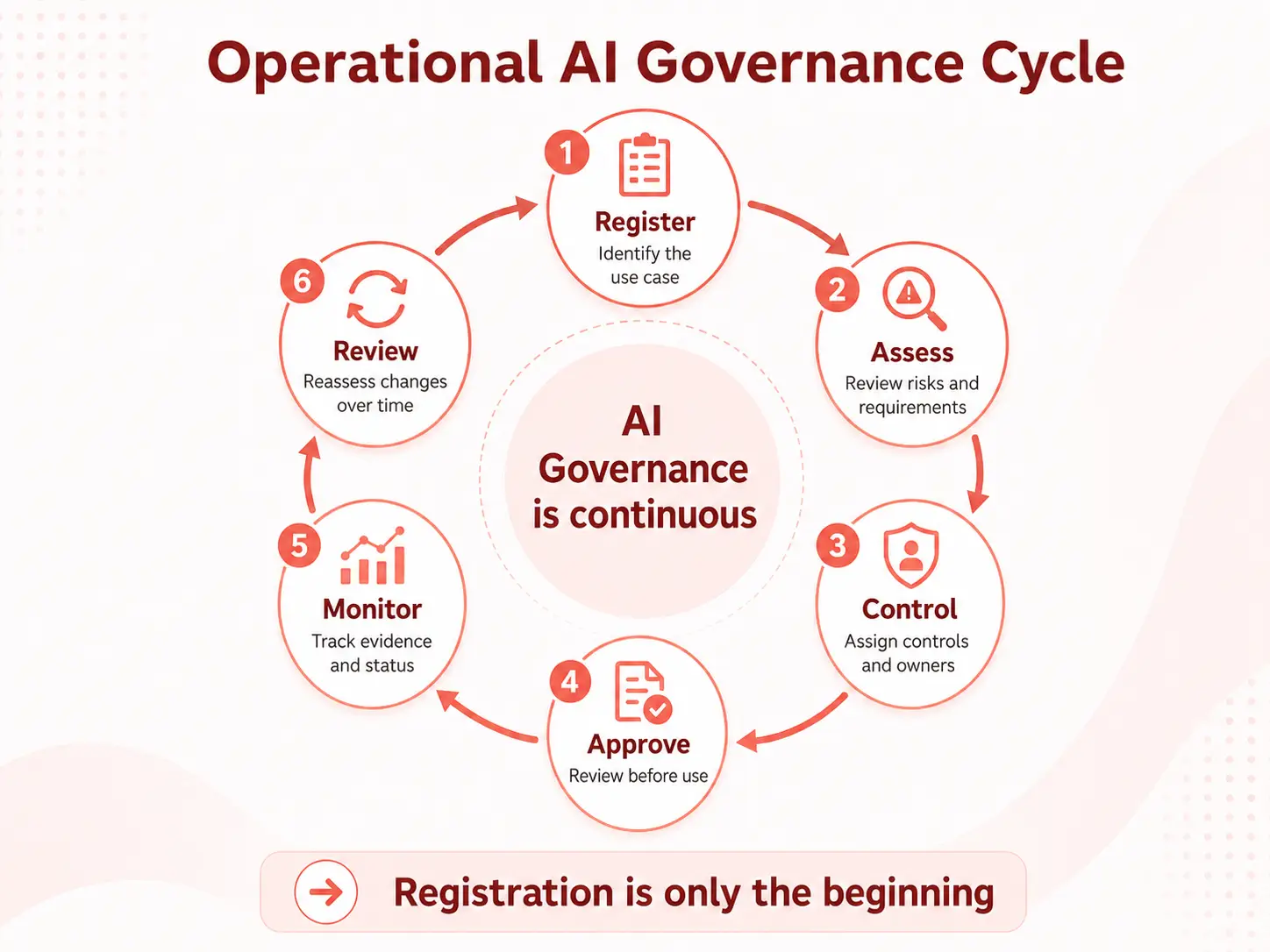
How ADOGRC Supports Operational AI Governance
With ADOGRC, an AI use case is registered once and connected — continuously and in context — to everything that governs it: risk assessments, compliance requirements, controls, owners, third parties, actions and evidence. Opening the entry for a screening tool shows what applies to it, what has been assessed, what is still open and who is responsible for closing it.
The information no longer has to be traced across spreadsheets and shared folders held by different teams. Structured workflows assign responsibilities, track assessments and drive remediation to completion, while dashboards and reports give GRC teams and management a current view of gaps, deadlines and implementation status across the AI landscape.
As AI use grows, the same structure absorbs new systems and new requirements without a parallel effort to rebuild the picture from scratch.
From AI Visibility to Operational Governance
An AI inventory is a necessary starting point rather than the final outcome of AI Governance. Operational governance must also show why each system is used, which risks and requirements apply, who is accountable, how those risks are controlled and what evidence supports the organization’s decisions.
Connecting these elements creates the traceability needed to make informed decisions, follow up on gaps and reassess AI use when systems, vendors or business conditions change.
With ADOGRC, organizations can bring this information together in one connected environment, moving beyond the documentation of AI initiatives towards accountable, transparent and continuously monitored AI Governance.




Already got our weekly updates?